
Staff Reporter
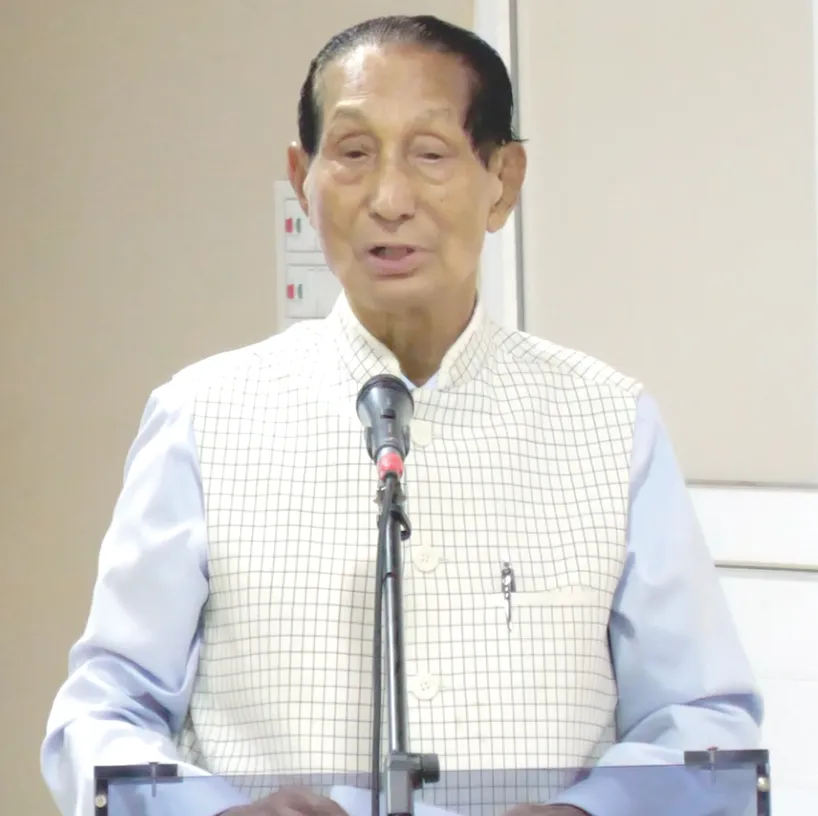
DIMAPUR, NOV 11 (NPN): Former Nagaland chief minister and governor, Dr SC Jamir, has called for greater political clarity and acceptance of the existing Framework Agreement and Agreed Position to resolve the protracted Naga political issue. He said the way forward should not be another round of negotiations or a fresh agreement, but a collective effort to understand and implement what had already been agreed upon.
Speaking at a consultative meeting organised by the Central Nagaland Tribes Council (CNTC) with senior citizens at its office in Dimapur on Wednesday, Jamir said the issue could be addressed if people honestly assessed the prevailing situation and understood the political realities reflected in the two agreements.
Expressing concern over the prevailing situation, he said nationalism among Nagas had increasingly given way to tribalism, fascism and extremism, clouding the judgment of both “overground” and “underground” sections of Naga society. Questioning why Nagas continued to discuss the need for a solution despite two major agreements signed between the Government of India and Naga Political Groups (NPGs), Jamir described the situation as a paradox reflecting a failure to understand the agreements.
He said Naga leaders, both overground and underground, remained preoccupied with the past while the rest of the world advanced through scientific and technological developments. He identified attachment to historical grievances as a major obstacle to understanding present political realities.
Jamir also alleged that vested interests within the overground and underground establishments were unwilling to see the issue resolved, with mutual accommodation among some leaders contributing to prolonged uncertainty.
Maintaining that the two agreements were signed voluntarily by the respective negotiating parties with an understanding of the prevailing political and constitutional realities, he said issues of sovereignty and integration had been set aside during negotiations and that the agreements fell within the Indian constitutional framework.
He argued that competencies contained in the agreements, wherever constitutionally permissible, could be incorporated through appropriate constitutional provisions and parliamentary processes. The Government of India, he said, was aware of what could be accommodated within the Constitution, and there was no need to burden the people with demands for a third draft agreement.
Referring to statements by the Prime Minister on Manipur’s territorial integrity and the Union Home Minister’s assertion in Parliament that India had one Prime Minister and one Constitution, Jamir said these reflected the Centre’s position and should be acknowledged by all stakeholders. Calling for wider consultation, he urged CNTC to bring together all tribal hohos to discuss the agreements and develop a common understanding. He also suggested that CNTC approach the state government and Nagaland Legislative Assembly to reaffirm their endorsement of a political settlement and establish a collective position.
Stressing that prolonged uncertainty had caused suffering, Jamir called for the restoration of peace and normalcy. He urged churches to demonstrate their commitment to peace, noting that the Christian community had also suffered due to the absence of a lasting solution. He also called upon the Centre to show concern and compassion by facilitating an early resolution, saying the people had suffered long enough and deserved peace.
KK Sema calls for transparency, wider public say
Also speaking during the discussion, KK Sema urged Nagas to move beyond narrow perceptions and recognise changes taking place in the wider world. Comparing Naga society to a frog in a small pond, he said people should not remain confined to a limited outlook while the rest of the world progressed.
Sema expressed concern that many Nagas were increasingly driven by money and material interests, often compromising larger principles without examining the circumstances.
On the political issue, he said negotiations between NSCN (I-M) and the Working Committee of the NNPGs concerned the future and destiny of the Naga people and should not be treated as agreements belonging to a few individuals or groups.
Questioning the lack of transparency surrounding the Framework Agreement, he pointed out that while the NNPGs had made their competency clauses public, NSCN (I-M) had not done so. He questioned why an agreement concerning the entire Naga people should remain undisclosed.
Sema also raised concerns over the influence of Tangkhul leaders in NSCN (I-M)’s functioning and decision-making, asserting that the future of Nagas in Nagaland should not be determined by people from outside the state. “Either be transparent with us, or get out,” he said, maintaining that the people of Nagaland should have a decisive say in matters concerning their political future.
Describing tribalism as a longstanding problem that had increasingly impeded unity, he also expressed disappointment over what he called the “silence of the Church” on issues concerning Naga rights and truth. “Nagaland for Christ is in the ICU,” he said, calling upon the Church to reform, reinvigorate its prayer life and actively uphold the rights and interests of the Naga people.
Other speakers, including Alemtemshi Jamir, Sulanthung, Dr H. Hotokhu Chishi, T.L. Merry, Y. Vandanshan Lotha, H.K. Khulu, Ralanthung Lotha and Thungjanthung Murry, also shared their views.
The discussions raised questions over the mandate of NSCN (I-M) to negotiate on behalf of the Nagas, while some participants alleged that the group and the Forum for Naga Reconciliation (FNR) were obstructing a solution.
Participants also questioned the circumstances surrounding the agreement reached at Ungma and whether it went beyond the Framework Agreement and Agreed Position. The need for greater unity within CNTC, the proposed formation of a Nagas of Nagaland apex body and concerns over support for the formation of other Naga Political Groups were also discussed.
The consultation was chaired by CNTC vice-president Temjen Kichu, while CNTC president Hukiye K. Yepthomi delivered the welcome and keynote address. Representatives of Ao Senden and Lotha Hoho also spoke. CNTC general secretary Akum Pongen summed up the discussion, and secretary Vikato Shikhu Achumi proposed the vote of thanks.