
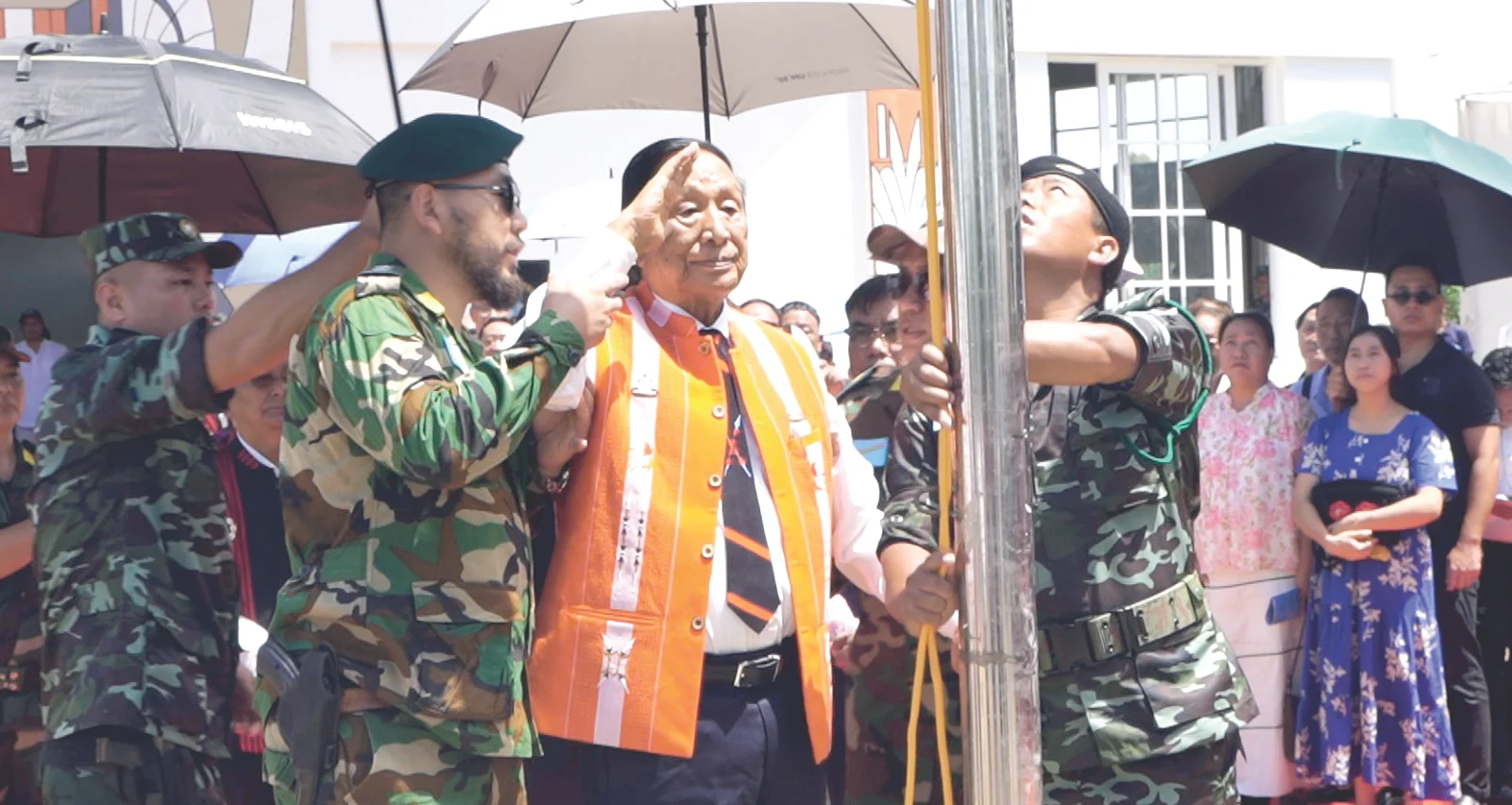
DIMAPUR, AUG 14 (NPN): Various Naga political groups (NPGs) observed the 80th Naga Independence Day at their respective headquarters and designated camps across Nagaland on August 14, 2026 with Naga political leaders paying tribute to the martyrs and reiterating their positions on the Naga political issue.
Naga flag, constitution, sovereignty non-negotiable, says Muivah
NSCN (I-M) observed the 80th Naga Independence Day at the newly inaugurated Tatar Hoho House, Camp Hebron.
Reading out NSCN (I-M) ato kilonser Th Muivah’s speech, deputy ato kilonser V.S. Atem, reiterated that the ongoing Indo-Naga political negotiations must culminate in an “acceptable and honourable” political agreement based on the letter and spirit of the August 3, 2015 Framework Agreement (FA). He asserted that Nagalim’s “unique history”, sovereignty, sovereign territory, national flag and constitution were non-negotiable for the NSCN.
Muivah said the Almighty God had given Nagalim to the Naga people and described the Naga homeland as a “God-given land”. He maintained that Nagas had a unique history and had never been part of India or Burma (present Myanmar), either by consent or conquest.
Muivah paid tribute to Naga patriots and martyrs and remembered late chairman Isak Chishi Swu, late vice-chairman Khadao Yanthan, late Brig. Thungbo Pangmi and late vice-chairman Gen (Retd) Kholi Konyak for their contributions to the NSCN and the Naga national movement.
He also extended greetings to organisations, national workers and leaders who, according to him, had remained committed to “sovereign Nagalim”. He thanked supporters for their commitment to what he described as the letter and spirit of the Framework Agreement.
A major part of Muivah’s speech centred on the historical identity and territorial claim of the Nagas.
He said Naga ancestors moved from Mongolia through China and Burma before settling in Nagalim. Questioning why the ancestors did not settle in China or the Irrawaddy valley despite the availability of fertile land, he said they eventually reached the Patkai range and the plains of the Brahmaputra and settled there.
Muivah argued that the settlement of the Nagas in the present homeland demonstrated that Nagalim was their God-given land. He said Nagalim “did not start with us, and it will not end with us”, stressing that the present generation had a responsibility to preserve it for future generations.
He alleged that Nagalim had subsequently been divided by “artificial states” and “so-called international boundaries”, leaving Naga people divided between India and Myanmar. He said the NSCN remained committed to integrating what he described as the fragmented Naga territory.
Muivah urged Nagas not to lose confidence in their history and political rights, saying their future should not be determined by others. He warned against accepting what he described as a “wrong decision or solution” that could leave the Nagas without their historical identity.
Muivah said the Naga spirit of freedom had existed long before the present NSCN leadership. He referred to resistance against British expansion from 1832, the 1929 memorandum to the Simon Commission and the resistance led by Haipou Jadonang.
He asserted that the Naga national resistance movement did not begin with the NSCN, but that its foundation had been laid by earlier generations. He particularly credited the Naga National Council (NNC) and its leaders, including A.Z. Phizo, Imkong Meren and T. Sakhrie, with consolidating Naga nationalism into an organised political movement.
Muivah said the slogan “Nagalim is ours” had united Nagas under Phizo’s leadership and recalled that the message had deeply influenced him personally.
He said the central question was who continued to uphold the Naga national principle and the mandate of the people. According to him, following the 1975 Shillong Accord, the NSCN took the position that the accord was not the end of Naga history.
Muivah described the 1975 Shillong Accord as a major turning point in the Naga political movement. He said the accord had resulted in the division of the Nagas and claimed that those who accepted it had lost faith in Nagalim and renounced the rights of the Naga people.
He said the NSCN was subsequently formed in 1980 after rejecting the Shillong Accord, with the stated objective of preserving the Naga national principle.
According to Muivah, the national principles included defending and protecting the August 14, 1947 declaration of Naga independence and the May 16, 1951 plebiscite.
Muivah said the Naga political struggle had demonstrated that the conflict could not be resolved militarily. He claimed that Indian leadership and at least three Indian Army generals had acknowledged that a military solution was not possible.
He recalled the NSCN’s international campaign, including its admission to the Unrepresented Nations and Peoples Organisation (UNPO) in 1993 and participation in international forums relating to indigenous peoples and human rights.
He said the NSCN had subsequently made interventions at the UN Human Rights Commission and participated in the United Nations Working Group on Indigenous Populations. He also referred to the acknowledgement of Naga sovereignty by the Flemish support group KWIA in 1992.
According to Muivah, these international activities contributed to the Government of India eventually initiating efforts for political dialogue with the NSCN.
Muivah recalled meetings with former Prime Ministers P.V. Narasimha Rao and H.D. Deve Gowda in the mid-1990s, saying both had expressed support for a political and peaceful solution.
He said the Indo-Naga ceasefire was announced in 1997 during the prime ministership of I.K. Gujral and came into effect on August 1, 1997.
According to Muivah, the ceasefire marked a shift in India’s approach from seeking a military solution to pursuing a political settlement. He said the political dialogue was initiated on the understanding that talks would be unconditional, held at the highest level, preferably at the Prime Ministerial level, and conducted outside India.
He also referred to the fourth principle concerning third-party participation, saying that this remained unsettled.
Muivah recalled a 1998 meeting with former Prime Minister Atal Bihari Vajpayee in Paris, where, according to him, Vajpayee expressed support for a peaceful political solution and ruled out violence and a military solution.
He also referred to the 2001 meeting with Vajpayee in Osaka and the subsequent removal of the ban on the NSCN under the Unlawful Activities (Prevention) Act, as well as the invitation for the NSCN leadership to come to India for political talks.
Muivah highlighted the July 11, 2002 Amsterdam Joint Communiqué as another important development in the peace process.
He quoted the communiqué as stating that the Government of India recognised the “unique history and situation of the Nagas” and that talks should proceed in an “accommodative and forward-looking manner” towards a lasting and honourable solution.
Muivah said the recognition of the unique history and situation of the Nagas represented positive progress in the political dialogue and should be taken to its logical conclusion.
His speech also focused on the August 3, 2015 Framework Agreement between the Government of India and the NSCN. Muivah maintained that the agreement represented a political recognition of the unique history and sovereignty of the Nagas. He said the eventual settlement must be consistent with the “letter and spirit” of the Framework Agreement and its competencies.
He asserted that the Naga national flag and constitution were also rooted in the political understanding reached during the peace process.
According to Muivah, the Framework Agreement established a basis for a “new relationship” and “sharing sovereign power” between the two entities.
He alleged that the Government of India was now failing to honour the letter and spirit of the agreement and warned that such a breach could undermine the political process.
Muivah made it clear that the NSCN would not compromise on what he described as the core national principles.
He said the final political agreement must recognise Nagalim’s unique history and provide for sovereignty, sovereign territory, national flag and national constitution.
He declared that these issues were “non-negotiable” and said the NSCN would defend and protect them “to the last, come what may”.
Muivah warned that any agreement that failed to uphold these principles would amount to a betrayal of the Naga national principle. He also rejected what he described as an imposed solution.
He said the NSCN would not remain a “silent spectator” to what he characterised as a return to a military approach.
Muivah acknowledged that the Nagas remained divided, but attributed the division largely to differences in political ideas and interpretations of Nagalim.
He said Nagas were fundamentally one people but differed in their understanding of their political rights, land and future.
He maintained that the Nagas had the right to determine their own future and urged them to remain confident in their history and political identity.
At the same time, he criticised factions that he alleged had emerged out of rebellion, mutiny or vested interests, claiming that such forces had been encouraged by adversaries to weaken the Naga movement.
Christian faith remained a central theme of Muivah’s speech. He repeatedly attributed the survival of the Naga political movement to divine intervention and said the future of the Nagas ultimately remained in God’s hands.
He called for repentance and national confession, saying internal wrongdoing and moral degradation posed a greater danger to the Naga people than external adversaries.
Muivah said political freedom alone would not be sufficient if it resulted in a “Godless society”. He therefore concluded that freedom and the Naga political struggle must ultimately be guided by Christian faith. He reiterated the NSCN’s position that the ultimate goal was “Nagalim shall be for Christ.”
Muivah said the NSCN and its political team had taken every possible step towards an early settlement and reiterated the demand for an agreement that was acceptable and honourable to both sides.
He urged the Government of India to respect and honour the commitments made during the peace process and specifically the August 3, 2015 Framework Agreement.
He also thanked Naga civil society organisations, churches, supporters, international groups and what he called the “prayer-warriors” for their continued support.
Concluding his address, Muivah said Nagas were not asking others to give them anything but wanted the world to respect their unique history and sovereignty. He reiterated that the NSCN would neither accept an imposed solution nor remain silent in the face of what it considered a military approach.
He ended by reaffirming that the final political agreement should respect Nagalim’s unique history and the letter and spirit of the Framework Agreement, including recognition of the Naga national flag and constitution.
The programme was attended by representatives of various Naga organisations and civil society bodies. Short speeches were delivered by advisor Naga Hoho HK Zhimomi; vice president, Naga Mothers’ Association, Apeuna Iheilung; secretary general, NPMHR, Neingulo Khromhe; GNF member Kevitho Kere; assistant general secretary, NSF, Veze Tunyi; president, UNC, Lorho; president, NCD, GK Rengma; advisor, ATKK, Lughozhe Swu; and DNSU president Hinoto P. Awomi.
The programme began with an opening prayer by Head Chaplain, GHQ, Naga Army, Col. Pitovi L. Kive, followed by a silent prayer in honour of martyrs offered by CNC general secretary Rev. Seksim Kasar.
Patriotic songs and cultural performances were presented by Gilgal Orphanage School Dimapur, Green Valley Academy, Razhaphe Hau Village, Mercy Newmai, Soul Sisters and the Rengma Cultural Troupe. (Staff Reporter)
Naga solution must be inclusive, honourable, says Vusshe: NSCN-K (Khango-Vusshe) ato kilonser Hokato Vusshe has called for an “honourable and inclusive” Naga political solution, urging the Government of India to demonstrate sincerity and implement the commitments contained in the Framework Agreement and Agreed Position.
Delivering his 80th Naga Independence Day speech at CHQ Thamsao, Vusshe said the August 14, 1947 declaration marked a significant chapter in Naga history and paid tribute to the pioneers and martyrs of the Naga national movement.
He said NSCN-K remained committed to the collective objective of an honourable and inclusive Naga solution. Referring to the Framework Agreement signed between the Government of India and NSCN (I-M) in 2015 and the Agreed Position signed with Working Committee of NNPGs in 2017, he said both remained significant political instruments but were yet to be fully implemented. “A people can forgive a hard bargain; a people do not easily forgive a promise left to gather dust,” he said.
Vusshe said developments since the signing of the agreements—including changes in the fiscal, constitutional, forest, telecommunications, criminal justice and other sectors—had altered the political and socio-economic environment and required the Naga political process to take contemporary realities into account.
Referring to the Forest (Conservation) Amendment Act and the proposed changes to the Free Movement Regime, he said such developments had direct implications for Naga land, forests and traditional movement across the Indo-Myanmar border.
On Foreign Contribution (Regulation) Amendment Bill, 2026, Vusshe said churches and civil society organisations had raised concerns and urged Naga Hohos, church bodies and representatives to place their concerns on record clearly and in writing.
“These developments bear upon Naga land, law, faith, movement, data and opportunity,” he said, adding that no political instrument could remain frozen while the circumstances surrounding it continued to change.
He said NSCN-K had submitted its “Charter of Convergence- A Path to Naga Destiny” as an addendum to the Agreed Position to A.K. Mishra at Dimapur on September 11, 2025. Vusshe described the charter as a constructive contribution intended to supplement the existing agreements rather than compete with or delay them. Vusshe urged Government of India to honour its commitments and work towards a comprehensive and inclusive solution without further delay.
At the same time, he acknowledged divisions among Naga political groups and called for unity, saying pride, mistrust and rigid positions should not continue to weaken the Naga cause. “This is the moment to bury the hatchet, lay aside vanity, walk the talk and come together for the early solution for which our people have waited so long,” he said.
He also cautioned against presenting “impractical dreams” to the public for political support, saying the Naga people should be informed honestly about the limitations placed on the negotiations by New Delhi, including its stated position on one inclusive solution, sovereignty and territorial integration.
Vusshe, however, maintained that sovereignty ultimately rested with the people and said what might be deferred at the negotiating table was its exercise, not the principle itself.
He outlined what he described as a two-phase concept of the political solution, with the first phase focused on building strong institutions, constitutional protection, education, economic capacity and accountable governance, while the second would be for a future generation to determine its destiny after the Naga people had become self-reliant.
“Our task is to build, brick by brick and clause by clause, the schools, institutions, productive economy, trained minds and accountable governance that turn proclamation into capacity,” he said.
He called upon civil society organisations, NGOs, church leaders, student bodies and other stakeholders to rise above personal interests, tribalism, favouritism and self-ambition and work towards the Naga solution.
Vusshe said unity among the Naga people was essential for any political agreement or negotiation to succeed and urged the present generation to build a strong foundation for future generations.
NSCN-K, he said, would remain steadfast in its commitment to the Naga cause, guided by freedom, justice, dignity and the welfare of the people.
Meanwhile, NSCN-K (Khango-Vusshe) president ‘lt. gen.’ (Retd.) Khango Konyak, called for preservation of peace, Naga unity and an early political solution to the Naga issue in his 80th Naga Independence Day message on August 14.
Paying tribute to the martyrs and patriots, Khango said the present peace was the result of sacrifices, restraint, dialogue and collective wisdom, and urged Nagas to remain vigilant against forces seeking to create division through hatred, misinformation and violence.
He called on the state government to rise above political considerations and demonstrate sincerity and statesmanship in addressing the aspirations of the Naga people. He also urged the Government of India to accord priority to the Naga political issue and bring the peace process to its logical conclusion with renewed urgency and political will.
Khango reaffirmed the NSCN’s commitment to freedom, justice, dignity, equality, self-determination and the welfare of the Naga people, while calling for unity by putting aside personal interests, tribal divisions and selfish ambitions. He said the Naga cause must be pursued with courage, wisdom and perseverance for a future based on justice, reconciliation and lasting peace.
Educated young Nagas must shoulder Naga legacy, says Akato: NSCN/GPRN-R (Akato) president Akato Chophi has called upon educated young Nagas to shoulder the legacy of the Naga national movement and help steer it towards an honourable Indo-Naga political solution.
In an 80th Naga Independence Day message, Akato extended greetings to Nagas and paid tribute to the founding fathers and fallen heroes of the Naga national movement.
He said the NSCN’s priority remained fulfilling the aspirations of the Naga people as a whole and pursuing a “pragmatic approach” towards an honourable political solution acceptable to both entities.
Akato said educated young Nagas had a responsibility to examine past mistakes and help bring the movement back on the “right track”.
He said the Naga people must look towards a secure future while remaining conscious of their history and identity, stressing that Nagas were “Nagas by birth and not by choice”.
Akato also acknowledged the contributions of Naga civil society organisations, churches, the public, supporters, sympathisers and individuals whose advice, prayers and support, he said, had helped the movement continue.
Calling upon Nagas everywhere to uphold the legacy of their forefathers, Akato urged them to remain steadfast in safeguarding the interests of future generations.
Provisional govt formed to uphold Naga sovereignty, says Ikato Swu: Chairman of the National Socialist Council of Nagalim (NSCN) Provisional Government, Ikato I. Chishi Swu, said the formation of the Provisional Government was necessitated by what he described as the “betrayal and political compromise” of the Naga political movement.
In his speech on the occasion of the 80th Naga Independence Day, Swu said Naga political struggle was rooted in the 1929 memorandum to the Simon Commission, the August 14, 1947 declaration of Naga independence and the May 16, 1951 Naga plebiscite, which he said represented the political aspirations of the Naga people.
He recalled that the Indo-Naga political dialogue under the NSCN had been conducted on three principles– talks without preconditions, at the highest level at the Prime Ministerial level, and in a third country– and culminated in the August 3, 2015 Framework Agreement after the Government of India recognised the “unique history and situation” of the Nagas.
However, Swu alleged that the spirit of the Framework Agreement was subsequently undermined, particularly after the Government of India’s 2019 ultimatum over the demand for a separate Naga flag and constitution. He further alleged that competencies subsequently submitted by the Hebron leadership compromised the Naga people’s right to sovereign existence.
He said an extraordinary joint meeting of Civil National Workers and Naga Army officers held at Mt. Horeb Camp on July 21, 2026 condemned the competencies and declared the establishment of a Provisional Government until a full-fledged government is formed.
Swu called upon Naga national workers, Nagas across the Naga homeland and the Naga diaspora to join in the formation of a Addressing the gathering, Swu said the Naga political movement was rooted in the 1929 memorandum submitted by the Naga Club to the Simon Commission, the August 14, 1947 declaration of Naga independence and the May 16, 1951 Naga plebiscite. He described these as the political heritage handed down by the Naga forefathers and said the Naga spirit had endured despite decades of conflict, divisions and political setbacks.
He said the Naga movement had experienced major setbacks, particularly the 16-Point Agreement of 1960 and the Shillong Accord of 1975, which, according to him, fractured Naga unity and altered the course of the political struggle. He called upon the younger generation to learn from both the sacrifices and mistakes of the past.
Referring to the Indo-Naga peace process, Swu said efforts under the late NSCN chairman Isak Chishi Swu and general secretary Th. Muivah had resulted in the Government of India acknowledging that the Naga issue was political and could not be resolved militarily. He said the subsequent dialogue was based on three principles– without preconditions, at the highest level and in a third country.
Swu said the recognition by the Government of India of the “unique history and situation” of the Nagas eventually led to the signing of the Framework Agreement on August 3, 2015 between the Government of India and the NSCN, which he described as a historic development in the political process.
However, he alleged that the spirit of the Framework Agreement was later undermined after the Government of India issued a three-month ultimatum in 2019 over the Naga demand for a separate flag and constitution. He claimed that competencies subsequently submitted by the NSCN leadership at Hebron came within the jurisdiction of the Indian Constitution and therefore contradicted the principles of the Framework Agreement as well as the political position expressed through the 1947 declaration and 1951 plebiscite.
Swu criticised the Hebron leadership for what he termed its “apparent acquiescence” to the authorities, alleging that it had compromised the principles entrusted to the Naga leadership. He said national principles should not merely be remembered during ceremonial occasions but must be upheld through “conviction, responsibility and steadfast action.”
He said it was against this backdrop that an extraordinary joint meeting of Civil National Workers and Naga Army officers was convened at Mt. Horeb Camp on July 21, 2026. According to Swu, the meeting condemned the competencies submitted to the Government of India by the Hebron leadership, claiming that they compromised the Naga people’s right to sovereign existence within the Constitution of India.
He said the joint meeting subsequently declared the establishment of a Provisional Government to “save the Naga nation” and rescue the Naga political movement from its present predicament until a full-fledged government could be formed.
Swu appealed to Naga national workers and the Naga people across the Naga homeland, as well as the diaspora, to join the process of forming a unified national government that would uphold the principles of the founding fathers and spearhead the movement towards restoration of Naga sovereignty.
He said the Nagas should not remain passive if their political aspirations and agreements were undermined. He called for a “strong, united and organised response” to any further breach, including through political as well as armed resistance, and urged the people to defend their political rights with courage and determination.
Swu also acknowledged what he described as the steadfast stand of the people of Eastern Nagalim, expressing appreciation for their commitment to the Naga common cause.
On the question of sovereignty, Swu argued that if sovereignty resides with the people, the constituent authority must also belong to the people. He said no government, leader or organisation could assume such authority merely through negotiation or representation.
“Negotiating authority may be delegated, administrative responsibilities may be assigned but the sovereignty of the people cannot be transferred without people’s explicit will,” he said, stressing the importance of the constitutional question.
He said the proposed competencies relating to institutions, administration, taxation, land and security should ultimately be measured against the principle that the people are the source of all political power. He also invoked the 1951 plebiscite as a testament to the expressed will of the Naga people.
Swu said his appeal was not directed against any particular organisation or leader but towards the entire Naga nation. He warned against what he described as the danger of “permanent fragmentation” and called for differences to be addressed through unity, wisdom and truth.
He maintained that a just and lasting political settlement must command the confidence of the people whose future it would shape. He called for truth over convenience, public responsibility over personal ambition, accountability over secrecy, and the national interest over personalities, organisations and tribal affiliations.
Swu further said the Naga political movement had inherited a legacy of sacrifice, hope and responsibility and urged the people to remain faithful to what he described as God’s purpose for the Naga nation and the covenant of “Nagalim for Christ.”
Calling for a united approach to the future, he urged the people to learn from past mistakes without losing faith, remain courageous without abandoning wisdom and uphold national principles while pursuing justice.
On occasion, Swu prayed for wisdom among Naga leaders to distinguish “truth from convenience”, courage to uphold national principles over immediate personal interests, and faithfulness to preserve freedom and dignity for future generations.
He also called upon the younger generation to play a greater role in shaping the future of the Naga people, saying the next chapter of the Naga story should be written through unity rather than division, courage rather than fear, truth rather than hatred, and service rather than selfish interests.
Swu concluded by calling for continued faith in God and the Naga people, saying the Naga journey had been long and marked by confrontation and sacrifice but that the people had endured.
Peace process must be protected, strengthened, says Michael: NSCN/GPRN-K ato kilonser K. Michael has reaffirmed the group’s commitment to the peace process, ceasefire and Agreed Position between the NNPGs and the Government of India, describing them as expressions of political maturity and a shift from violence to dialogue.
In his message on the occasion of the 80th Naga Independence Day, Michael said the Naga people had a unique history, distinct identity and proud culture, with aspirations that had survived decades of struggle, sacrifice and political uncertainty.
He said the peace process represented hope for safeguarding the aspirations of the Naga people through political means and stressed that it must be “protected, respected and strengthened”.
According to Michael, peace required discipline, sincerity and sacrifice and would provide future generations with security, confidence and hope.
He called upon Nagas to exercise restraint, wisdom and loyalty to the collectively pursued peace process, saying the conduct of the people was as important as the ideals of the movement.
Michael said the Naga issue was closely connected to historical identity, cultural survival, social cohesion and the future of generations yet unborn. He urged Nagas to rise above personal ambition, factional interests and short-term emotions, asserting that “the Cause is larger than any individual or group, it belongs to the people.”
Acknowledging challenges ahead, he said the Naga people were not without direction, citing the Agreed Position, the peace process and what he described as positive developments.
He expressed hope that the enduring will of the people would lead to a “just, honorable and lasting political settlement” and called for moving forward with discipline and purpose.
Starson says unity only way forward: NSCN-K (Niki) ato kilonser Starson Lamkang has called for greater unity among the Nagas and urged intellectuals, scholars, political and social thinkers to work towards strengthening and restructuring Naga civil society organisations.
In his 80th Naga Independence Day speech, Lamkang paid tribute to the martyrs and patriots who sacrificed their lives for the Naga cause and said the occasion should remind Nagas of their legacy and the road ahead.
He called for practical and workable strategies to strengthen or realign organisations such as the Naga Hoho, Naga Mothers’ Association and Naga Students’ Federation, or establish a new unified forum representing all Naga tribes across Naga-inhabited areas.
“A united voice will always be needed, if we are to exist as a Nation. There is no other way as Unity is the only way forward,” he said.
Lamkang said every Naga had a role in building the nation and urged individuals to contribute towards unity. He said while historical and political rights were widely acknowledged, few were willing to “walk the talk” when faced with difficulties.
He called upon Nagas to recommit themselves to the cause of “Sovereign Nagaland for Christ”, warning that future generations could judge the present generation for sowing division and contributing to the disintegration of the Naga nation.
Quoting Naga leader A.Z. Phizo, Lamkang said, “I am a Naga first, a Naga second, and a Naga last.” He reaffirmed that NSCN/GPRN would continue to stand for and defend the political aspiration of a “Sovereign Nagaland for Christ.”
NNC calls for Naga unity, political solution: NNC general secretary V. Nagi called for greater unity among Naga political groups and leaders, saying continued division would prolong uncertainty and suffering.
In his Naga Independence Day message, Nagi paid tribute to Naga patriots who sacrificed their lives for the political rights and aspirations of the Naga people, and stressed the need to preserve their identity and pursue a just and honourable political settlement.
He urged Naga leaders and national workers to rise above differences and work collectively towards a peaceful and lasting solution. He also called for protection of Naga indigenous rights, land, identity and traditional way of life amid the prevailing situation in the Northeast.
Referring to the situation in Manipur, Nagi expressed concern over displacement and insecurity and called for stringent measures against illegal immigration, including identification and repatriation of those found to be illegal immigrants.
He also stressed the importance of democracy, constitutional governance, rule of law, minority rights and religious freedom, while observing that political problems ultimately require political solutions through dialogue, reconciliation and mutual understanding.
FGN observes 80th Naga I-Day: Federal Government of Nagaland (FGN), under the leadership of ‘brig.’ (Retd.) S. Singnya, Kedahge, observed the 80th Naga Independence Day on August 14 across various regions.
The respective Midan Peyus, as regional heads, organised the observance in their jurisdictions in accordance with directives of the FGN. The Khiamniungan Region observed the day at Longdon Range, Khiamniungan Region.
K. Thanghiu, secretary to Kedahge, attended the programme as chief guest, unfurled the Naga National Flag and delivered the Kedahge’s message. The programme was chaired by S. Langoi, deputy secretary of the Khiamniungan Region.
A sanctification prayer was led by L.K. Pishen, head chaplain, NNPC FGN, while the proceedings were initiated by the GOC E/C, N/A FGN, and the Midan Peyu of the Khiamniungan Region.
Regional and other authorities attended the observance. M. Mechu, speaker, Lecy Hoho, Khiamniungan Region, delivered the vote of thanks, following which the programme concluded with a mass prayer.
GoI has no intention to resolve Naga issue, says T. Ovung: NPGN/NNC (N/A) president T. Ovung has alleged that the Government of India has failed to implement the August 3, 2015 Framework Agreement and accused it of attempting to “sabotage” the agreement by entering into another agreement with a different Naga group.
In his 80th Naga Independence Day message, Ovung said several rounds of negotiations had eventually led to the signing of the Framework Agreement between the Government of India, represented by then interlocutor R.N. Ravi, and the NSCN (I-M), represented by its general secretary Th. Muivah.
He said several years had passed since the agreement was signed but it remained unimplemented. Instead, he alleged, the Government of India had entered into another agreement with another group and was now insisting on “one agreement and one solution”.
Ovung described this position as “totally impossible” and alleged that it indicated that the Government of India had no intention of resolving the protracted Naga political issue.
He said Nagas should not expect a solution from the Government of India, asserting that Nagas were a free people before the advent of the British and had declared independence on August 14, 1947, a year before India’s Independence.
He maintained that Nagas had continued to observe August 14 as Naga Independence Day and questioned why they should seek a political solution from India after having already declared independence.
Ovung also called for the Naga people to uphold the May 16, 1951 plebiscite conducted by the Naga National Council (NNC), claiming that 99.9% of Nagas had voted to remain independent.
He said Nagas should instead “firmly stick and uphold” the plebiscite and defend their “birth rights and lands” themselves, as, according to him, they had done before.
He concluded by urging Nagas to remain committed to their historical and political position rather than relying on the Government of India for a settlement.
NNC/FGN urges Nagas to uphold historical, political rights: NNC/FGN Kedahge Zhopra Vero has urged Nagas to uphold their historical and political rights, warning against compromising the Naga political aspiration for short-term political, economic or developmental gains.
In his 80th Naga Independence Day speech, Vero said the declaration of Naga Independence in 1947 represented the political aspirations of the Naga people and called for unity, dignity and continued commitment to the principles of the Naga national movement.
He said the Naga political struggle predated India’s Independence and referred to the 1929 memorandum to the Simon Commission, the classification of Naga Hills as an “Excluded Area” under the Government of India Act, 1935, the 1946 correspondence between Jawaharlal Nehru and Naga National Council general secretary T. Sakhrie, and the 1947 meeting between Naga leaders and Mahatma Gandhi as historical milestones underpinning the Naga political position.
Vero said the August 14, 1947 declaration of independence, which he said was communicated to India, the British Government and the United Nations, should not be reduced to a commemorative occasion but remain an expression of the collective political will and national aspirations of the Naga people.
He urged Nagas to reject proposals that sought to redefine the Naga political issue as one of administrative adjustment or economic accommodation, cautioning against bartering their rights for developmental packages, financial assistance, incentives or employment opportunities.
Referring to Nagaland’s experience as a state under the Indian Union, Vero cited what he described as inadequate infrastructure, unemployment, fiscal deficits, corruption and dependence on financial assistance from the Centre as evidence of the limitations of political accommodation within the existing constitutional framework.
He said the 14-Point Memorandum submitted by the Naga delegation led by ato kilonser Kughato Sukhai during the fourth round of political talks in 1966 should remain a cornerstone of the Naga national movement and serve as a foundational framework for future engagements between the Government of India and the Nagas.
Vero paid tribute to the pioneers, leaders, martyrs and citizens who, he said, had upheld the Naga national principles despite political pressures. He also expressed gratitude to the Naga National Council for maintaining what he described as the historical foundations of the movement, including the 1929 Simon Commission Memorandum, August 14, 1947 declaration and the 1951 Naga Plebiscite. He called upon Nagas to preserve and defend their historical and political rights for future generations and urged them to move forward with unity, dignity and pride.
FGN kedahge, says Naga sovereignty cannot be compromised: Federal Government of Nagaland (FGN) Kedahge ‘gen.’ (Retd.) T.M. Rhakho, in his 80th Naga Independence Day message, called upon the Naga people to remain united, steadfast and committed to the national legacy left by their forefathers.
Rhakho paid tribute to the fallen patriots and comrades, saying their sacrifices must never be forgotten, diminished or traded away. He attributed the Naga people’s resilience over eight decades of struggle to the intervention and protection of Almighty God.
He said the NNC/FGN would not compromise the fundamental national position of Naga sovereignty or barter the sacrifices of the past for any accord, agreement, development package or temporary political arrangement.
“Our history is not for sale. Our sacrifices are not for sale. Our national conviction is not for sale,” he said. Rhakho urged the people to remain prayerful and uphold the principles entrusted to them by their forefathers, expressing faith that God would fulfil His purpose for the Nagas.
Kiumkhum calls for unity, urges honourable Naga solution: NNC/GDRN (NA) president Kiumkhum Yimkhiung called for Naga unity and urged all stakeholders to rise above differences and work towards an honourable and acceptable solution to the Indo-Naga political conflict.
In his 80th Naga Independence Day message, Kiumkhum paid tribute to the forefathers, pioneers and martyrs, and recalled the 1929 Simon Commission memorandum, the August 14, 1947 declaration of Naga Independence and the May 16, 1951 plebiscite as milestones of the Naga political movement.
He highlighted the signing of the Agreed Position on November 17, 2017 and the conclusion of talks on October 31, 2019, while expressing concern over the proliferation of groups and individuals allegedly pursuing personal interests and disrupting the political process.
Kiumkhum also questioned the sincerity of the State government and Government of India, saying their alleged lack of commitment had contributed to the prevailing confusion.
He appealed to Nagas to set aside differences and egos, and emphasised forgiveness, love, unity and peaceful resolution among the Naga people and political groups. He also acknowledged the support of tribal bodies, civil society organisations, student and women’s groups and churches.
NNC (PB) calls for unity preservation of Naga identity: Naga National Council (Parent Body) president Z. Royim, in his 80th Naga Independence Day message, called upon Nagas to preserve their history and identity, strengthen unity and remain committed to a peaceful and just future.
Royim paid tribute to those who sacrificed their lives, homes, freedom and personal interests for the Naga cause, saying their contributions formed an inseparable part of Naga history. He urged the younger generation to understand the sacrifices of earlier generations and face the future with education, discipline, courage and confidence.
He appealed to Nagas to rise above personal interests, factional differences and temporary political considerations, stressing that the interests of the Naga people must remain greater than those of any individual or group. Differences, he said, should be addressed through dialogue, mutual respect and wisdom.
Royim also called upon elders, traditional leaders, intellectuals, church leaders, women, students and civil society organisations to contribute to the welfare and future of the people. He stressed that national aspirations must be accompanied by moral responsibility, saying Nagas must work against corruption, dishonesty, exploitation and discrimination within society.
He further called for protection of land and natural resources, preservation of customs and cultural heritage, stronger communities and better educational and livelihood opportunities for the younger generation.
Describing the 80th Independence Day as an occasion for renewal rather than mere ceremony, Royim urged Nagas to learn from the past, acknowledge their present responsibilities and prepare future generations to carry forward their heritage with wisdom and courage.
NPGN/NNC stresses unity, peace and reconciliation: NPGN/NNC ato kilonser Hokato Rotokha has called for greater unity, cooperation and reconciliation among Nagas, stressing that the long-term welfare and future of the people cannot be built on division.
In his 80th Naga Independence Day speech, Rotokha said the NPGN/NNC Government, in coordination with the Working Committee of the NNPGs, was working towards peace, stability and the welfare, dignity and rights of the Naga people.
He said the engagement between the two groups was aimed at building trust and ensuring that political differences did not become barriers to progress. He stressed the need to strengthen traditional institutions, protect Naga land, resources and identity, and ensure fair delivery of justice.
Rotokha said the NPGN/NNC and WC, NNPGs might come from different backgrounds but shared the same objective of enabling Nagas to live in peace, with honour and self-respect. He said efforts were being made to move forward together through reconciliation, accountable governance and creation of opportunities for Nagas in both villages and towns.
Calling for patience and collective effort, he urged elders to provide wisdom, mothers to continue supporting families and youth to contribute their energy towards building a better future. He also appealed to Nagas not to allow differences to divide the Naga family.
Rotokha called upon the people to renew their commitment to protecting their land, upholding their identity and working together for peace and progress.
Solution should recognise history, identity: Kitovi
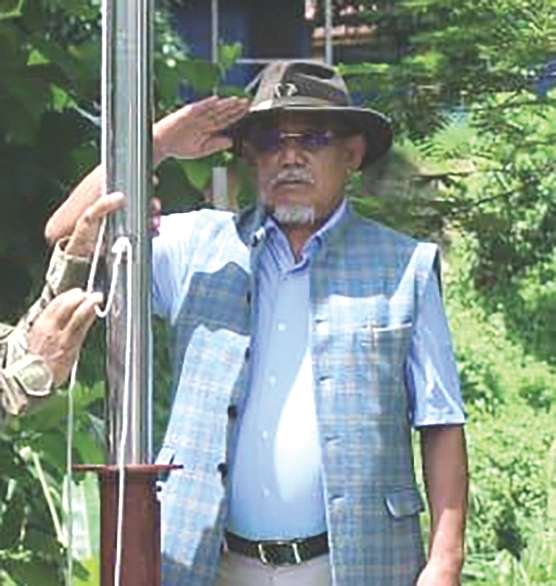
GPRN/NSCN ato kilonser N. Kitovi Zhimomi has called for an “honourable and acceptable” Naga political solution based on the recognition of Naga history and identity, while urging the Government of India (GoI) to create appropriate political and administrative space for the Nagas within a federal structure.
In his 80th Naga Independence Day speech at designated camp Khehoyi on August 14, Kitovi said the Indo-Naga political struggle had been guided by what he described as “extraordinary supernatural” forces and credited successive generations of Naga leaders with guiding the national movement.
Reflecting on the significance of August 14, he said the declaration of Naga independence in 1947 had marked a new chapter in Naga history and instilled a sense of pride and belief among the Naga people.
Kitovi, however, expressed concern over what he described as distrust, disloyalty, hatred, defective political orientations and the proliferation of political groups and civil bodies, which he said had weakened the Naga movement.
He also alleged that the lure of money and leadership positions had turned the Naga political movement into an “illegal industry” for some.
Referring to developments over the past 15 years, Kitovi alleged that “enemies of the Naga people” had influenced several senior kilonser and military commanders to establish separate groups and governments, weakening what he described as core Naga history, identity and political rights.
At the same time, he said he held no grudge against former comrades who had formed new organisations and maintained that all Naga groups remained on the same table on the Naga issue.
“One goal, one vision,” he said, expressing hope that all groups would work with equal participation and responsibility towards an “honourable and acceptable Naga political solution”.
Kitovi said he believed that the ground was now prepared for what was best for the Naga people.
Turning to the Government of India, he urged its leadership to draw lessons from the pre-Independence period while addressing the Indo-Naga political issue.
He said the signing of the Framework Agreement and Agreed Position on November 17, 2017, reflected what he described as the Naga people’s acceptance of contemporary political realities and their choice to co-exist with India while retaining the right to self-determination in consonance with their distinct history and identity.
According to Kitovi, this would require broadening and strengthening political and administrative mechanisms within a federal structure through constitutional amendment.
He said such an arrangement would also enable the Nagas to play a strategic role in the Act East policy.
Kitovi further noted that the Naga people were scattered across four states in India and Myanmar, which he described as an arbitrary division resulting from history.
He called for appropriate political and administrative measures, without altering existing state or international boundaries, to recognise and respect Naga history and identity.
He also referred to the “Status Paper” of the Working Committee, Naga National Political Groups (WC, NNPGs), and its addendum papers, claiming that these documents clearly defined an “honourable and acceptable Naga solution”.