
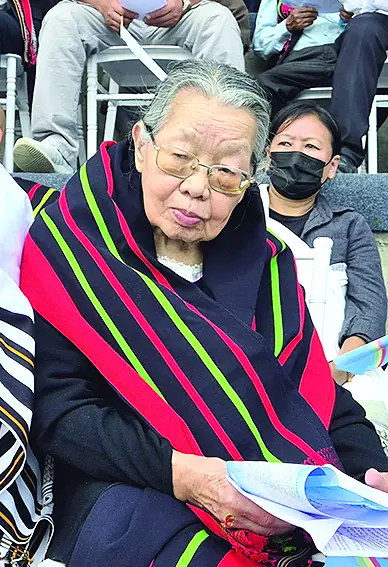
KOHIMA/DIMAPUR, MAY 16 (NPN): Various Naga political groups and organisations across Nagaland observed the ‘Naga Plebiscite Day’ on May 16, commemorating the 1951 plebiscite conducted under the leadership of A.Z. Phizo, with speakers reiterating the historical and political significance attached to the event and calling for unity among the Nagas.
NNC: Naga National Council (NNC) commemorated the ‘76th Naga Voluntary Plebiscite Day’ at Peace Hall, Chedema on Saturday.
A short speech was delivered by former Kedahge of the FGN, ‘gen.’ (Retd.) V. Metha while the message of NNC president Adinno Phizo was read out by joint secretary, NNC, Zhoshelü Khamo.
In the address, Adinno described the day as historic, commemorating the voluntary plebiscite through which the Nagas asserted their independent status. The message maintained that the decision was a calculated step taken in view of the prevailing circumstances of the time.
Highlighting the historical background leading to the plebiscite, the message stated that the Nagas were historically free people who practised self-rule through republic village states and democratic systems long before British intrusion.
It claimed that Naga territories were never part of India and alleged that the British failed to fully subdue the Nagas despite military campaigns between 1832 and 1878.
The address further maintained that no Naga village state had entered into a written treaty with any foreign power and asserted that the British administration in the then Naga Hills district from 1880 to 1947 was only for maintenance of peace.
Referring to the period before India’s independence, Adinno stated that Naga leaders had appealed to the British Crown to recognise the independent status of the Nagas, citing the memorandum submitted to the Simon Commission in 1929. According to the message, the memorandum sought that the Nagas be allowed to determine their own future and not be placed under India or Burma.
The programme was chaired by Zhoshelü Khamo, Bible reading and prayer led by pastor Chedema Baptist Church, Neizo Pienyü. A short speech was delivered by former kedahge FGN ‘gen.’ (Retd.) V. Metha. Special songs were presented by BKK Chedema and K. Heshu & Friends. (Correspondent)
NNC/FGN KR: NNC/FGN commemorated the 76th Naga Plebiscite Day at Eastern Oking, Khiamniungan Region (KR), on May 16.
The message of Kedahge was delivered by its secretary Tanghiu while short speeches were delivered by border affairs kilonser P. Samuel, midan peyu K/R K. Langkhang and dy. c-in-c, Naga Army ‘lt. gen.’ Sutha.
The speakers highlighted the significance of the historic Naga Plebiscite conducted on May 16, 1951, stating that Naga leaders organised the plebiscite to uphold and protect Naga heritage and as a symbol of hope, unity and victory for future generations.
Invocation prayer was pronounced by head chaplain NNPC L.K. Pishen, while vote of thanks was delivered by regional vice president, NNC K/R Pahiu. The programme was chaired by razou peyu Longdon range FGN M. Bushem Razou.
NSCN (I-M) reaffirms Naga sovereignty: NSCN (I-M) observed the 75th Naga Plebiscite Day at GHQ Hebron on May 16, with chairman Q. Tuccu reiterating the organisation’s stand on Naga sovereignty and self-determination.
In his address, Tuccu said the historic Naga Plebiscite of 1951, organised by Naga National Council under the leadership of A.Z. Phizo, remained one of the defining milestones of the Naga political movement.
He said the plebiscite, held after the declaration of Naga independence on August 14, 1947, witnessed 99.9% of Naga population affirming their desire to remain an independent and sovereign nation separate from the Indian Union.
Tuccu described the plebiscite as a testament to the rights of indigenous peoples, referring to Article 3 of the United Nations Declaration on the Rights of Indigenous Peoples (2007).
He also linked the plebiscite to earlier political assertions, including the 1929 memorandum to the Simon Commission and the declaration of Naga independence in 1947.
Referring to the situation in Manipur, Tuccu accused Indian security forces of colluding with “Kuki narco-terrorists” in attacks on Naga villages and dismantling Naga defensive bunkers.
(Full text on p-4)