
Staff Reporter
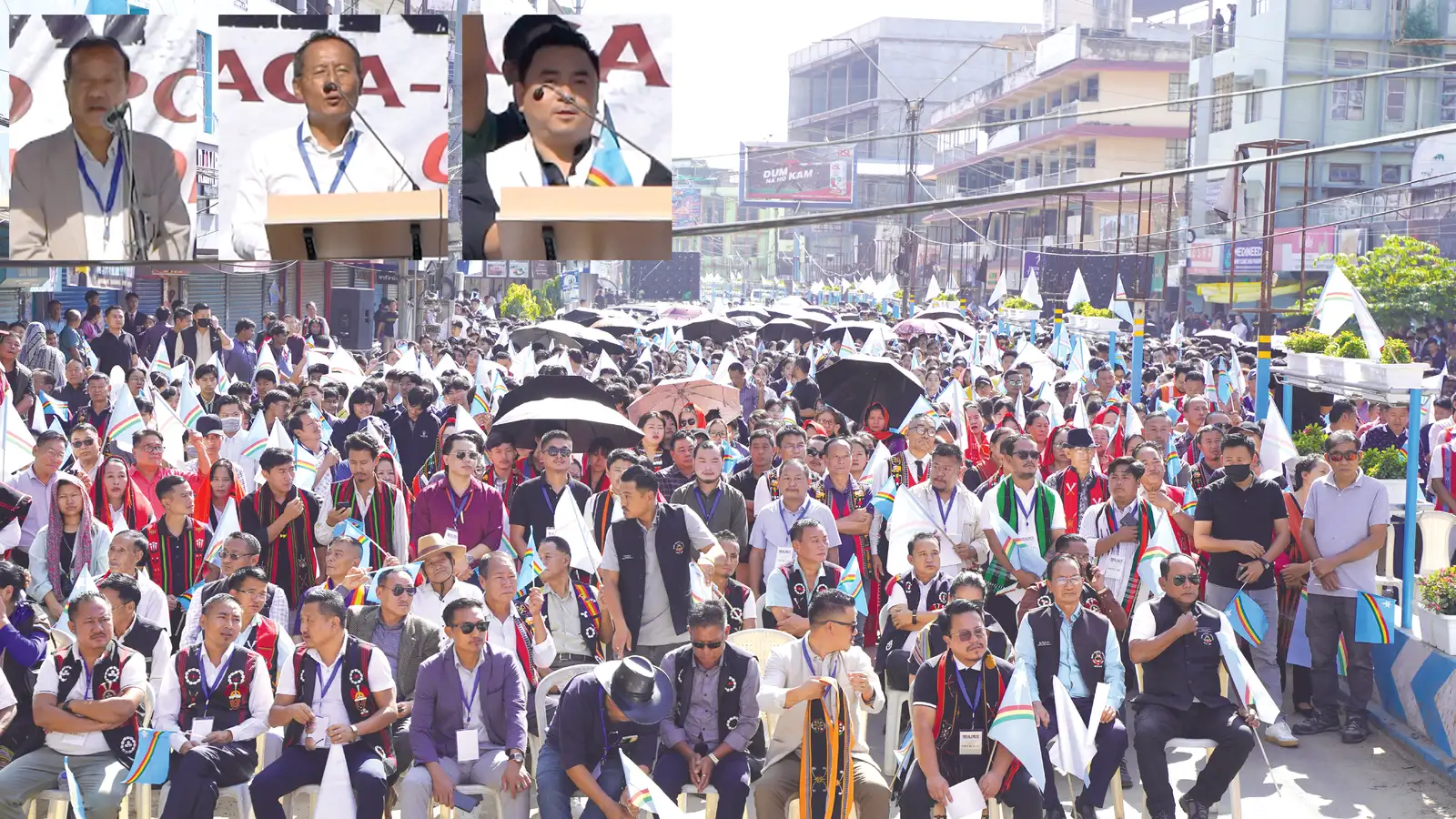
DIMAPUR, NOV 27 (NPN): Hundreds of Nagas from different walks of life, that also included students from across several educational institutions in Dimapur and nearby areas, converged at Clock Tower, Dimapur, on Friday, calling for an early, just and honourable solution to the long-standing Naga-Indo political issue and reaffirming their commitment to Naga identity, history and unity.
Krome slams delay: Addressing the rally, veteran Naga human rights activist Dr Neingulo Krome, secretary general of the Naga People’s Movement for Human Rights (NPMHR) Nagaland, questioned the purpose of continuing the “Indo-Naga” political negotiations if the Government of India could not honour commitments made during the process.
Krome said the Naga people had endured nearly 80 years of political struggle marked by sacrifice, bloodshed, suffering and uncertainty.
The movement will enter its 80th year in 2027. He referred to statements attributed to former prime ministers Jawaharlal Nehru and Morarji Desai, saying their positions reflected opposition to Naga independence.
Citing accounts passed down by Naga elders, Krome claimed that more than 300,000 Nagas, including women and children, had died in decades of conflict before the ceasefire. He recalled the 1964 ceasefire between the Government of India and the Naga National Council (NNC), followed by six rounds of talks. Indira Gandhi had reportedly offered the Nagas anything except sovereignty, he said, while Naga delegates maintained they would accept nothing from India except sovereignty.
Krome said divisions within the Naga political movement were affecting younger generations. Despite a ceasefire due to complete 30 years next year, uncertainty persisted, he said, adding that leaders had become complacent, national workers corrupt and sections of the public increasingly driven by personal interests.
He said the Working Committee of the Naga National Political Groups (NNPGs) deserved recognition for stating that its negotiations with the Government of India had concluded instead of allowing talks to continue indefinitely.
On negotiations involving the NSCN (IM), he questioned the prolonged process and the government’s approach, alleging successive interlocutors had failed to secure implementation of understandings and the government had repeatedly gone back on its commitments.
Krome said an agreement reached under former interlocutor R.N. Ravi had initially raised hopes, but a lack of clarity and implementation had created confusion and suspicion.
He said the Government of India and the Naga negotiating team appeared to differ over the agreement’s competencies.
He also questioned why current interlocutor Ajit Lal had reportedly sought time to study the agreement and competencies after taking responsibility, following a recent meeting with the Naga team in New Delhi.
“If you cannot honour your own commitment to the already agreed points of negotiation, just forget the whole thing, leave us alone,” Krome said. He linked the appeal to the 1929 Naga memorandum to the Simon Commission, recalling the demand to be left alone to determine the people’s future and way of life.
Krome warned that frustration over prolonged uncertainty was fuelling hatred, blame and divisions among tribes and individuals. Apologising to schoolchildren and young Nagas at the rally, whom he described as the third generation to grow up amid the suffering, he urged unity, a change in attitude and positive action, citing the biblical teaching to overcome evil with good.
NSF for unity: In his presidential address, NSF president Mteisuding called for greater unity among Nagas, saying their political destiny, identity and rights must remain in their own hands.
He said generations had made sacrifices in the political movement and stressed the need for a sovereign settlement. Mteisuding urged elders, tribal institutions, civil society organisations and young people to put the larger Naga identity ahead of individual, tribal and organisational interests.
Referring to tribes including the Angami, Ao, Tikhir, Konyak, Wancho, Mao and Inpui, he said distinct tribal identities should strengthen, not overshadow, the broader Naga identity.
He clarified that the rally was not directed against any community, but sought to build unity and advance recognition of Naga political rights. The issue, he said, was historical and political, not an ordinary administrative matter.
Mteisuding urged the Government of India to show political will and reach a settlement honouring Naga rights and aspirations. He called on Nagas to heal past wounds and move forward as “One People, One Nation – As One Naga Family.”
Former NSF president Senchumo NSN Lotha called for an early political solution, saying Nagas could not continue to bear the cost of prolonged uncertainty.
Addressing the gathering, he said any settlement should protect Naga identity, dignity and political rights, including recognition in their homeland. He urged Nagas to set aside differences, remain committed to shared aspirations and resist divisive influences and narrow interests, stressing peace, unity and mutual understanding.
A message from the Naga Students’ Organization of the Naga Self-Administered Zone in Myanmar, delivered by Dimapur Naga Students’ Union assistant general secretary Rukuwezo Wetsah, also urged unity. It said generations had endured sacrifices, hardship and uncertainty, while their forefathers held to the belief that Nagas had a distinct history, identity and political aspiration.
The message noted a gap between Nagas’ calls for unity and their actions, stating: “A divided people cannot build a united future.”
It added that a political solution alone would not ensure peace and prosperity. Nagas must also develop political maturity, mutual respect, responsible leadership, social discipline and a genuine commitment to unity.
The organisation said self-determination and sovereignty remained fundamental to the Naga political movement and that any lasting settlement must meaningfully address these aspirations.
Representatives of the Naga Students’ Organization from Myanmar, Tirap Changlang and Longding People’s Forum (TCLPF), Eastern Naga Peoples’ Organization (ENPO), United Naga Council (UNC) and Nagaland Tribal Hohos Coordination Committee (NTHCC) delivered solidarity messages.
In a message read by Naga Council Dimapur general secretary L.K. Peter Anal, the TCLPF said Nagas shared a common identity, history, aspirations and collective future regardless of where they lived. It backed an early, inclusive solution and urged continued unity.
The NTHCC message, read by Naga Women Hoho president Imlinungla, called for an early, inclusive and honourable settlement, urging political will, transparency and unity among Naga political groups. It said prolonged delays had heightened uncertainty, especially among young people, and called on the Government of India and other stakeholders to bring negotiations to an honourable conclusion.
The committee also urged transparency about the demands and key understandings under discussion, saying Nagas had a right to know what was being negotiated in their name and the possible implications of any settlement.
The programme was chaired by Naga Rally convenor Senchumo NSN Lotha, with the invocation offered by pastor K. Benjamin Sümi of Dimapur Sümi Baptist Church. The song “Kuknalim” was presented by Oriental Theological Seminary, while “Nagalim for Christ” was presented by Bamile and Thoidam. The programme concluded with words of gratitude by Sakulemba Jamir.
Naga Public Rally 3-point resolution
A three-point resolution of the rally was read out by former NSF president Kegwayhun Tep wherein it affirmed its commitment to uphold the shared history of the Naga people, preserve their identity and strengthen unity.
- Affirm that the Naga political movement belongs to all the Naga people, and therefore, this assertion, position, leadership and manifestation must rest with the Nagas. Hereby, all Naga Political Groups must uphold this fundamental principle and stand together against all divisive forces.
- Uphold the oneness of the Nagas, rise above tribal differences and administrative divisions, safeguard our valued identity and historical narratives that forms the core foundation of our aspirations which will ultimately define our political destiny.
- Stand resolute against every attempt to distort, misinterpret or undermine Naga history, identity and political rights. We pledge to preserve our historical truth, honour the sacrifices of our forefathers and safeguard the Naga narrative for generations to come.
Standing firm on the above assertions, the rally impresses upon the Government of India and the Naga political groups to bring about a solution to the Naga-Indo issue which must be inclusive and honourable.