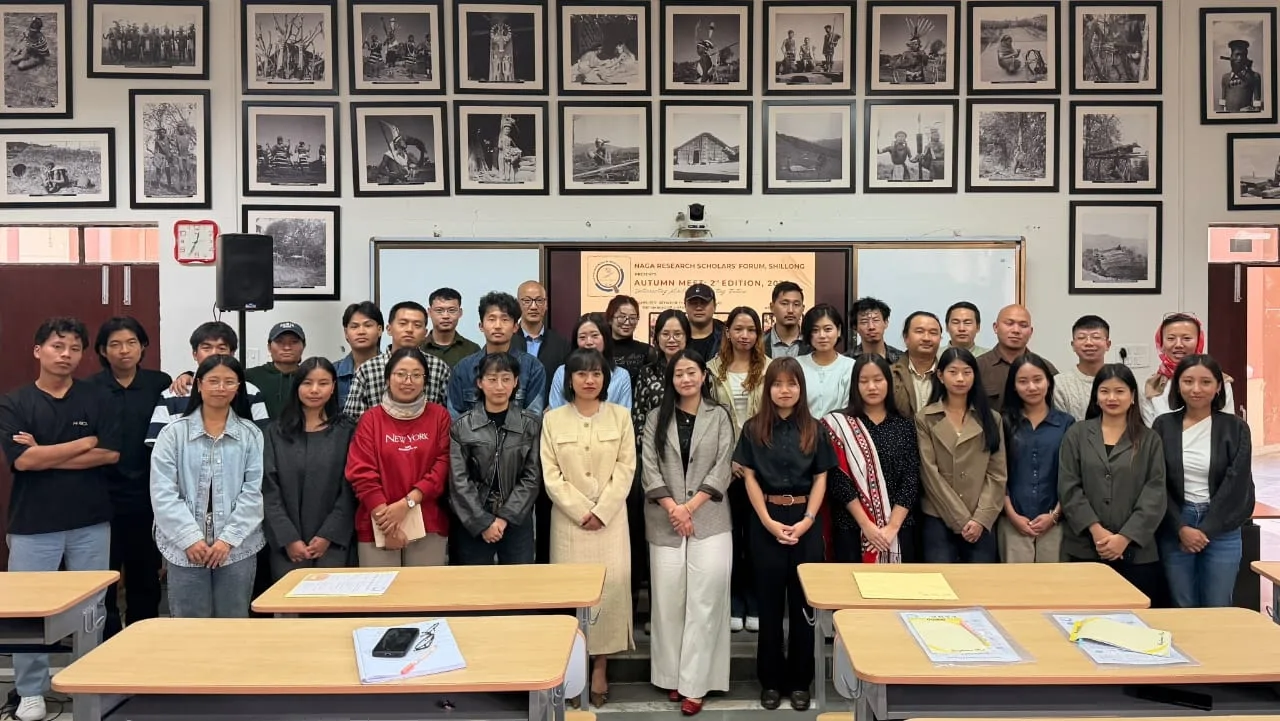
DIMAPUR: Naga Research Scholars’ Forum (NRSF), Shillong, organised the Autumn Meet: 2nd Edition 2026 at North-Eastern Hill University (NEHU) on October 24, under the theme “Intersecting Minds, Illuminating Future”, bringing together research scholars to reflect on the realities, challenges and transformative nature of academic research.
The programme, chaired by Vizovonuo Suohu, began with a welcome address by E. Ongarhoni Ovung.
The first session, titled “Between Theory and Ground: The Making of Research,” featured presentations by three scholars who shared their academic and fieldwork experiences.
Delivering the keynote presentation, Dr. Ab. Dijinbou from the Department of Culture and Creative Studies explored the relationship between theory and field realities. Drawing from folklore and cultural studies, he highlighted how myths and folk songs could serve as valuable sources for understanding cultural memory, history and evolving traditions.
He encouraged researchers to critically examine their assumptions rather than allowing ideology or preconceived notions to shape interpretations. Emphasising conceptual analysis and intellectual openness, Dr. Dijinbou said researchers should remain receptive to new insights and changing perspectives. He also noted that traditions should be viewed as dynamic practices continually reinterpreted by communities rather than static inheritances.
The second speaker, Zulotoshi Imchen from the Department of Geography, shared his personal experiences as a research scholar, including fieldwork conducted in Aizawl and Shillong. He spoke about challenges such as language barriers, unfamiliar environments and the need to adapt to new situations while collecting data.
Imchen also reflected on the difficulties of academic publishing, including repeated rejection of research papers. He observed that perseverance, continuous learning, extensive reading and stronger analytical approaches had helped him improve his work over time. Describing research as a long and often demanding journey, he encouraged scholars not to be discouraged by setbacks but to view them as opportunities for growth.
The third speaker, Aras Kumar Gurung from the Department of Anthropology, recounted his fieldwork experiences among the Sherpa community in Nepal. He challenged stereotypical perceptions of Sherpas solely as mountain guides and porters, highlighting the complexity of their social and cultural lives.
Sharing the challenges of conducting research in mountainous terrain, Gurung spoke about long journeys, difficult climatic conditions and logistical constraints. He said prolonged engagement with the community ultimately provided deeper insights into local society, culture and everyday life. His presentation underscored the importance of adaptability, observation and immersion during fieldwork.
Despite their differing academic backgrounds, all three speakers highlighted a common reality: research rarely unfolds exactly as planned. Their presentations emphasised that meaningful scholarship often emerges through questioning, reflection, adaptation and discovery.
An interactive session followed, during which participants discussed methodological and practical issues related to research. Responding to a question on handling qualitative data, Dr. Dijinbou explained that conversations that initially appear unrelated to a research topic often become valuable during later stages of analysis. Such discussions, he noted, may contribute not only to theses but also to future publications.
Addressing a query on dealing with manuscript rejections, Imchen stressed the importance of persistence, revision, analytical rigour and continuous reading. He said academic writing is refined through repeated practice rather than immediate success.
The second session featured a workshop on Academic Presentation conducted by Pheloseno Shaiza from the Department of Anthropology. The workshop focused on effective communication of research findings through PowerPoint presentations and academic content organisation.
As part of a group activity, participants were divided into five groups and assigned books from which they selected topics for presentation. Given 20 minutes to prepare, the groups were tasked with identifying key ideas, selecting relevant information and presenting their findings coherently.
The exercise demonstrated that effective academic presentations depend not on the volume of information presented but on the clarity and organisation of the core message. It also encouraged teamwork, critical thinking and decision-making under time constraints. The programme concluded with a vote of thanks proposed by Ebina Panmei, followed by lunch and the dispersal of participants. According to the organisers, the Autumn Meet provided a platform for scholars to reflect on the broader meaning of research, highlighting the importance of questioning assumptions, embracing challenges and engaging critically with knowledge. The event underscored that research is not merely about producing answers but also about cultivating the questions that drive deeper understanding.