
Department of Political Science, Asufii Christian Institute (ACI), Punanamei, Mao, undertook an academic field visit to Khonoma, a historic village located about 20 kilometres from Kohima. The visit was led by Dr. Soreiphy K, HoD, accompanied by Dr. Adani Kollo, Dean of Students, faculty member Chovoni Cheng, and 44 students.
According to Dr. Soreiphy K, HoD, Department of Political Science, ACI, guided by local resident Ketu, the students explored Khonoma’s historical and political significance. Ketu explained that Khonoma—locally known as Khwunomia—derives its name from Khwuno (a plant found in the area) and Mia (dwellers), reflecting the deep interconnection of identity, territory, and ecology.
Khonoma historically functioned as a self-governing unit with defined territorial boundaries protected by the Kharu (traditional wooden gate), symbolising sovereignty and collective security. The village is most remembered for its resistance to colonial expansion during the Anglo-Khonoma War (1879–1880), which marked the final armed resistance of the Angami Nagas against British intrusion. The war memorial continues to serve as a site of contested memory.
The village is organised into three major Khels—Thevo-ma, Merhu-ma, and Semo-ma—which served as foundational units of governance. The reconstructed forts, especially the Semo-ma Fort described by British officer Major John Butler as one of the strongest in Northeast India, illustrate the strategic capabilities of indigenous societies. Traditional morungs (bachelors’ dormitories) also played a vital role in political socialisation, training youth in discipline, leadership, and communal responsibility.
Khonoma’s contemporary identity as Asia’s first green village reflects its transition from armed resistance to environmental stewardship. Its community-managed resources and conservation practices present an alternative model of governance rooted in collective decision-making. Visits to Dzuleke village and Heunambe cave and waterfall further enriched discussions on ecological governance.
For the students, Khonoma emerged not merely as a heritage site but as a living political text—illustrating the evolution of power from indigenous self-rule and colonial resistance to participatory and sustainable governance.
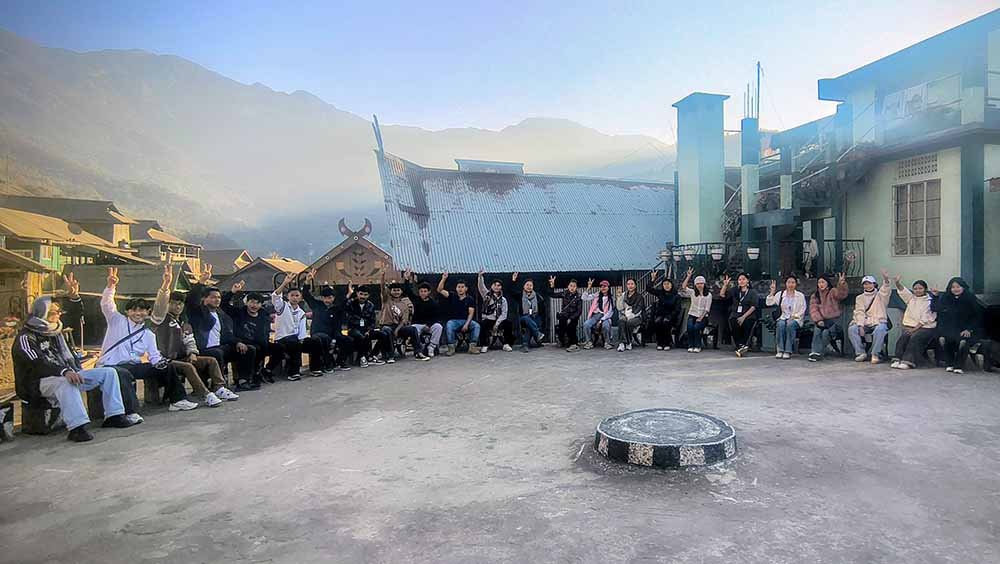
Nagaland: ACI students academic visit to Khonoma
DIMAPUR