
Correspondent
KOHIMA, SEP 1 (NPN): The Nagaland Legislative Assembly on Tuesday expressed serious concern over the proposed Foreign Contribution (Regulation) Amendment Bill, 2026, with members warning that provisions relating to renewal of registration and takeover of assets could adversely affect churches, charitable institutions and grassroots organisations engaged in education, healthcare and humanitarian work.
Initiating the discussion on matters of urgent public importance under Rule 50, by advisor Achumbemo Kikon and supported by advisor Temjenmenba and Y. Mankhao Konyak, MLA, members urged the Centre to ensure wider stakeholder consultation and constitutional scrutiny of the proposed legislation.
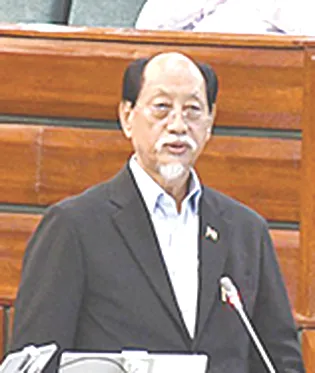
Leader of the house and chief minister Neiphiu Rio, in his remarks, said the proposed amendments had generated widespread concern, particularly among the Christian community in Nagaland. Rio said he had consulted Christian leaders and representatives of the Nagaland Baptist Church Council (NBCC), Bishop Diocese of Kohima and Nagaland Joint Christian Forum, including a joint deliberation on August 9.
He said churches and Christian organisations had historically contributed to Nagaland’s spiritual and community life as well as education, healthcare, poverty alleviation, social welfare, livelihood support and assistance to vulnerable sections.
Rio said legitimate foreign contributions had supported numerous educational, healthcare, humanitarian and social service activities, particularly in remote and economically weaker areas. He, however, acknowledged the responsibility of the Government of India to ensure transparency, accountability and compliance in the use of foreign contributions.
The chief minister said he had written to Union Home Minister Amit Shah conveying the concerns of church bodies and highlighting Nagaland’s “unique social, historical and development circumstances”.
He said he had sought greater parliamentary scrutiny and wider stakeholder consultation, including referring the proposed legislation to a Joint Parliamentary Committee (JPC). The Union government subsequently referred the Bill to a 31-member JPC on August 12. “I am confident of the JPC providing an opportunity to address genuine concern, remove apprehensions, and build greater public confidence in the proposed regulatory framework,” Rio said.
He also urged that FCRA renewal cases be examined individually and sensitively so that legitimate charitable, educational, healthcare and social welfare activities were not affected by broad or generalised assessments.
Rio cited the Missionaries of Charity, founded by Mother Teresa, whose FCRA renewal was denied in 2021 before being subsequently renewed following public concern and review.
He said the Christian community’s longstanding international links had contributed to philanthropic and charitable activities in Nagaland and elsewhere in India.
“While we fully recognise and respect the responsibility of the Government of India to ensure transparency, accountability and compliance with the law in respect of foreign contribution, it is equally necessary to ensure that genuine charitable education, healthcare, humanitarian institutions which have rendered exemplary service to our nation for generations are not inadvertently affected,” Rio said.
Earlier, moving the discussion, Kikon traced the evolution of the FCRA and raised concerns over proposed powers relating to assets and institutions following cancellation, cessation or non-renewal of registration.
Kikon referred to correspondence from the Diocese of Kohima, saying its FCRA renewal applications had been refused in 2024 and 2025. He said the Bishop of Kohima had subsequently approached the Deputy Chief Minister in charge of Home Affairs and the Governor seeking intervention.
He also referred to representations from various Christian denominations and the NBCC, which, he said, raised concerns over proposed provisions concerning institutional assets, renewal and government control.
Kikon said the proposed legislation had implications for constitutional rights, including Articles 25, 29 and 30, and called for consideration of Article 371A in the context of Nagaland.
He said the NBCC had urged the state government to seek withdrawal of the Bill and advocate a broad-based consultative process involving state governments, churches, faith-based organisations, civil society institutions and development agencies.
Kikon also criticised what he described as excessive regulatory requirements, saying smaller grassroots organisations could find compliance particularly difficult.
Advisor Temjenmenba, while appreciating Rio’s intervention, said Nagaland’s unique history needed to be considered while examining amendments to the FCRA.
He said churches and Christian organisations had been working in Nagaland for more than 150 years, often reaching remote areas before many modern government institutions.
While acknowledging the need for regulation, transparency and accountability, Temjenmenba said legitimate charitable and developmental activities should not be unintentionally affected. He called for proper notice, opportunity of hearing, reasoned orders, reasonable time for compliance and an effective appellate mechanism.
He termed the referral of the Bill to the JPC a welcome development, saying it would provide stakeholders an opportunity to place their concerns before Parliament.
Y. Mankhao Konyak, MLA, said the existing FCRA framework already imposed substantial restrictions and compliance requirements on organisations receiving foreign contributions.
He said organisations were required to maintain designated accounts, file financial returns and adhere to the 20% ceiling on administrative expenditure, among other requirements.
Konyak said any further amendment should provide a “simple, affordable, transparent and clear procedure” for renewal of FCRA certificates.
Advisor Kudecho Khamo said the proposed provisions could impose disproportionate burdens on smaller churches and grassroots ministries with limited administrative capacity.
He expressed concern that the framework could disrupt long-standing partnerships between Indian Christian organisations and international counterparts and affect programmes serving children, women, persons with disabilities, the elderly and economically weaker communities.
Khamo, however, said regulating foreign contributions, protecting national security and maintaining financial accountability were legitimate objectives, but these should be balanced with the interests of institutions engaged in genuine public service.
P. Longon, MLA described the issue as concerning all Nagas and not merely the Christian community.
He said the Assembly should speak “in one voice” before the JPC and called for wider stakeholder consultations, a white paper on cancellation of FCRA registrations and dropping the proposed provisions relating to the designated authority and assets.
Longon said the existing FCRA framework was already strong enough to regulate foreign contributions and warned that the proposed amendments, if enacted in their present form, could create “disunity, disharmony and enmity” among communities.
The members broadly maintained that regulation of foreign contributions was necessary but should not undermine legitimate educational, healthcare, humanitarian and developmental activities.
Concluding the discussion, Rio reiterated that the state government would continue engaging with stakeholders and the Union government to ensure that legitimate concerns of churches and other institutions were addressed.
The House was subsequently adjourned to meet again at 9.30 a.m. on September 3.
Earlier, before commencement of official business, Speaker Sharingain Longkumer welcomed newly elected and youngest member of the 14th NLA, Daochier I. Imchen.
The house also paid an obituary tribute to former legislator G. Kughavi and observed a moment of silence in his honour.