
A state-level seminar on “Women in Contemporary Naga Society” organized by the Nagaland State Commission for Women (NSCW) with National Commission for Women(NCW) was held at SIRD auditorium on April 17 where speakers stressed the need for greater participation, representation, and empowerment of women across all sectors amid changing social dynamics.
NPF legislator Achumbemo Kikon, the special guest, observed that while Naga society has traditionally been patriarchal, women have gradually asserted their rights. He noted that although men have largely led decision-making, it has never been isolated from women’s influence, as critical choices are shaped through consultations within families.
Drawing a vivid analogy, he remarked that while the father is considered the head of the family, “without the neck, the head cannot function,” underscoring women’s essential role in holding both the family and society together.
Highlighting recent electoral trends, Kikon said women’s participation in recent ULB elections has exceeded 37 percent, surpassing the 33 percent reservation benchmark and demonstrating their capacity to contribute meaningfully. He added that more women are now being included in government nominations.
With a female literacy rate of around 76.11 percent, he noted, women are making significant strides in education and professional fields, excelling as officers, educators, and leaders.
Kikon encouraged women to support one another, stressing that progress should not depend solely on men’s backing. He called for greater preparedness for leadership roles, particularly in view of ongoing discussions on women’s reservation in Parliament, and urged women to remain determined while upholding dignity and respect.
Secretary of Social Welfare, Limawabang Jamir, said that while Naga society is known for its rich cultural heritage, women’s roles have historically been confined to domestic and community spheres. However, he said this dynamic has steadily changed, with women now playing a vital role in shaping modern society.
He highlighted their growing presence in education, politics, business, and social activism, with education serving as a key tool of empowerment. Jamir noted that women are increasingly pursuing higher studies and contributing as teachers, doctors, administrators, and entrepreneurs, while also playing a crucial role in the economy through markets and enterprises.
Referring to political milestones, he pointed out that S. Phangnon Konyak became the first woman from Nagaland elected to the Rajya Sabha, while Salhoutuonuo Kruse and Hekani Jakhalu Kense made history in the Legislative Assembly, with Kruse becoming the state’s first female cabinet minister. This progress, he added, has extended to grassroots governance, with women securing over 37 percent of council seats in recent urban local body elections, surpassing the mandated quota.
At the same time, Jamir acknowledged persistent challenges, including gender inequality, limited representation, and deep-rooted social expectations. Despite these hurdles, he said women continue to show resilience and adaptability, preserving cultural identity while redefining it. He concluded that empowering women is essential for strengthening society.
NSCW chairperson W. Nginyeih Konyak said Naga society is at a critical stage of transformation, with women at the centre of this transition. She stated that women have always been the backbone of families and communities, contributing to culture, agriculture, and the economy, while increasingly taking on leadership roles in governance, education, and public service.
However, she pointed out that challenges persist in representation, decision-making, access to opportunities, economic independence, and protection from violence and discrimination. Referring to the seminar’s theme, she stressed the need for reflection on how women navigate education, employment, leadership, customary practices, digital spaces, and public institutions, and whether systems are evolving to uphold their rights and dignity.
She asserted that empowering women is a societal necessity, stating that inclusive development cannot be achieved if half the population remains underrepresented. “When women are empowered, families prosper and communities grow stronger,” she said.
Konyak added that the NSCW remains committed to advocating for women’s rights, addressing grievances, and creating platforms for dialogue. She urged that the seminar serve as a call to collective action towards building a more equitable and just society.
The programme also included a technical session moderated by Gracy Aye, state mission coordinator, Mission Shakti. Dr. Theyiesinuo Keditsu, Assistant Professor at Kohima College, spoke on “Empowering Women through Awareness, Dialogue and Cultural Sensitivity”; Rev. Dr. Ellen Konyak Jamir, Associate Professor at Oriental Theological Seminary, presented on “Navigating the Socio-Cultural Challenges of Women in Nagaland”; and Dr. A. Wati Walling, Associate Professor and Dean (Academic) at NIT, spoke on “Balancing Tradition and Transformation in Naga Society.” The programme concluded with a vote of thanks by NSCW member Akokla Longchar.
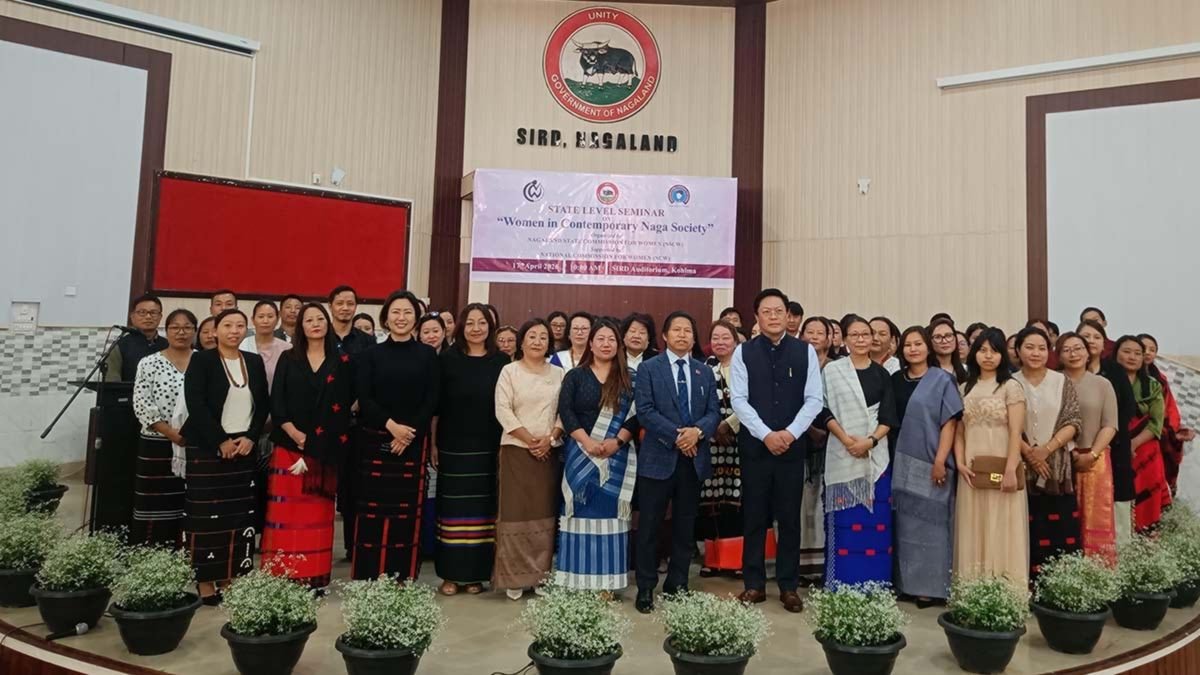
Nagaland: Call for stronger women’s participation across sectors
Correspondent