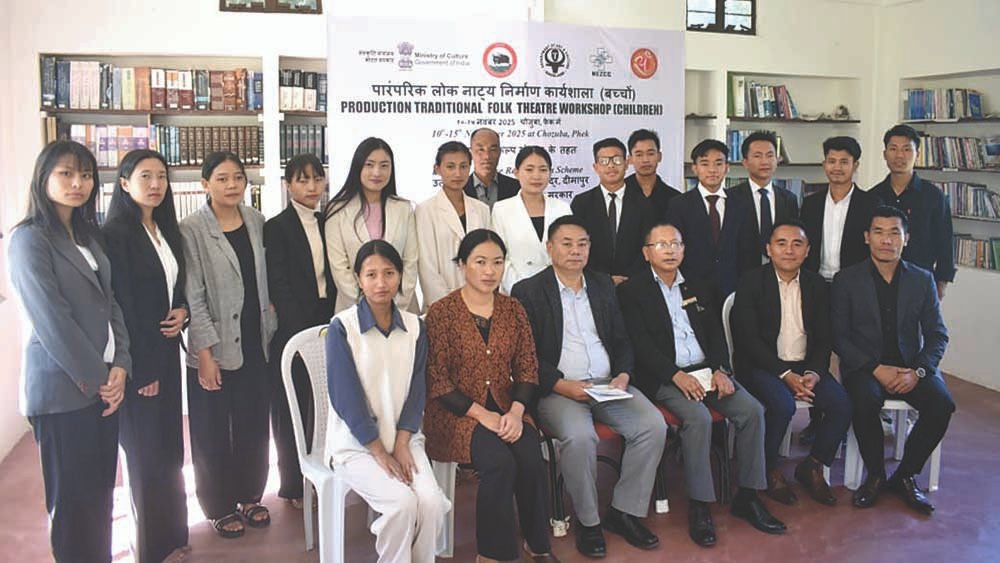
A drama production entitled “The Light at Chozuba,” under the production traditional folk theatre workshop (children’s theatre), has been completed under the sponsorship of North East Zone Culture Centre (NEZCC) Dimapur, Government of India and Art & Culture Department, Govt. of Nagaland in collaboration with Nagaland Theological College, Chozuba.
The drama was inspired by the earliest accounts of the emergence of Christianity in Chozuba village and captures a significant transformational period in the region’s religious and cultural history.
The production was conceptualized with the primary objective of educating the younger generation and the general public on how Christianity first dawned in Chozuba and aimed to provide a deeper understanding of the cultural heritage, tribal identity, and the traditions of the forefathers that shaped the early mission era.
The drama portrays the challenges, sacrifices, and triumphs of early missionaries and local pioneers who embraced Christianity, highlighting the struggles faced by the early converts, including social rejection, cultural conflicts, and spiritual awakening.
The inaugural program of the drama was held on November 10 at Nagaland Theological College, Chozuba, the program was graced by Art & Culture Department, Government of Nagaland Deputy Director Teisovikuolie Therie, who highlighted the importance of documenting local history through performing arts, encouraged participants to express identity, faith, and community through drama, and outlined schemes and opportunities offered by the Art and Culture Department and North East Zone Culture Centre,Dimapur to support the talented youth across Nagaland and North East India
Over 20 participants, including actors, narrators, and technical staff, brought the drama to life. Key scenes in the drama included, the arrival of early missionaries, the commissioning of Chozuba’s first two evangelists by Rev. Rivensburg, community resistance, the evangelists’ perseverance, and the dedication of the first church. To maintain realism, the team travelled to the interior parts of Chozuba Village, selecting locations that still have remnants of the old wooden houses of the forefathers, giving depth, authenticity, and cultural richness to the visual production.
The workshop and drama production concluded on November 15 with a formal closing ceremony in the presence of Nagaland Theological College, Principal Vekudu Lohe.