
A Common Platform Programme to demand an early and inclusive Naga political solution based on the Framework Agreement and the Agreed Position will be held on November 18 at 10 a.m. at Agri Expo, Chümoukedima. Organized under the aegis of the GBs Federation, the initiative calls upon all Naga tribes, civil societies, and political groups to come together and make a collective stand on the Indo-Naga political issue.
Announcing the programme at a press conference on Thursday at Hotel Saramati, Dimapur, Senior Citizen Association Nagaland (SCAN) spokesperson KK Sema said the effort seeks to provide a unified voice of the Naga people on whether they want a solution without further delay. “We are calling upon all fathers and mothers in and outside Nagaland to realize that the Naga political issue belongs to us. It is our responsibility to ensure that our children get a fair opportunity for the future,” he stated.
Expressing concern over what he described as an “environment of uncertainty, lack of opportunities, and social degradation,” Sema said generations of Nagas have suffered under the guise of nationalism. “As a father, I say this is not fair for my children. I think my children deserve better,” the 79-year-old remarked, urging the present generation to end the decades-long stalemate.
Explaining why the GBs Federation was chosen to lead the initiative, Sema said the body carries traditional authority and is non-partisan. “There is no single civil organization in Nagaland today that can bring all 17 tribes together. But the GBs, as traditional custodians and leaders of their communities, have always borne the burden of both the government and the underground,” he said.
He dismissed perceptions that GBs are government agents, clarifying that they are unpaid community representatives who historically serve both the state a “Our national workers have done their best. Now the question is why the Government of India is refusing to give the final solution when talks have been concluded,” he asserted.
Sema said all Naga political factions, irrespective of differences, would be invited to participate. “We want the factions to tell us clearly whether they are in favor of a solution or not. The common man has reached a point of intolerance. We are tired of the burdens of taxation and uncertainty,” he remarked.
He assured that the concerns of Nagas living outside Nagaland-in Manipur, Arunachal Pradesh, and Assam-have been taken into account, with provisions for autonomous territorial councils in those areas.
Responding to speculation that the initiative was a parallel move to the Forum for Naga Reconciliation (FNR), Sema clarified: “This is not a parallel movement.
The FNR’s work of reconciliation is honorable and necessary, but the GBs Federation is addressing the political issue directly, with a clear goal-to achieve a final solution based on the two agreements.”
On whether invitations had been issued to all stakeholders, including the NSCN (I-M), Sema confirmed that the Common Platform is open to every Naga political group, civil society organization, and tribal body. “Yes, invitations are being sent to every organization—civil societies, apex tribal bodies, and all political factions. Each group can decide for itself whether to attend or not,” he said.
Referring to earlier instances where NSCN (I-M) declined to attend similar gatherings, Sema said such a decision would again be “unfortunate.” “If they choose not to attend, they will miss the sentiment of the people being expressed. This platform is an opportunity for all factions to present their positions directly to the people. It’s a two-way street—the people also deserve to hear from them,” he added.
Sema stressed that the Naga Common Platform is not intended to impose any particular viewpoint but to reflect the collective will of the Naga people. “At the end of the day, what emerges from this platform will represent the voice of the people, which will be conveyed to the Government of India. Every faction must understand the importance of engaging with the people and demonstrating unity in purpose,” he said.
Concluding his appeal, Sema urged all sections of Naga society to participate in the November 18 gathering. “The question before us is simple but vital-do we want a solution or not? Our people are weary of the burdens of taxation, division, and uncertainty. It is time to come together and speak with one voice,” he said.
He asserted that the message from the upcoming platform should be clear to both the Naga factions and the Government of India: the Naga people desire an inclusive, honorable, and early political solution.
Leaders call for end to prolonged negotiations: Meanwhile, former Nagaland Tribes Council (NTC) president Theja Therieh has voiced strong concern over the prolonged Indo-Naga peace talks, describing the 28-year-long negotiation process as a heavy burden on the Naga people. Addressing a press conference, Therieh urged for greater openness in the peace process and active involvement of civil society.
“The 10 years of the Framework Agreement have been kept on hold. We must give a platform for the people to rise to the occasion and speak their minds,” Therieh said, while appreciating the Nagaland GB Federation for convening a Common Platform on November 18.
Recalling earlier efforts to unite the Naga National Political Groups (NNPGs) and the NSCN (I-M), Therieh said meetings were held with top Indian leaders, including the Prime Minister, to push for an inclusive agreement. He stressed that all stakeholders must now be answerable to the people. “There must be accountability. The delays and challenges have cost us dearly. Twenty-eight years is a generation lost,” he lamented.
Therieh warned that prolonged uncertainty has deeply affected Naga youth, depriving them of opportunities and hope. He called for the final settlement to be decided in the people’s court, describing it as a people’s movement. “We cannot sit at the negotiation table forever. We have to see life beyond this process,” he asserted.
Meanwhile, Naga Hoho president H. Sulanthung reaffirmed the body’s role as a unifying force, appealing to all Naga tribes within and outside Nagaland to come together in “trust, confidence, and oneness” for an inclusive solution. “We continue to follow the philosophy of our legendary leader, A.Z. Phizo. Nagas are one people wherever we are-whether in Nagaland, Manipur, Assam, Arunachal, or Myanmar,” he said.
Sulanthung clarified that the Naga Hoho would not align with any political faction but would support policies that uphold the people’s interest. He confirmed that the Hoho, along with other tribal and civil society leaders, will participate in the November 18 platform. “We respect both the Framework Agreement and the Agreed Position. Both represent the Naga issue, and both must be respected,” he stated, urging the Government of India to integrate the two into one inclusive solution.
Adding his voice, Nungsang Jamir president of Naga Tribal Union Chümoukedima Town (NTUCT) , expressed frustration over the stalled process. “I once believed the agreements would bring resolution. But it seems to remain in limbo with the Government of India. This is deeply frustrating, not only for me but for everyone who has long awaited meaningful cooperation,”” he said, urging Nagas to speak out collectively.
He urged the people of Nagaland to voice their shared frustration and to make their sentiments heard by the Government of India. “It is high time we speak out together,” he stated, expressing appreciation to the Committee of Nagaland for organizing the upcoming platform.
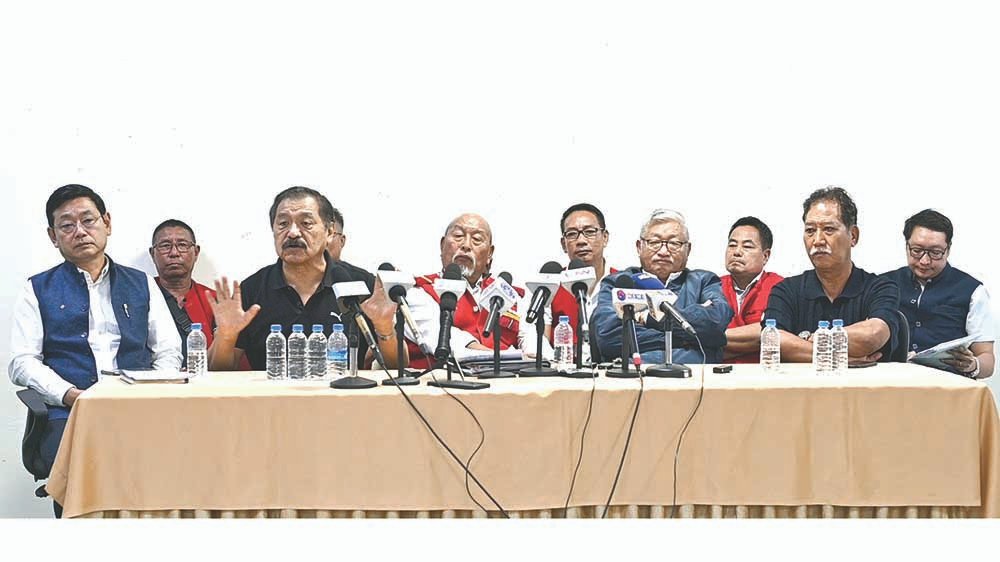
Nagaland Common platform on Naga solution to be held Nov 18
Staff ReporterDIMAPUR, NOV 13 (NPN)