
The first-ever Regional Conference of Heads of Anti-Narcotics Task Forces (ANTF) of the eight North Eastern states, along with West Bengal, commenced on Thursday at Rhododendron Hall, Police Complex, Chümoukedima.
The two days conference is being organised by Narcotics Control Bureau (NCB), with the aim to strengthen inter-state coordination and operational strategies to combat growing menace of drug trafficking in the North East.
Delivering the keynote address, Nagaland DGP Rupin Sharma said the North East has become pivotal in India’s fight against drugs due to its proximity to the Golden Triangle—Myanmar, Laos, and Thailand, one of the world’s largest drug-producing regions. Highlighting the vulnerability of India’s 1,643-km porous border with Myanmar, he said drug trafficking has evolved from a law-and-order issue into a threat to national security and public health.
Sharma revealed that Nagaland alone has about 1.2 lakh drug users consuming nearly 10,000 kg of narcotics annually, while the figure across the North East could exceed one lakh kg per year. He warned that the region has become a major drug pipeline for India, noting that enforcement agencies intercept barely 5,000 kg annually“ a classic story of failure.” The economic cost, he estimated, could reach `2.5 lakh crore near border areas and several times more in mainland India.
Proposing a three-pronged framework, Coordination, Enforcement, and Accountability, the DGP called for real-time intelligence sharing, joint interrogations within 24 hours of major arrests, and 100% case data upload to the NIDAAN portal. He also urged use of modern tools such as darknet monitoring, cryptocurrency tracking, and digital forensics.
On enforcement, he emphasized shifting focus from low-level couriers to financial facilitators and kingpins through inter-agency coordination, use of drones and satellite mapping, and financial investigations. He proposed 24/7 bank access for law enforcement to freeze mule accounts and trace money flows in real time.
Under accountability, Sharma flagged weak prosecution as a major gap, urging better documentation and a shared database of offenders, couriers, financers, and vehicles.
“Our efforts are fruitless if the legal process fails,” he said. He also stressed capacity building and modernizing forensic labs in every state.
His policy proposals included amendments to the NDPS Act, graded sentencing, plea bargaining, witness protection, a dedicated North East Anti-Drug Trafficking Agency, upgraded forensic infrastructure, and a ‘Nasha Mukt Bharat’ Reward Helpline for public reporting.
He further called for stronger community engagement with churches, NGOs, and civil society for rehabilitation, while balancing privacy and national security. Sharma concluded by highlighting the region’s key challenges, narco-insurgency nexus, socio-economic vulnerabilities, institutional gaps, and limited health and legal infrastructure.
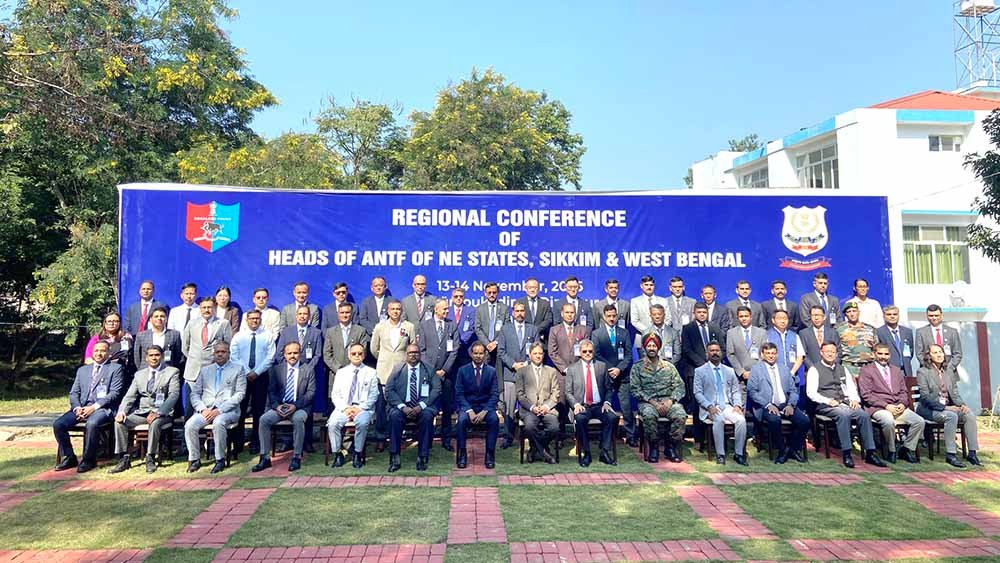
Nagaland Conference of ANTF for NE States begins
Staff ReporterDIMAPUR, NOV 13 (NPN)