
As part of the party’s 45-day nationwide campaign—MGNREGA Bachao Sangram—against the repeal of the UPA-era rural employment law, the Dimapur District Congress Committee (DDCC) on Saturday held a press conference at Congress Bhavan here demanding the withdrawal of the VB-G RAM G Act and restoration of MGNREGA.
Speaking at the press conference, DDCC president Kutuho Chishi said alleged that the VB-G RAM G Act would fundamentally dilute the MGNREGA and weaken the constitutional right to work of rural households.
He said MGNREGA had been a lifeline for millions of rural families across the country by guaranteeing 100 days of wage employment in a financial year to every household whose adult members were willing to undertake unskilled manual work.
Chishi stated that the scheme had not only provided income security but also empowered rural workers, reduced poverty levels, strengthened rural infrastructure, and reinforced grassroots democracy.
Further, he expressed concern that the VB-GRAM-G Act threatened to dismantle the core principles of MGNREGA by centralising decision-making, diluting statutory guarantees, and altering implementation mechanisms in a manner that could exclude the most vulnerable sections of society. He also alleged that the changes would convert a rights-based employment guarantee into a discretionary welfare scheme controlled by the Centre.
Highlighting the objectives of the 45-day campaign, Chishi said it sought to expose the adverse impact of the new Act on rural employment and income security, mobilise public opinion, and sensitise media about the importance of preserving MGNREGA in its original form to maintain socio-economic stability.
He also added that the party would continue to advocate for withdrawal of VB-GRAM-G Act and the restoration of MGNREGA’s original provisions to ensure uninterrupted employment opportunities for rural workers.
DDCC president urged the Centre to reconsider the implications of the new Act and engage in meaningful dialogue with stakeholders, including state governments, Panchayati Raj institutions, civil society organisations, and workers’ representatives.
He also called upon the people to participate in the planned programmes to safeguard the dignity of labour and protect the right to livelihood.
Providing details of the agitation, Chishi informed that the protest, to be carried out through peaceful and non-violent means, had commenced on January 8 and would continue for 45 days in various forms, which would include panchayat-level outreach programmes, ward-level sit-ins on Martyrs’ Day, and district-level dharnas from January 31 to February 6, as per directives to be issued by the Nagaland Pradesh Congress Committee (NPCC) in coordination with the All India Congress Committee (AICC).
DDCC general secretary, Kumgjimong alleged that while BJP projected the new Act as beneficial on paper, it contained many loopholes that would weaken the legal right to work guaranteed under MGNREGA.
He claimed that under the new framework, excessive control would vest with the Centre, leaving states and local bodies with limited authority in decision-making.
Kumgjimong expressed concern that the focus of the new framework appeared to be on asset creation rather than employment generation.
On removal of Mahatma Gandhi’s name from the scheme, Kumgjimong questioned why the BJP was “so opposed to retaining the name of the Father of the Nation”.
He further criticised the introduction of the acronym “RAM” in the proposed scheme, alleging that it was deliberately designed to appeal to a particular section of a religious society rather than to uphold the inclusive spirit of MGNREGA.
DDCC media secretary Andrew Humtsoe also elaborated on the modes of protest and informed that the agitation would begin at the district level and gradually extend to panchayat and ward levels to ensure widespread public participation.
Briefing on what he described as the Modi government’s “four attacks on the right to work”, Humtsoe stated that the proposed changes would attack on one’s right to work, right to fair wages, on panchayati Raj, and on state finances. (See Picture for full details).
Humtsoe also read out the Congress party’s demands, which included “Right to work, wages, and accountability”, “immediate restoration of MGNREGA”, “reinstatement of the constitutional right to work”, and “implementation of an all-India minimum wage of Rs 400”.
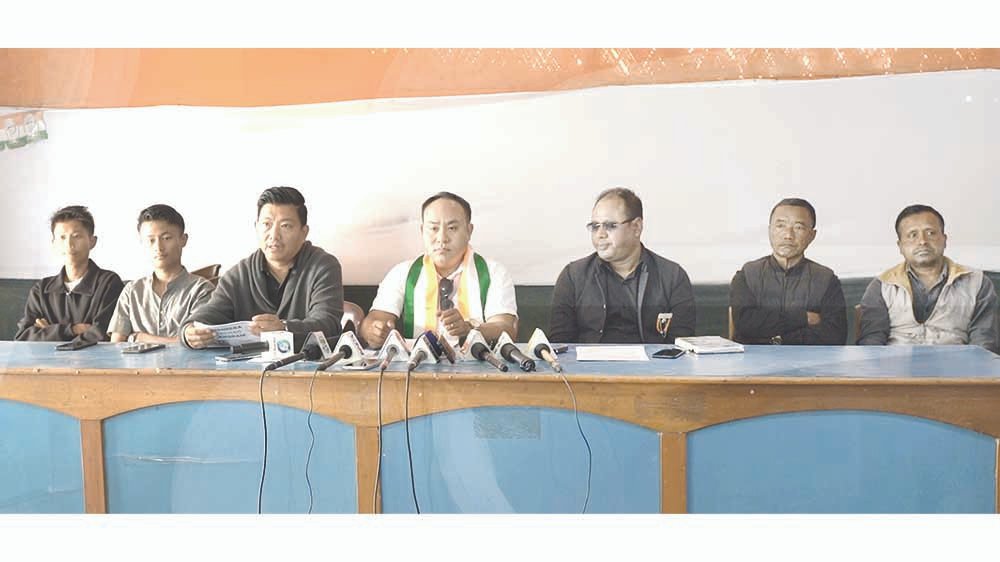
Nagaland: Cong questions intent behind VB-G RAM G Act
Staff ReporterDIMAPUR, JAN 10 (NPN)