
Supreme Court advocate Vrinda Grover warned of the alarming rise in digital abuse against women and girls and called the violence as a global and urgent concern.
She said this while addressing the International Day for the Elimination of Violence Against Women programme, at Town Hall here Tuesday, organised by the Nagaland State Commission for Women (NSCW) with the district administration and DHEW, Mission Shakti, under the theme “UNITE to End Digital Violence Against All Women and Girls.” The event also witnessed the launch of the global “16 Days of Activism Against Gender-Based Violence” campaign.
The Supreme Court Advocate urged society to confront the roots of gender-based violence and strive to move India beyond its current “Orange” rating on global gender-safety indicators. She stressed that true development must be measured not by GDP alone but by equality and constitutional freedoms for all, irrespective of gender, orientation, ethnicity or caste.
Recalling the 2012 Nirbhaya case, Grover noted it spurred the Justice Verma Committee and landmark 2013 legal reforms that recognised digital offences such as stalking, voyeurism and trafficking. She warned that technological advances have created new avenues of abuse, with perpetrators exploiting digital platforms—an issue the UN defines as Technology-Facilitated Violence Against Women and Girls.
Highlighted alarming trends in digital abuse against women and girls by citing global and national data, Grover said 73% of women journalists face online violence, while girls aged 14 to 16 often encounter cyber-harassment for the first time.
She also said NCRB statistics reveal sharp increases in cyberstalking, bullying, blackmail and pornography-related crimes. Grover expressed concern over the misuse of Non-Consensual Intimate Imagery (NCII), warning that deepfake technology has made manipulation easier and particularly dangerous for young people.
She pointed to the “Sulli Deals” (2020) and “Bulli Bai” (2022) cases, where more than 100 Muslim women, including students and journalists, were targeted through fabricated online auctions. Many perpetrators, she noted, were aged between 18 and 26. Grover also shared case studies of victims blackmailed, harassed and intimidated through morphed images, stressing that digital violence increasingly intersects with offline abuse, intensifying its impact.
Addressing challenges in tackling cybercrime, she highlighted jurisdictional hurdles and stressed the importance of Zero FIR, enabling victims to file complaints at any police station. She urged survivors to use the National Cyber Crime Reporting Portal and preserve devices and digital evidence such as screenshots, call logs and videos for forensic use. Grover outlined key laws addressing digital and gender-based violence, including POCSO, the Sexual Harassment Act, Bharatiya Nyaya Sanhita and IT Act provisions. She noted that possession of child pornography is punishable under POCSO, reaffirmed by a Supreme Court ruling.
Grover said technology evolves faster than law but India has strong legal tools. She stressed prevention requires tackling inequality and urged women and families to report abuse promptly and seek NSCW support.
Deputy Commissioner Dimapur, Dr. Tinojongshi Chang launched the UNITE campaign on November 25, calling the day a reminder of a global crisis and a moral call to action. He stressed that violence against women-whether at home, workplaces, public spaces or online-remains a grave human rights violation, with fear shaping many women’s daily lives.
Despite stronger laws, he noted, one in three women worldwide still face physical or sexual violence. Urging collective responsibility, he appealed for safe spaces, survivor support, education and community engagement, affirming that progress depends on women’s safety and empowerment.
NSCW chairperson W. Nginyeih Konyak, in her inaugural address, reaffirmed the Commission’s resolve to end violence against women and girls. Highlighting digital threats such as cyberstalking, deepfakes and misogynistic networks, she urged collective action. Marking the Beijing Declaration’s 30th anniversary, the campaign calls for survivor support, stronger enforcement and public engagement under the slogan “#NoExcuse for online abuse.”
DC Dimapur also launched the poster campaign, handing it to Dimapur District Auto Drivers Union president Tito Yepthomi for dissemination. The programme was chaired by DHEW District Mission Coordinator L. Lanusangla Jamir, and invocation was offered by Ikali Wokhami. The 16 Days of Activism campaign will conclude on December 10, 2025.
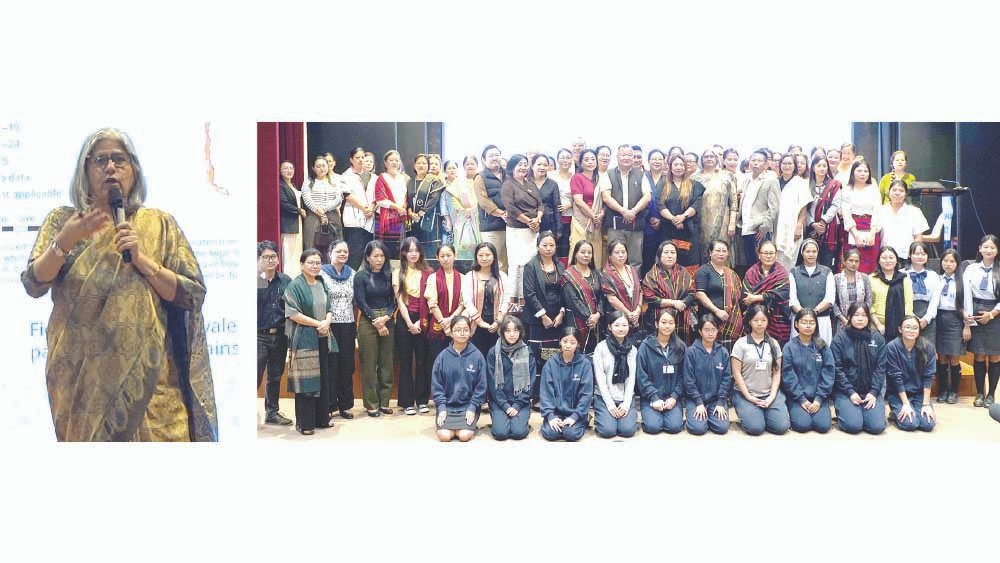
Nagaland Digital violence now a majorthreat to women, girls: Grover
Staff ReporterDIMAPUR, NOV 25 (NPN)