
The second day of the White Owl Literature Festival and Book Fair, organized by White Owl in collaboration with Penguin Random House India (PRHI), opened with a thought-provoking session on “Fake News and the Age of Misinformation” at Zone by the Park, Chumoukedima.
The discussion was moderated by Sangeeta Barooah Pisharoty, president of the Press Club of India, with panelists Snigdha Poonam, creative non-fiction writer from Oxfordshire, and Karma Paljor, journalist and co-founder of East Mojo.
Pisharoty noted that fake news extends far beyond journalism, infiltrating phones, social media, and digital platforms, shaping everyday life.
Panelist Paljor recalled his first encounter with misinformation during coverage of the Sikkim earthquake, when footage aired by a national channel turned out to be from Colombia. He warned that misinformation today is “factory-produced,” citing fake websites mimicking national newspapers, AI-generated videos, and violent clips circulated during the Manipur conflict.
He criticized some mainstream television channels for acting as “disinformation factories” during national security events, eroding credibility and public trust. His advice to audiences: avoid sensational debates, distrust shouting anchors, and reject content targeting communities.
Paljor linked economic distress—unemployment, inflation, and insecurity—to rising fraud, describing scams as a global industry built on human psychology. He condemned victim-blaming, which silences those affected and allows fraud to thrive. He also raised concerns about data leaks, questioning why personal information remains widely accessible despite corporate assurances of privacy.
Calling it a “massive failure of the news media,” he said scams have flourished because large sections of the press have abandoned their duty to inform and educate.
While panellist Snigdha Poonam expanded the discussion, stressing that misinformation erodes trust across society. She recounted receiving a fake lottery message during COVID, endorsed with images of public figures, noting that even informed individuals can fall prey.
She explained how scam networks impersonate banks, the RBI, tax authorities, and government agencies, constantly evolving with digital adoption. Referring to Jamtara, she described how online fraud has a physical base, with young people trained in scamming through scripts and psychological manipulation.
Poonam emphasized that scams exploit social “cracks” such as caste hierarchies, gender inequality, and political discrimination. Unless these structural issues are addressed, she warned, scams will continue to adapt and survive.
The panel urged individuals to slow down, verify identities, and avoid responding to urgent messages. Young participants were encouraged to educate family members, especially parents, who are often more vulnerable.
The session closed with a reminder that journalism, as a pillar of democracy, must continue to question power and protect citizens in an era of growing misinformation.
The last session on “Social Media and the Creator Economy” was moderated by PRHI Executive Editor and Festival Programming Head, Deepti Talwar. Panelists included actor, content creator and writer, Merenla Imsong; social entrepreneur and Dimasa cultural practitioner, Avantika Haflongbar; Deputy Commissioner Bishupur and curator of the Loktak Literary & Arts Festival, Pooja Elangbem; and Reddit’s APAC Lead for Community Marketing, Vaishnavi Singh.
Merenla Imsong shared that she began making videos without any clear goal or follower targets, using social media as a creative outlet. She cautioned against blindly following algorithm-driven trends and emphasised the importance of personal boundaries, selective sharing, and resisting pressure to conform to viral formats or exaggerated brand endorsements.
Avantika Haflongbar recounted her accidental start on social media through documenting her late mother’s clothing and regional foods. She warned that algorithm-driven posting can cause burnout, income from platforms is unstable, and creators from the Northeast are often paid less than their mainland counterparts. She advised young people not to enter content creation with unrealistic expectations of financial sustainability.
Pooja Elangbem explained how her journey of sharing books online organically grew into a book-focused community amplifying voices from the Northeast. She cautioned that online harassment, particularly of women, can be overwhelming and noted that public assumptions about creators’ lives often add pressure. Vaishnavi Singh highlighted Reddit’s contribution-based model, where credibility and influence are earned through participation rather than follower counts. She said community feedback through upvotes and downvotes determines visibility, encouraging authentic engagement.
Singh observed a broader shift across platforms toward passion-driven content, with creators increasingly embracing unfiltered and unapologetic self-expression. She added that credibility comes from engaging honestly with feedback rather than managing perception, stressing that a community differs from an audience as it involves multiple opinions and conversations.
The discussion concluded with a shared view that while social media offers visibility and community-building opportunities, it remains economically uncertain. Panelists stressed the need for conscious content creation, realistic expectations, and prioritising integrity and sustainability over virality.
They emphasised that creators should focus on authenticity and passion rather than chasing trends or algorithms, noting that originality and sincerity help build loyal communities.
Other sessions of the day included “Reading: Inculcating the Habit,” moderated by PRHI Associate Commissioning Editor, Simran Kaur, with panelists Riri G. Trivedi, co-founder of Wellness Space and the Society for Energy and Emotions (SEE); Thejavino Krose, administrator of Stella Higher Secondary School; and author, columnist and historian, Probal Dasgupta.
A session on “Folklore & Oral Storytelling” was moderated by PRHI Senior Commissioning Editor, Archana Nathan, with panelists Senganglu Thaimoi, Assistant Professor of English at Miranda House, University of Delhi; independent researcher and editor from Nagaland, Vizovono Elizabeth; and Margaret L. Pachuau, Professor of English and Cultural Studies at Mizoram University.
The festival also featured a lively discussion on “Comics, Illustration and Visual Storytelling,” moderated by author Bijal Vachharajani, with panelists including Canato Jimo, art director and designer for children’s books at Pratham Books; animator and illustrator Rajiv Eipe; children’s book writer and comics creator Priya Kuriyan; visual artist Ogin Nayam; and illustrator-author Pankaj Saikia.
The final session on “Business, Books & Legacy” was moderated by Ben Kithan, director of Kairos Global Retail Pvt. Ltd. and Tikvah Healthcare Pvt. Ltd., with panelists Dr. Srinath Sridharan, strategic advisor; Gaurav Rampal, leading bloodstock professional; and Lezo Putsure, founder and CEO of Educentre.
The discussion explored how business leadership intersects with literature and legacy, stressing the importance of vision, mentorship, and knowledge-sharing in shaping future generations.
The second day of the literature festival also included workshops and children sessions. The festival will conclude on February 7.
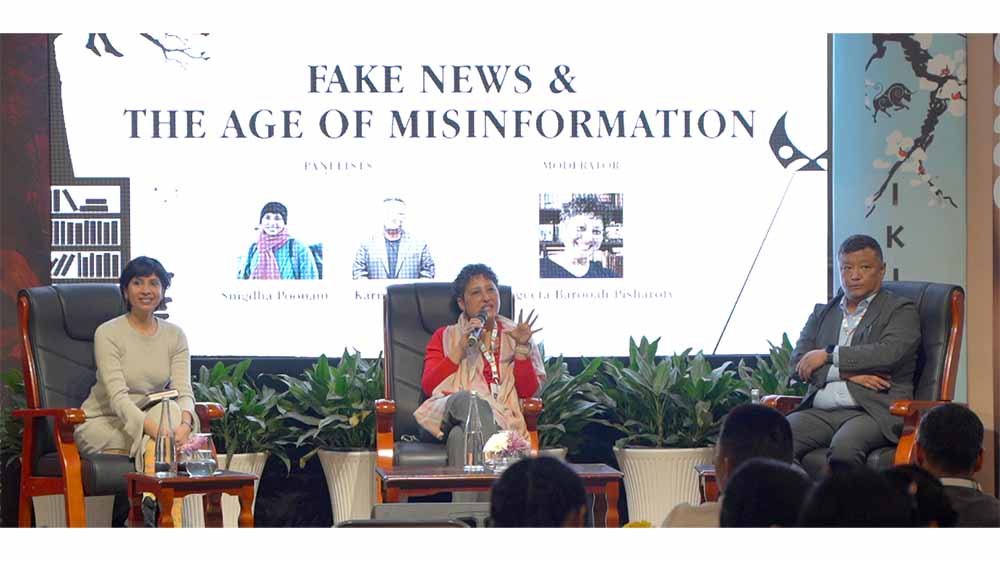
Nagaland: Fake news and scams take center stage at White Owl Festival
Staff ReporterDIMAPUR, FEB 6 (NPN)