
The 52nd biennial general conference of the All Sumi Students’ Union (SKK) was held from January 28–30, 2026 at Satoi Town, Zunheboto district, under the theme “Revitalizing Traditional Values.” The three-day event witnessed participation of prominent leaders who underscored the importance of education, unity, and reforms for the progress of the Sumi community and Nagas at large.
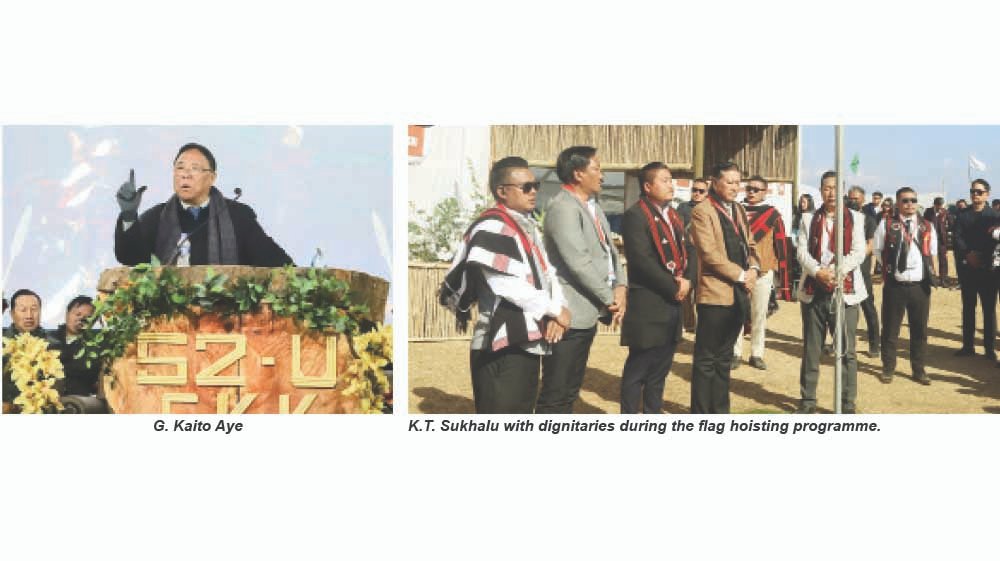
Minister for Roads & Bridges, G. Kaito Aye, addressing the opening session, welcomed delegates and described Satoi as a place of peace, reflection and rich cultural heritage.
He urged students to appreciate its beauty and carry back renewed inspiration and unity.
Speaking on education, the minister noted that while Nagaland has a high literacy rate, quality education remains a pressing need. He pointed out that the practice of proxy teachers is a major issue affecting learning and integrity, and urged students and the community to work sincerely towards strengthening the education system. He emphasized that true progress must involve collective development of the entire community.
On the upgradation of Khelhoshe Polytechnic, Atoizu, Kaito acknowledged the concerns of the Sumi student community and informed that the government is keenly pursuing its conversion into a degree college, as highlighted in the 77th Republic Day speech.
Highlighting infrastructure, the minister said Zunheboto district has about 1,594 km of roads, and despite difficult terrain and logistical challenges, the government is making sustained efforts to improve and maintain them. He appealed for patience and cooperation, stressing that lasting development requires mutual understanding and collective responsibility.
Kaito also urged students to serve as peacemakers among Naga tribes, promote harmony, and use technology responsibly. He cautioned against misuse of technology that could derail careers and encouraged constructive use for community progress.
Calling on youth to initiate meaningful electoral reforms, he questioned the practice of compromising democratic rights for short-term gains and challenged students to bring positive changes in politics for long-term societal progress. He concluded by urging disciplined lives and determination to become responsible, successful and visionary leaders.
On January 29, the second day’s inaugural session was graced by advisor for Food & Civil Supplies, K.T. Sukhalu, as chief guest. Sukhalu unveiled the monolith, hoisted the SKK flag and led the honoring of the SKK anthem. Recalling his tenure as SKK president (1977–79), he expressed delight at returning to Satoi and extended gratitude to minister G. Kaito Aye for hosting the historic event.
Addressing unemployment and competition in Naga society, Sukhalu urged students to draw inspiration from pioneers like Avito Kiba, who contributed immensely to advancing academics among the Sumi tribe.
He suggested SKK formally acknowledge Kiba’s role in the educational progress of the community. “Tomorrow, the future is yours—so commit to building the Sumi community,” he told the student body, while stressing that quality education, not possessions, secures the future.
Sukhalu further emphasized the need to preserve Sumi culture and identity, promote handicrafts for sustainable livelihoods, and instill discipline among youth. He also appealed to the NSF to recognize Kavito Kiba as the best teacher for pioneering schools in the Sumi region.
Delivering greetings, SKK president Dr. Vihuto Asümi congratulated the Organizing Committee and officials for successfully hosting the event. He described SKK as an intellectual platform that has produced prominent leaders, citing Sukhalu as an example of how former SKK leaders continue to uplift the Sumi and Naga communities.
Highlighting educational challenges, Dr. Asümi noted that while other communities advanced academically, many Sumi individuals were sidelined due to involvement in the Naga national movement, leaving the tribe underrepresented in bureaucracy. He urged students to embrace education and compete sincerely in today’s highly competitive era, pointing to recent police recruitment drives where many aspirants were graduates and postgraduates.
He stressed that conferences must yield tangible outcomes, advised limiting expenditures on event management, and commended the theme “Revitalizing Traditional Values” as timely for reflection and action.
Naga Students’ Federation (NSF) president, Mteisuding Heraang, also addressed the gathering, recalling the historic SKK protest at Satoi against AFSPA enforcement, where innocent lives were lost. He said the protest helped safeguard Naga identity and political aspirations.
Mteisuding praised the Sumi community as “one of the strongest backbones and a true pillar for both the Naga people and the NSF.” He urged students to gain knowledge that contributes to the Naga cause and called for unity under the NSF as the apex student body.
He lamented divisions among Naga political groups, stressing that true strength lies in unity beyond tribal and regional lines. Warning of growing influx into the state, he described it as a grave challenge and urged proactive steps to protect land and identity for future generations.
The NSF continues to advocate for Naga unity, identity preservation and political resolution amid ongoing challenges, Mteisuding said.
Nagaland: Kaito, Sukhalu stress education, reforms at SKK conference
DIMAPUR