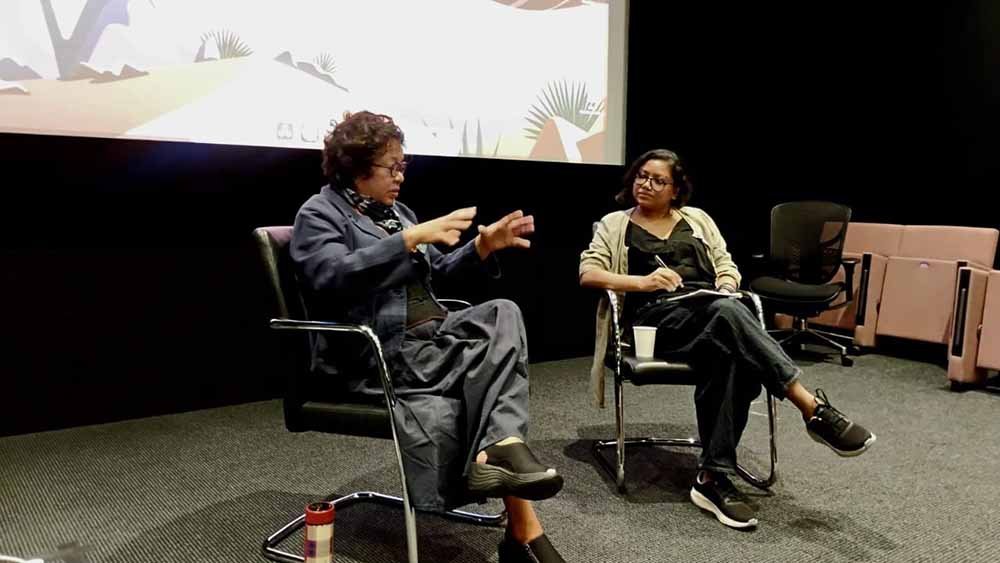
Noted filmmaker from Nagaland, Kivini Shohe, recently participated in Indigenous Cinema: South Asian Perspectives, a three-day international gathering held from December 8–10, 2025, at New York University Abu Dhabi (NYUAD). The event brought together filmmakers, scholars and artists to examine Indigenous cinematic traditions across South Asia.
Organised by the Rights and Representation Research Forum in collaboration with the NYUAD Film and New Media Programme and the Indigenous Film and Media Alliance South Asia, the programme featured curated screenings from Northeast India, including short films, documentaries and feature films. The screenings were followed by discussions on identity, land, memory, resistance and Indigenous representation.
As part of the programme, Shohe delivered an artist talk and screened her documentary Under the Longfuru Sky, which offers an intimate portrayal of a remote community negotiating the tensions between ancestral traditions and modernity.
Early in the film, archaeologists are seen working beneath a massive rock shelter, explaining that human habitation in the area dates back to the Neolithic age. This deep historical context frames the film’s exploration of an annual ritual that renews community ties along the India–Myanmar border. Against this long arc of human presence, the documentary observes how the community adapts to technological change while sustaining identity and continuity through shared traditions. Commenting on the film, Jose George, Visiting Associate Professor of Anthropology, noted that the work situates contemporary community life within an expansive civilizational timescale, highlighting how meaning and belonging are continually rediscovered through collective practices.
In her address, Shohe reflected on her personal journey as a filmmaker, the challenges of working in Nagaland, and her commitment to observational filmmaking. She said that for Indigenous communities like hers, cinema has become a vital means of archiving cultural memory and traditions that are increasingly under threat.