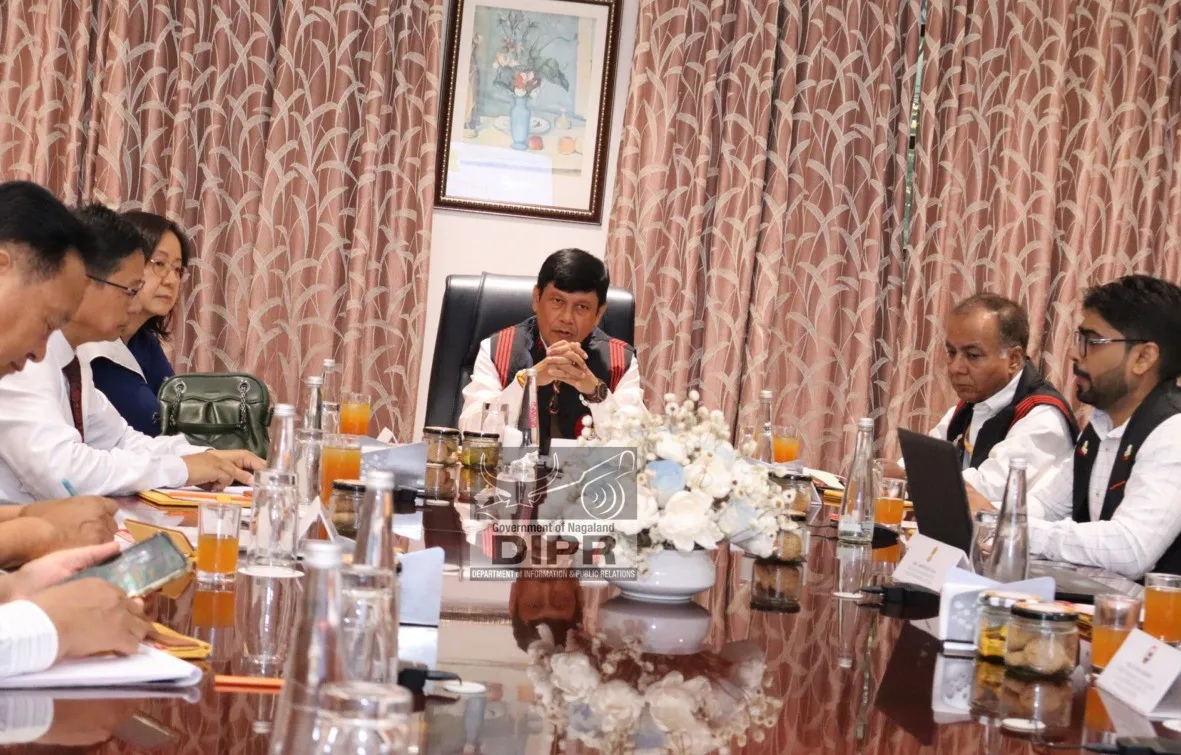
DIMAPUR: A review meeting on the implementation of the Special Assistance to States for Capital Investment (SASCI) 2026 27 under Livestock Sector Reforms was held at Zone Niathu, Chümoukedima, on July 11, 2026.
According to DIPR report, the programme was organised by the Animal Husbandry Statistics Division, Department of Animal Husbandry and Dairying, Ministry of Fisheries, Animal Husbandry and Dairying, Government of India, in collaboration with the Department of Animal Husbandry and Veterinary Services, Nagaland.
Delivering the welcome address, Dr. Kuokehebi Gwirie, director, Animal Husbandry & Veterinary Services Nagaland, extended gratitude to officials from the Ministry for visiting the State and providing continued guidance and technical support. He recalled that the department, established in 1964, had for decades carried out its responsibilities despite limited financial resources. He described SASCI as a well designed, performance based initiative with defined parameters and timelines that would bring greater transparency and accountability in implementation. Expressing confidence, he said the review meeting would provide officers with clarity on their roles and enable them to work more effectively for the welfare of the people.
In his inaugural address, Jagat Hazarika, adviser (STATS/NDLM/SASCI), DAHD, explained that the purpose of the visit was to review SASCI implementation in Nagaland and understand challenges faced by the State. He informed that recognising the growing contribution of the livestock sector to the national economy, the Department of Expenditure, Ministry of Finance had allocated Rs. 3,000 crore under SASCI 2026 27 for all States. He stated that States had been grouped into four categories based on the size of their livestock sector, with Nagaland placed under Category D. The scheme, he said, provides performance based incentives to States that meet prescribed qualifying and performance criteria. Assistance is linked to capital investment, including long term loans and eligible capital expenditure. He encouraged participants to openly discuss State specific issues so that practical solutions could be worked out.
Speaking on behalf of the State, Angelina Tajen, sSecretary, Animal Husbandry & Veterinary Services, reiterated that the livestock sector remained an important pillar of Nagaland’s economy. She reaffirmed the department’s commitment to ensuring that interventions under SASCI and the National Digital Livestock Mission (NDLM) translated into meaningful benefits for livestock farmers. Tajen described SASCI as a significant initiative of the Government of India that provides incentive based financial support to States for livestock sector reforms. To strengthen implementation, she informed that 10 Joint Directors had been assigned to oversee all 17 districts, ensuring closer monitoring, better coordination and greater community participation.
Acknowledging challenges, Tajen pointed to difficult terrain, poor connectivity, adverse weather conditions, OTP based portal updates, livestock insurance issues and constraints in the dairy sector. She said the biggest challenge was completing the programme within the stipulated timeline and stressed the need for officers to work together in mission mode on a war footing. Despite these constraints, she appreciated the dedication and professionalism of departmental officers and field functionaries.
She also urged the Ministry to expand support for the piggery sector, noting that pig farming was deeply embedded in Nagaland’s culture and economy.
She advocated promotion of indigenous pig breeds such as Nagal and Tenyivo, and requested enhanced support for biosecurity, restocking and compensation under the African Swine Fever Control Programme (ASCAD), given the recurring impact of ASF in the State. Tajen said the review meeting provided an opportunity to assess strategies, identify bottlenecks, strengthen coordination and develop practical solutions. Expressing confidence, she reaffirmed the department’s commitment to building a stronger and more resilient livestock sector in partnership with the Government of India.
The programme also featured technical presentations on SASCI and NDLM by Sunil Kumar, Senior Statistical Officer (AHS Division), DAHD, and Dr. Chubasangla, Joint Director & State Nodal Officer (NDLM). A presentation on Smart Livestock Farming Project, Vision 2047 was delivered by Dr. H. Inato Jimomi, Joint Director, AH&VS.
The meeting concluded with a vote of thanks proposed by R.P.S. Rathore, Additional Statistical Adviser, DAHD. Following the deliberations, visiting officials inspected two dairy farms at Ura Village and Ward 10, Chümoukedima, to gain firsthand understanding of ground realities.