
Staff Reporter
DIMAPUR, JUN 16 (NPN): In line with the approval of the Nagaland Agarwood (Conservation and Promotion) Policy, 2026, Nagaland government aims to turn agarwood cultivation into a key driver of rural economic growth, job creation, and forest conservation.
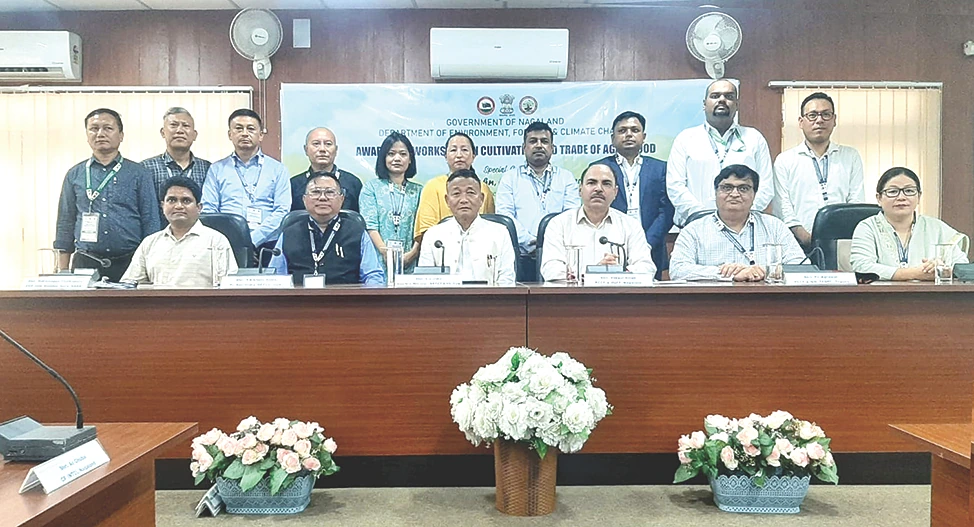
The vision was outlined during an awareness workshop on agarwood cultivation and trade organised by the Environment, Forest and Climate Change (EF&CC) department at Forest Office Complex here on Tuesday.
Addressing the gathering, EF&CC and Village Guards minister C.L. John said Nagaland possesses immense untapped potential in the agarwood sector due to its favourable climate, fertile soil and naturally occurring agarwood resources.
Describing agarwood as a high-value aromatic tree species used in perfumes, medicines and incense, John said international demand for agarwood chips and oil continues to grow, particularly in West Asia. He noted that naturally infected agarwood is found across several foothill and warmer regions, including Tzurang Valley, Japukong, Tuli, Oting, Upper and Lower Tiru, Tizit, Athibung and Beisumpui.
Citing a 2024 Botanical Survey of India report, he said Nagaland has around 22.8 lakh agarwood trees over two years old, underscoring the state’s strong resource base. The policy, approved by the cabinet on June 6, aims to promote cultivation on private and community lands, generate employment, strengthen the rural economy and conserve endangered species in its natural habitat.
John said a cluster-based development proposal would also be submitted to the Ministry of Development of North Eastern Region (DoNER) to accelerate growth of the sector.
He pointed out that while neighbouring Assam and Tripura have made significant progress in agarwood cultivation, Nagaland had lagged behind due to the absence of a dedicated policy framework.
The minister also urged the Centre to revise Nagaland’s export quota under the Directorate General of Foreign Trade (DGFT). He said the state currently receives an annual quota of 3,400 kg of agarwood chips and 180 kg of agarwood oil, accounting for only about 2.5 per cent of the national allocation.
The principal secretary, EF&CC, and development commissioner Y Kikheto Sema said Nagaland was entering a new phase where economic development and livelihood generation must become key priorities. He described agarwood as a high-value crop capable of transforming rural livelihoods while supporting environmental conservation.
Kikheto said much of Nagaland’s agarwood has traditionally been traded through Assam because of limited institutional support and the absence of a policy framework. He also informed that the state government was finalising an agreement with the Rain Forest Research Institute (RFRI), Jorhat, to facilitate transfer of artificial inoculation technology, which reportedly has a success rate of over 90 per cent.
Highlighting the crop’s economic potential, Sema said government assessments indicate that returns from agarwood cultivation could be more than 5,000 times higher than those from traditional jhum cultivation.
The inaugural session was followed by technical discussions on agarwood cultivation and commercialisation. Principal chief conservator of forests, Tripura, PL Agrawal, led a session on cultivation practices, including registration procedures, harvesting, artificial inoculation and processing techniques.
Representatives from the Ministry of Environment, Forest and Climate Change and DGFT delivered presentations on Certificates of Origin and regulatory compliance related to agarwood trade.
The programme concluded with a panel discussion on promoting agarwood cultivation and trade, featuring experts and representatives from MDoNER, the North Eastern Council, the North Eastern Regional Agricultural Marketing Corporation and the Rain Forest Research Institute.