
Nagaland has recorded an employment rate of 83.92% and an unemployment rate of 16.07%, according to the Survey Report on “Employment, Unemployment, Skill and Migration in Nagaland 2025” released by the Directorate of Economics & Statistics (E&S).
Despite the state’s high literacy rate, the unemployment figure remains significantly high, raising concerns over the gap between education and employability. The report highlights the need for targeted interventions in skilling, vocational training, and job creation to address the growing challenge.
The report was released on Friday by Advisor for Information Technology & Communication, Economics & Statistics, and Evaluation, H. Sethrongkyu Sangtam. Presenting the key findings, Director of E&S, Neidilhou Keditsu, noted that 59% of unemployed respondents cited unspecified “others” as the reason for joblessness, while none attributed it to shutdown of production units or lack of financial need—possibly reflecting the absence of industrial infrastructure and a culture of dependency.
The report mentioned that 65% of employed respondents had no written job contracts, and 15% were unaware of their social security entitlements, indicating gaps in formal employment practices. The survey employed multinomial logistic regression analysis to identify determinants of employment. Findings suggested that individuals with moderate education levels were more likely to be employed than those with no education, while employment odds declined at higher education levels. Casual employment was more prevalent among lower-income households, and individuals with formal vocational training had 46.2% higher chances of securing salaried jobs compared to those without such training.
Keditsu stated that the survey aimed to assess human resource utilization in the state, evaluate employment determinants through regression analysis, and study migration patterns. A total of 4,395 households were surveyed—1,315 urban and 3,080 rural.
The Labour Force Participation Rate (LFPR) was estimated at 56%, with 24% of respondents self-employed, 13% salaried, and 9% engaged in casual wage labour. Despite high literacy, unemployment remains a concern. Most unemployed respondents (59%) cited unspecified reasons, while none attributed it to shutdown of production units or lack of financial need—possibly due to limited industrial presence and dependency culture. Notably, 65% of employed individuals lacked written job contracts and 15% were unaware of their social security entitlements.
Regression analysis revealed that individuals with moderate education were more likely to be employed than those with no education, while higher education did not necessarily improve employment odds. Those with formal vocational training had 46.2% higher chances of salaried employment.
The survey also highlighted that 92% of respondents lacked technical or vocational training, with IT emerging as the most common skill area. Only 24% were registered with the Employment Exchange.
The average monthly household expenditure stood at Rs.16,522, with a minimum of Rs. 1,133 and a maximum of Rs. 3,61,647, indicating wide income disparity. District-wise highlights included: highest LFPR in Wokha (75%) and lowest in Tuensang (41%); highest employment rate in Mon (91.08%) and lowest in Phek (75%); highest unemployment in Phek (25%) and lowest in Mon (8.92%); highest self-employment in Zunheboto (40%) and lowest in Dimapur and Tuensang (14% each); highest household expenditure in Dimapur (Rs. 22,716) and lowest in Longleng (Rs. 13,849); and highest lack of vocational training in Kiphire (98%) and lowest in Mokokchung (78%).
On migration, 55% of respondents moved from rural to urban areas, 25% rural-to-rural, 17% urban-to-urban, and only 3% urban-to-rural. Reasons included unspecified factors (35%), public sector employment (27%), business (13%), marriage (13%), private sector employment (7%), and education (5%). At origin, 80% earned Rs. 10,000 or less, while in new settlements, 33% earned between Rs. 10,000 and Rs.20,000.
Keditsu expressed hope that the report would aid both state and district-level policy formulation to address unemployment and strengthen human resource development.
Earlier, Sethrongkyu Sangtam expressed hope that the report would serve as a vital tool for the State Government in framing effective policies to address unemployment. He stated that Nagaland is progressing towards the vision of “Viksit Nagaland” and emphasized that balanced regional development depends on quality district-level data.
He commended the Department’s leadership under Secretary Akunu S Meyase and Director Neidilhou Keditsu for identifying and addressing data gaps, particularly at the sub-state level.
He highlighted the establishment of the Nagaland Sample Survey Unit in 2024 as a timely initiative to strengthen the statistical system and support evidence-based policymaking.
Sangtam underscored the importance of district-wise disaggregated data in identifying challenges and leveraging opportunities unique to each district. He acknowledged the release of key reports such as the District Domestic Product (2023) and District Consumer Price Index (2025), which are already contributing to policy formulation.
He noted that the Department annually publishes several important reports including the Nagaland Statistical Handbook, Price Indices, National Sample Survey, Village Level Development Indicators, Gross State Domestic Product, Per Capita Income, Disaster Statistics, Gender Statistics, Civil Registration System, Nagaland Economic Survey, and Indices of Industrial Production.
These publications, he said, are widely used by scholars, researchers, and NGOs. Congratulating the Department on the successful compilation of the current survey—the first under the Nagaland Sample Survey Unit—Sangtam commended the officers for their growing technical capability in conducting large-scale sampling surveys on critical socio-economic issues.
He described unemployment as a global, national, and state-level concern with significant socio-political implications. Citing the Nagaland Statistical Handbook 2024, he informed that 71,034 applicants were registered with employment exchanges in the state as of March 31, 2025. He reiterated the government’s seriousness in addressing the issue, noting its deliberation in the recent session of the 14th Nagaland Legislative Assembly and mention in the Chief Minister’s address.
Sangtam emphasized the need to harness the state’s demographic dividend through skilling and capacity development, particularly among youth. He said assessing the current scenario of employment, unemployment, and skill development is essential for effective human resource policy and economic progress. He also stressed the importance of considering migration trends while analyzing labour issues.
Calling the report a comprehensive and much-needed publication, Sangtam said it would serve as a critical basis for framing labour policies and addressing district-specific challenges. He expressed confidence that the report would enrich public discourse and guide both official and public opinion. He urged Department officials to continue demonstrating diligence, innovation, and excellence in their duties, and to enhance technical capacity for timely delivery of quality data. He reiterated that accurate data is essential for good governance and development, and called upon all staff to uphold ethical standards in their work.
Secretary, Economics & Statistics, Akunu S Meyase, also delivered a brief address. The programme was chaired by Additional Director Neisatuo Puro, while the vote of thanks was pronounced by Additional Director Charles N. Kikon.
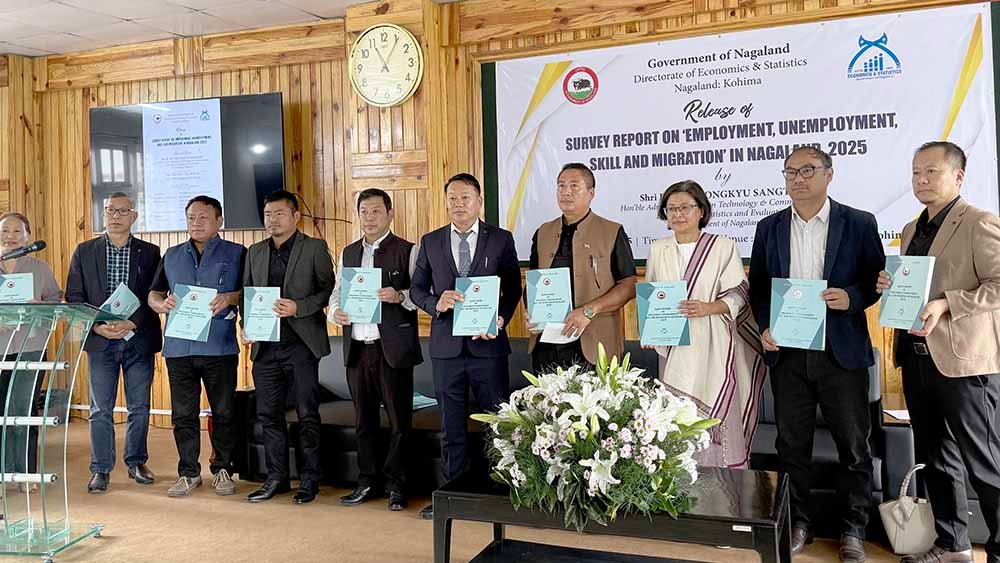
Nagaland records 16.07% unemployment despite high literacy
CorrespondentKOHIMA, Sep 19 (NPN)