
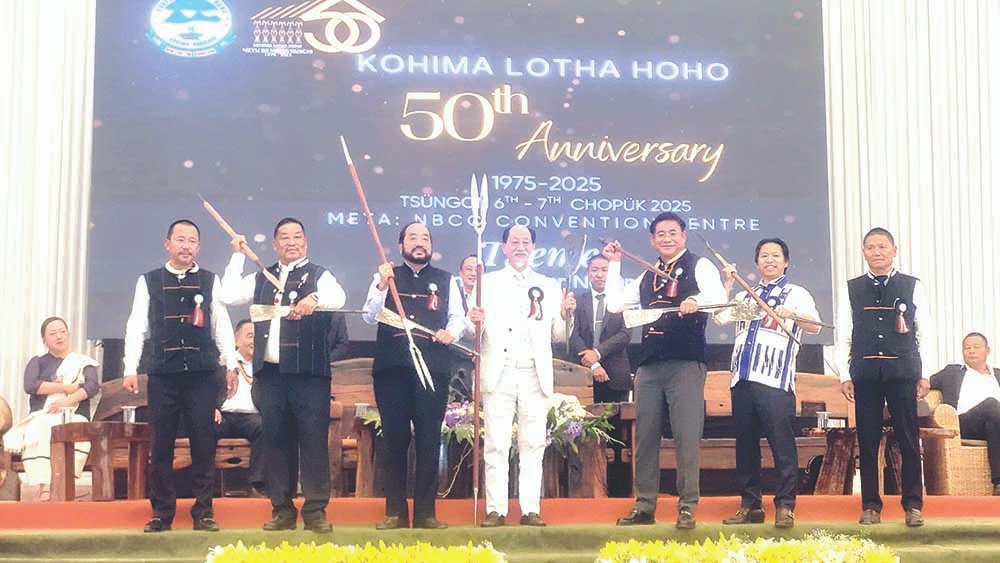
Nagaland chief minister Neiphiu Rio on Friday called for greater unity among Naga tribes and urged communities to channel their time and resources towards peace, cooperation and development as the Kohima Lotha Hoho (KLH) celebrated its golden jubilee under the theme “Future-Ready Reasoning”. The celebration, which coincided with Tokhü Emong, the premier festival of the Lotha community, witnessed participation from Lothas across districts, tribal leaders and well-wishers from various communities.
Addressing the programme as chief guest, Rio described the jubilee as “a pleasure and a privilege” to attend, noting that the occasion symbolised “oneness, gratitude and continuity” among the Lotha community in the state capital. He commended the KLH for reaching its 50-year milestone and lauded the organisers for bringing the community together in a meaningful celebration.
Rio reminded that the Kohima Lotha Hoho was established in 1975 and stressed the importance of honouring the pioneers and elders who worked to create a collective home for Lothas in Kohima. He highlighted that Lothas have had a presence in the capital since the early 1930s, mentioning Lilamo Patton as one of the earliest settlers, whose son, retired IAS officer M. Patton, played a significant role in Kohima’s social and administrative development. The chief minister said these early figures laid strong foundations for the community’s growth in the capital.
He also remembered several prominent Lotha personalities, including former Speaker T.N. Ngullie, retired chief secretary and first Lotha IAS officer T.C.K. Lotha, and community leader Renbo Ezung. Their vision, Rio said, helped strengthen the identity of the Lotha people while also fostering deeper bonds with other Naga tribes.
“They built a home away from home, maintaining the guardianship of culture and tradition while linking their village roots with township life,” he said, paying tribute to the elders for their foresight and service.
Emphasising inter-tribal harmony, Rio pointed to the longstanding friendship between the Lotha and Angami communities, strengthened by mutual respect, kinship, intermarriage and shared understanding. He said such relationships should serve as a model for all Naga tribes, adding that unity was the key to a strong future. “When the forest stands together, no storm can break it,” he remarked, underlining that Naga unity must remain the ultimate goal for a resilient collective destiny.
Speaking on Wokha district, Rio described it as “a land of plenty”, blessed with fertile land, rich forests and resilient people. He noted that Wokha continues to lead in per-capita income according to human development indices, crediting the district’s prosperity to its hardworking and innovative residents.
Referring to the recent Banana Festival held from October 22 to 24, he congratulated the farmers, officials and community leaders for showcasing the district’s agricultural potential and for promoting value addition through local resources.
Rio further highlighted the global significance of Wokha’s Doyang Valley, internationally recognised for the roosting of Amur Falcons. The valley, he said, had placed Nagaland on the map for ecotourism and wildlife research, adding that such unique features should be preserved and promoted responsibly.
Commending achievements of the Lotha community, Rio said the Lothas had produced some of the highest numbers of merit-based officers and government servants in the state. Their commitment to education, public service and cultural preservation, he added, continued to stand as an example. He highlighted Lotha cultural expressions—including songs, dances, shawls and motifs—as important markers of identity. Referring to Oying Motsü, a publication by Abeni T.C.K. documenting Lotha attire and ornaments, he lauded efforts to preserve traditional knowledge and encouraged other tribes to undertake similar documentation, including pursuing GI tagging for cultural items.
Rio also noted the growing popularity of Lotha cuisine, whose unique flavours and combinations have drawn interest across Nagaland and beyond. He said that over 4,000 Lotha households now reside in Kohima, forming a strong, cohesive and culturally rooted community contributing significantly to the city’s social and civic life.
Expressing hope for lasting peace and progress, Rio called upon the people to rise above trivial divisions and focus on constructive development. “We spend most of our time fighting over small issues, but we must now spend our resources and time for the good of our state,” he said. During the programme, the chief minister also launched the book “The Divine in the Ordinary” by Sentienla P. Ezung.
Delivering the guest of honour’s address, deputy chief minister Yanthungo Patton extended greetings on behalf of the Lotha community and reaffirmed their full support to the chief minister’s leadership. He praised Rio’s long tenure as the longest-serving chief minister in the Northeast and the country, commending his dedication to the welfare of the Naga people. Patton encouraged the youth to uphold unity, forgiveness and hard work, stressing that the state’s progress depended on solidarity among its tribes.
Earlier, KLH chairman K.N. Mhonthung Lotha, in his welcome address, reflected on the Hoho’s 50-year journey and its role in nurturing cultural identity and community welfare. Greetings were shared by Lotha Hoho Okying, Lotha Officers’ Association and Kohima Lotha Eloe Ekhung.
Invocation was pronounced by Mhonchumo S. Lotha of Kohima Lotha Baptist Church. Benediction was said by Rev. Fr. Mhabemo Humtsoe, special prayer by Rev. Dr. K. Benry, and the jubilee prayer by Khonbemo Ngullie.
The celebration concluded with cultural presentations showcasing traditional Lotha songs and dances, followed by a vote of thanks from Jonas Yanthan. The event was co-hosted by advisor Mhathung Yanthan, MLA, Y. Mhonbemo Humtsoe, MLA and Achumbemo Kikon, MLA.
Nagaland Rio stresses unity as key to Naga future
CorrespondentKOHIMA, NOV 7 (NPN)