
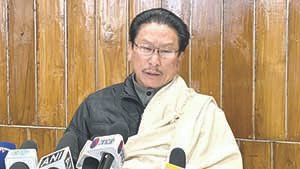
Parliamentary Affairs & Power minister and government spokesperson KG Kenye on Wednesday said the State cabinet, which met at Rhododendron, Chümoukedima on Tuesday morning, took stock of several issues, including the ENPO demand for Frontier Nagaland Territorial Authority (FNTA), exploration of natural resources, Free Movement Regime (FMR), Protected Area Permit (PAP), and regulation of the state’s land-holding system.
Addressing media at Hotel Japfü here on Thursday, Kenye said the meeting was held early in the morning and the press could not be informed in advance, and that while many issues were discussed, only some were of immediate public importance.
FNTA announcement likely today: On Eastern Nagaland People’s Organisation (ENPO issue, Kenye said a delegation was already in New Delhi and discussions with the Government of India were scheduled for February 4. He said the state government was hopeful that an announcement could be made on February 5 on the long-pending demand for creation of Frontier Nagaland Territorial Authority. He added that the issue, pursued for over a decade, should be resolved in line with the wishes of the people.
PAC subcommittee: To effectively pursue political matters, the Cabinet decided to constitute a subcommittee under the Political Affairs Committee (PAC). Kenye said the PAC was a large body and it was not always feasible for all members to travel together. The subcommittee would be convened by the chief minister and include the two deputy chief ministers, the two Members of Parliament, and a few other members to assist the Cabinet. He said members able to travel had already left for New Delhi.
FMR and PAP: Kenye said the subcommittee would also take up issues related to the Free Movement Regime and the re-imposition of the Protected Area Permit. He said the subcommittee would persuade the Centre to review the PAP, as it was affecting the state in several ways.
Oil and natural gas exploration: Kenye said oil and natural gas exploration had become contentious after being taken to court, but the government was relieved when the court agreed to hear the matter, though the final verdict had not been pronounced for other reasons. He said the Cabinet decided that, based on rights guaranteed under the Constitution, particularly Article 371A, the state would proceed with efforts to explore and exploit its natural resources. He asserted that Article 371A provided that land and its resources belonged to the people of Nagaland.
He said unlike other states, where petroleum and natural gas were treated as central subjects, in Nagaland all natural resources on, above and below the surface belonged to the people and private landowners, and the elected state government, with consent of landowners, was empowered to act in the best interest of the people. He said the dispute arose when the Centre applied central laws uniformly without segregating Nagaland’s special constitutional status, leading to the matter being taken to court, which he said should not have happened. With withdrawal of the case by the concerned organisation, he said the matter had effectively become infructuous and the constitutional position remained clear even without a court verdict. He clarified that proceeding with oil and gas exploration would not go against the Centre’s interests or any standing order and reiterated that Article 371A remained the guiding constitutional provision.
Land-holding regulation: On land-holding and land regulation, Kenye said the Cabinet examined proposals from the Land Revenue Department, including issues arising from implementation of the SARFAESI Act and various office memorandums issued over the years. He admitted the government had not been firm or decisive earlier on regulating the land-holding system.
Taking into account the Inner Line Permit system, the Bengal Eastern Frontier Regulation, and the Register of Indigenous Inhabitants of Nagaland (RIIN), he said the government felt the need to arrive at concrete, long-term decisions.
Accordingly, the Cabinet decided that non-cadastral areas and government-occupied lands, which had not been issued individual pattas so far, would now require proper registration. Organisations and individuals occupying such lands would be required to obtain pattas and pay land revenue, similar to private landowners. He said detailed notifications and directives would be issued soon.
Kenye said important matters deliberated by the subcommittee would always be placed before the full PAC, and that several ministers and MLAs were already in New Delhi in connection with the ENPO and FNTA issue.
On the Naga political issue, he said the PAC was co-terminus with the tenure of the Assembly and was reconstituted with every new House, which was why its composition changed periodically.
Regarding the forthcoming Assembly session, Kenye said the Business Advisory Committee was yet to meet and may convene on February 18 or 19, after which details of the session could be shared.