
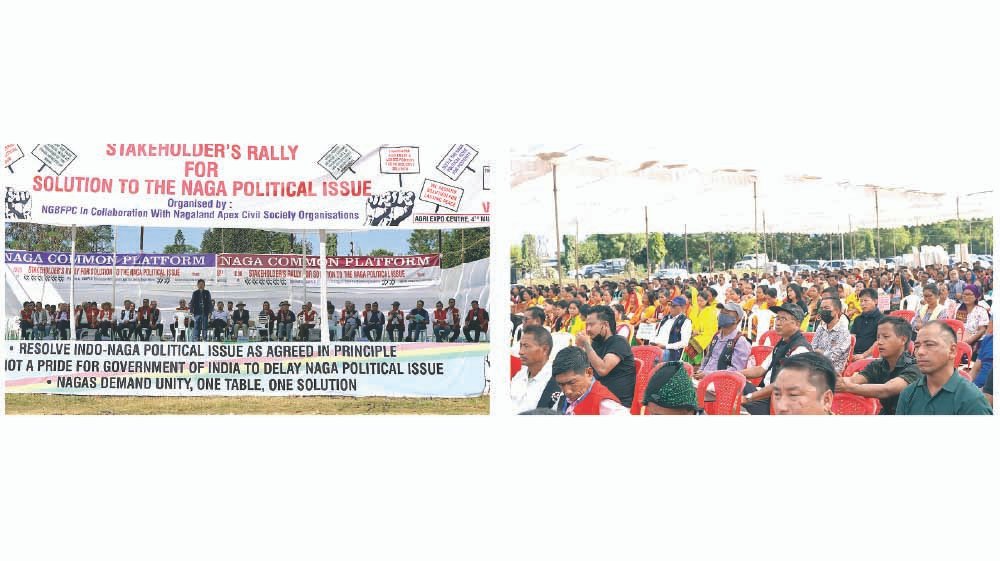
In a major show of public sentiment and defying calls for boycott from various CSOs, thousands from various Naga communities- including Gorkhas, Marwaris, Kacharis, Kukis and other communities- gathered at the Agri Expo ground, Chümoukedima on Tuesday under the banner of the Naga Common Platform (NCP), to demand an early and honourable settlement of the Indo-Naga political issue and to urge upon the government of India to resolve the issue “as agreed in principle.”
The rally was organised by the Nagaland GB Federation (NGBF) Peace Committee in collaboration with various apex Naga civil society organisations.
Around 3000 people attended the rally, with many carrying placards some of which read- “We demand execution plan to bring the talk to a logical conclusion”; “Resolve the Naga political issue based on the Framework Agreement & Agreed Position,” and “Stop ignoring Naga political issue” etc. There was also partial closure of shops in and around Dimapur in response to the appeal from DDCF.
NCP organising committee member and chairman at the rally, Theja Therieh, clarified that the NCP was not formed to counter any organisation. He said the platform was simply an occasion for Nagas from all walks of life to express their views. “People will come forward, share their minds and make clear whether we want an early solution or prolonged negotiations. This is the only reason we called the Nagas- to express their opinion loud and clear,” he stated.
Delivering the introductory note, NCP organising committee member, Khekiye Sema, accused armed groups of “destroying our lives through national tax,” questioning how long citizens could continue paying multiple taxes to various factions.
“They say it is for sovereignty, but how many factions have come out? Are they all seeking sovereignty?” he asked, warning that the public may one day be forced to say “enough is enough.”
Sema clarified that the platform was not a parallel movement but a space for all citizens regardless of differing views.
“We haven’t challenged anyone. It is for our children and their children. The only intention is to bring an early resolution,” he said. Calling the crowd “a people of conscience,” he reminded that even tribal hohos had earlier declared their desire for a settlement.
“For the sake of our children, we have to make our voices heard,” he said, accusing apex hohos of being “under the payroll of elected legislators and ministers” and alleging that recent directives issued by tribal hohos were made “at the behest of the chief minister.” He said the gathering sought to convey the people’s desire directly to the State government.
He asserted that the Centre had already ruled out both integration and sovereignty. On the long-standing role of GBs, he said they had been the “punching bags” of the Naga movement. “The NPGs have guns. People are living in fear,” he said.
Sema pointed out that the Naga movement had splintered into “20–30 factions,” questioning, “What kind of sovereignty, how many kinds of sovereignty are they looking for?” He said rampant taxation had become the only visible outcome of factionalism, adding that many leaders lived in luxury while citizens paid taxes out of fear. He warned that a time would come when these groups would be answerable to the people.
On NSCN (I-M), he said the group insisted it would not accept a solution without a flag and constitution.
He questioned the secrecy around its negotiations, asking why the people-the real stakeholders- were being kept in the dark. “It is time the NSCN (I-M) talks to our people honestly. You cannot decide our future in secret,” he said.
Sema said it was contradictory for NSCN (I-M) to claim sovereignty yet demanding flag and constitution from the Centre. Reiterating long-standing public aspirations, he said people wanted peace, development and a clear political settlement so that their children could move forward. He criticised both the State government and tribal bodies for failing to take a decisive stand. “When the time comes to voice out, he (CM) controls the apex hohos. Is this the solution he wants?” he asked.
He also questioned the role of tribal hohos, lamenting that many had “no authority” and were “destroying the feelings of the people.” On the ongoing solution stalemate, he said NSCN (IM) knew its demands (flag and constitution) could not be granted and urged the group to consult the people. He reaffirmed that “no sovereignty, no integration” had already been made clear by the Centre and said only democratic integration and autonomous arrangements were possible.
NGBF advisor, Vikuto Zhimomi, said the call for the rally arose out of genuine concern for the Naga future and urged participants not to waste the opportunity. “If the process fails, who will shoulder the responsibility?” he asked. He said the event was the second major public effort to push the State and Central governments toward a settlement.
Former ex-parliamentarian forum vice-president and NGBF advisor, C. John, said the Naga struggle had become the “longest freedom movement in the world” but had been weakened by leadership struggles that led to the rise of 31 factions. He questioned why Nagas should “sell the cause short” after 25 years of ceasefire and the signing of the Framework Agreement, and urged people to “open our eyes and go ahead for our Naga people.”
Former ENPO vice-president, Yonglong Konyak, said the Framework Agreement already existed and that the Centre had asked Naga groups to unite. “It is time to identify the real obstacles and correct our course instead of blaming one another,” he said.
Eastern GB Association president, Chuba Konyak, reiterated the principle of “unity first, solution second” and said ENPO’s absence should not be misinterpreted. He said ENPO’s demand for Frontier Nagaland Territory (FNT) was separate and not a hindrance to the political process. “Talking big will not clear the solution,” he said, emphasising coordination and clarity.
Committee member, Z. Lohe, said those present had come at their own expense, despite some attempts to prevent the gathering. He lamented persistent disunity, trust deficit and prolonged negotiations under the ceasefire. Using an analogy, he said Nagas kept studying for a solution “but are not appearing for the examination.” He said peace would come only when a final settlement was reached, and warned that some opposed the settlement for fear of losing financial gains.
Lohe cited the Centre’s efforts against the Naxalite-Maoist insurgency, warning that if the Naga issue remained unresolved, the Centre could take a different approach. He said if Nagas failed to secure an early settlement, there would be “no political status, no agreement” left to claim dignity. He urged Naga national leaders to introspect, saying cadres had become stubborn while ordinary citizens suffered.
Short speeches were also delivered by Chubatangit Jamir, who criticised the lack of collective direction despite high education levels and urged peaceful civil mobilisation; former NTC president Thepfulhouvi Solo, who made it clear that the rally was not an illegal gathering but a democratic one; and Naga Hoho president Sulanthung Lotha, who called for trust and cooperation among all sections.
Earlier, the welcome address was delivered by Shikuto Zhalipu, chairman of the NCP organising committee, and invocation prayer was offered by Rev. P. Nribemo Ezung, pastor, AG Church, 5th Mile.
Later, the resolution was read out by Theja Therie, member of the mediation committee.
Naga Common Platform adopts 3-point resolution
- The Naga Common Platform (NCP) held at Agri Expo, Chümoukedima, on November 18, 2025 unanimously resolved to support the landmark agreements signed between the Government of India, NSCN (I-M) and the Working Committee, NNPGs.
- The NCP unambiguously resolved to urge the Government of India to deliver a political solution based on the Framework Agreement (FA) and the Agreed Position (AP) for lasting peace in the Naga areas.
- A century of political struggle and 28 years of political negotiation is a huge burden on peace-loving people, and therefore, we strongly urge the Naga negotiators and Government of India to listen to the cry of stakeholders and collectively bring the talks to their logical conclusion with a comprehensive agreement.
The resolution was signed by organising committee members- Shikuto Zalipu (convener), secretaries– Akhu Naga and Zanbenthung Ezung, Zhovehu Lohe, Khekiye K. Sema, Dr. Khekugha Muru, Khondao Ngullie, Theja Therieh, Sulanthung Lotha, Khehovi V. Chopi, Vikato Achumi, Kholie Kapfo, Hokuto Zhimomi, Richard Kuki, Y. Kikon, Nungsang Jamir and John Konyak