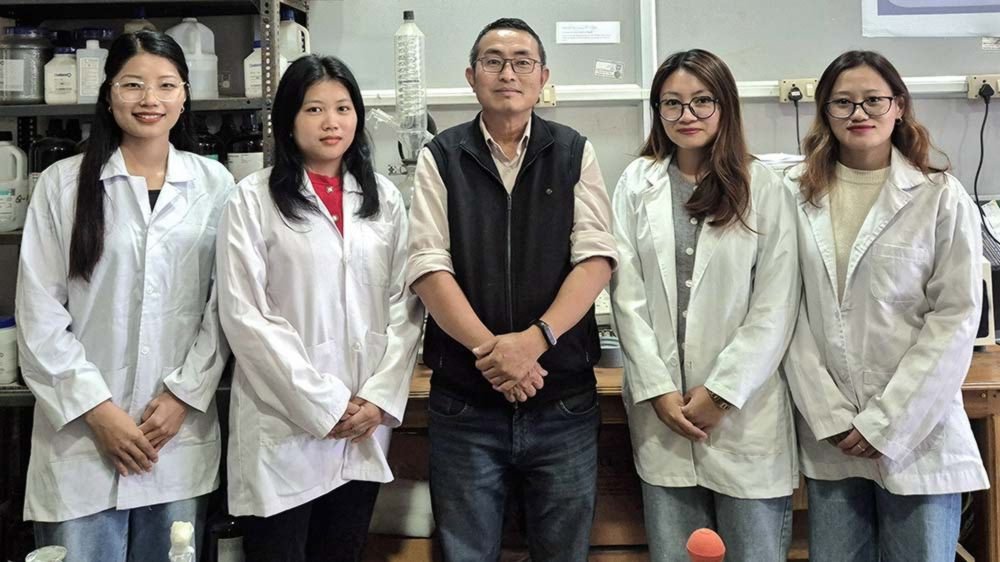
Researchers from Nagaland University and Fazl Ali College, Mokokchung, have transformed one of the State’s most problematic invasive weeds, Mikania micrantha, into highly efficient silver nanoparticles with significant applications in pharmaceuticals, medicine, and green industry.
Using an eco-friendly “green chemistry” approach, the team developed a method to produce stable silver nanoparticles from the plant’s leaf extracts without using toxic chemicals. These nanoparticles can act as ultra-fast catalysts, enabling the production of key pharmaceutical compounds called ‘Imidazoles’ — essential building blocks for a wide range of medicines — in just 30 to 180 seconds.
The research, supported by the Anusandhan National Research Foundation (ANRF) and the National Fellowship for Scheduled Tribe Students (NFSTMOTA), was published in the peer-reviewed journal Biochemical and Biophysical Research Communications.
The paper was co-authored by Manthae C. Phom, Phitovili Sumi, Betokali K. Zhimomi, Khonzani Yanthan, Tonge W W, Shokip Tumtin, and Tovishe Phucho.
Commending the research team, NU vice chancellor Prof. Jagadish K. Patnaik said this innovative study highlights a fast, eco-friendly approach to drug synthesis while demonstrating significant antibacterial and anticancer potential. Prof. Patnaik said such research underscored the university’s commitment to scientific excellence and sustainable solutions to address global health challenges.
Dr. I. Tovishe Phucho, associate professor, Department of Chemistry, NU, highlighted the immense potential of locally available plants and called for greater funding to explore more such resources.
Key findings: The nanoparticles function as reusable catalysts and can be used at least six times with minimal loss of efficiency, making drug production faster, cleaner, and more cost-effective.
They exhibited strong antibacterial activity against dangerous pathogens including Staphylococcus aureus and Yersinia pestis.
Lab tests on human colon cancer cells showed the nanoparticles nearly doubled the cancer cell-killing potency compared to the plant extract alone.
The plant-derived nanoparticles are exceptionally stable even at high temperatures (up to 165°C), making them suitable for industrial applications.
By transforming the highly invasive Mikania micrantha into a valuable raw material, the study not only addresses an ecological challenge but also showcases how Nagaland’s rich biodiversity can contribute to global advancements in sustainable healthcare and green technology.