
Researchers from Nagaland University have completed a GIS-based hydrological study examining how geo-ecological conditions and human activities influence runoff and river flow in the North Eastern Himalayan hill region, an area marked by limited scientific data and ongoing debate.
The study addresses the hydrological impact of land use change on river discharge, floods and environmental degradation. It proposes a four-zone runoff classification—low, moderate, high and very high—to support water resource planning, flood mitigation and integrated watershed management.
Vice-Chancellor Prof. Jagadish K. Patnaik congratulated the research team, stating that the study provides benchmark data on land use change and river flow, strengthens understanding of runoff patterns and flood risks, and supports informed policy and planning for environmental security in fragile hill ecosystems.
Titled ‘GIS Modeling to investigate geo-ecological and anthropogenic impacts on runoff and river flow in the North Eastern hilly region of India’, the study was conducted by Dr. K. Belho and Prof. M. S. Rawat of Nagaland University, along with Dr. Pradeep Kumar Rawat of Asian International University, Imphal. It was funded through a Non-NET Fellowship of Nagaland University with support from the Ministry of Tribal Affairs. The findings were published in the International Journal of Geographic Information System Research and Development.
Prof. M. S. Rawat said the study focused on four experimentally monitored watersheds in Kohima district, combining geospatial techniques with field-based hydrological measurements. Continuous stream discharge data were generated across dense forests, open forests, agricultural and urban landscapes.
Dr. K. Belho noted that dense forests showed strong rainfall absorption and sustained sub-surface flows, while urban and modified landscapes produced high monsoon runoff and reduced lean-season flows, increasing flood risks and dry-season water scarcity.
Dr. Pradeep Kumar Rawat stressed the need for more instrumented catchments and long-term monitoring stations for reliable flood forecasting and sustainable development in the Himalayan region.
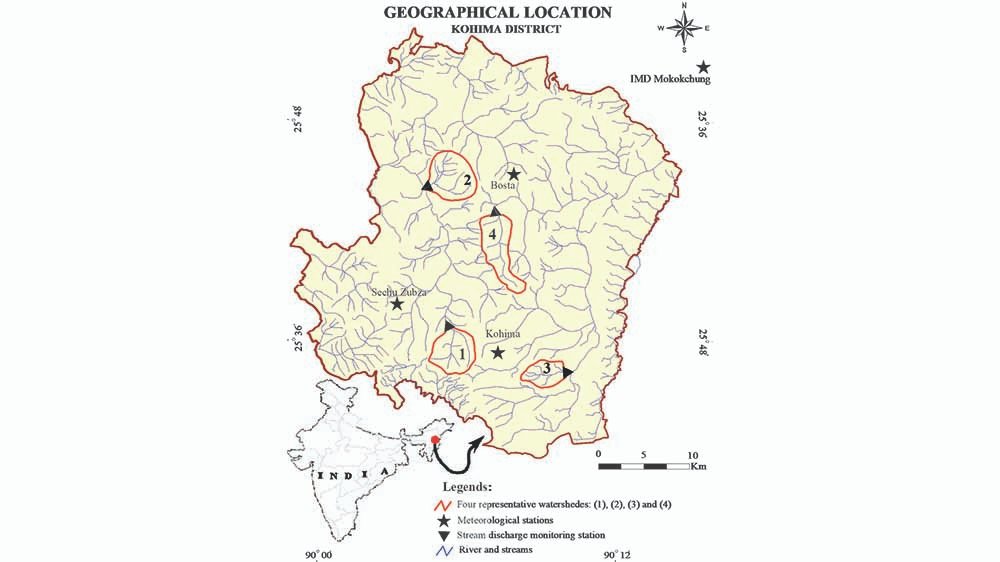
Nagaland University study provides benchmark data on land use change, river flow in NE Himalayas
DIMAPUR