
Correspondent
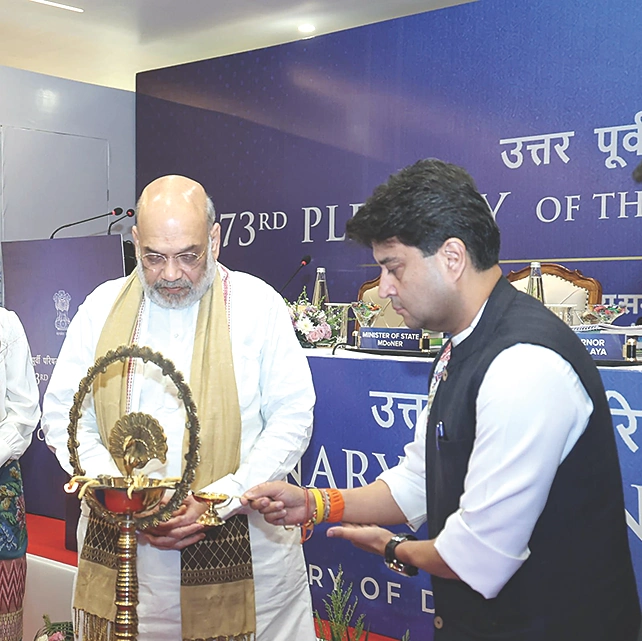
SHILLONG, JUN 4: Union Minister for Development of North Eastern Region (DoNER) Jyotiraditya M. Scindia on Thursday said the eight North Eastern states will form the central core of Viksit Bharat by 2047, following the roadmap laid out by Home Minister Amit Shah.
Talking to reporters after the 73rd plenary session of the North Eastern Council (NEC), Scindia said Shah had set the roadmap for the NEC and the eight states for the next 12 months.
Shah, who is also the chairman of the NEC, had chaired the plenary meeting in the presence of Governors and Chief Ministers of Assam, Arunachal Pradesh, Meghalaya, Mizoram, Manipur, Nagaland, and Tripura, and senior government officials. The Home Minister also reviewed the ongoing developmental projects and finalising development priorities for the North Eastern states for 2026-27.
Under the Prime Minister’s leadership, Scindia said the eight states are going from strength to strength. “They (North Eastern States) will become the Ashta Lakshmi of India as we advance towards Viksit Bharat 2027,” he said.
Crediting Prime Minister Narendra Modi for driving growth in the region, the Union Minister said, “The leaps of progress that the North East had undertaken under Prime Minister’s visionary vision has actually led to huge economic growth across the length and breadth of the North East.”
“By 2047 as the Bharat becomes a Viksit, the North East will become a very central core of that Viksit Bharat 2047,” he said
Mizoram CM pushes for NE economic corridor
Aizawl, Jun 4 (PTI): Mizoram Chief Minister Lalduhoma on Thursday called for a comprehensive one-grid approach to connectivity, stronger investment promotion and accelerated implementation of the Northeast Economic Corridor (NEEC) to develop the region, an official statement said.
Addressing the 73rd plenary session of the North Eastern Council (NEC), chaired by Union Home Minister Amit Shah in Shillong, Lalduhoma said the Prime Minister’s Act East Policy provides a strong and visionary framework for the development of the Northeast.
He said that the region, with its rich natural resources, vibrant human capital and unique cultural heritage, is strategically positioned to become a major driver of India’s future growth.
During the meeting, Lalduhoma submitted the final report of the High-Level Task Force on the Northeast Economic Corridor to the Union Home Minister and said the implementation of the proposed corridor would provide a unified framework for strengthening inter-state connectivity, tourism, investments, trade and logistics across the Northeast.
A key recommendation put forward by the Mizoram Chief Minister was the adoption of a comprehensive “One-Grid Approach” that would integrate roads, railways, air connectivity, waterways, power supply, telecommunications and logistics infrastructure into a coordinated development framework, according to the statement.
With the Kaladan Multi-Modal Transit Transport Project nearing completion, Lalduhoma stressed the need for institutional and social preparedness to fully capitalise on emerging economic opportunities, it said.
He urged the Ministry of Development of North Eastern Region (DoNER) to support programmes focused on investment readiness, trade facilitation, entrepreneurship development, skill enhancement, logistics infrastructure and community engagement.
The chief minister also advocated a cluster-based investment strategy, highlighting sectors such as bamboo, agri-horticulture value chains, food processing, textiles, eco-tourism, green energy and digital services as key drivers of inclusive growth.
He proposed that tourism should be developed through a common Northeast tourism circuit supported by unified branding and facilitation mechanisms.
The CM further observed that the Northeast could emerge as a major logistics and trade gateway under the Act East Policy, particularly through the India-Myanmar-Thailand Trilateral Highway.
Lalduhoma also stressed the need for effective implementation of the mandated 10 per cent Gross Budgetary Support earmarked for the Northeast and proposed the establishment of a dedicated coordination mechanism under DoNER or the NEC to improve monitoring and convergence of development programmes.
Emphasising the importance of youth empowerment, he called for increased investments in skill development, incubation centres, tourism and hospitality, logistics, agribusiness, green technology and start-up ecosystems.
To accelerate project execution, he suggested setting up DoNER Project Implementation Units (PIUs) in every Northeastern state.
The chief minister expressed gratitude for the recognition of Mizoram as the “Ginger Capital of India” and reiterated the importance of the Mizoram Ginger Unique Selling Proposition (USP) project.
He also highlighted the importance of successfully implementing the proposed Thenzawl Peace City, which, according to him, has the potential to emerge as a major centre for tourism, education, healthcare, sports and agro-based development.
The event was attended by DoNER Minister Jyotiraditya Scindia, Minister of State for DoNER Sukanta Majumdar, chief ministers and senior officials from all Northeastern states, the statement said.