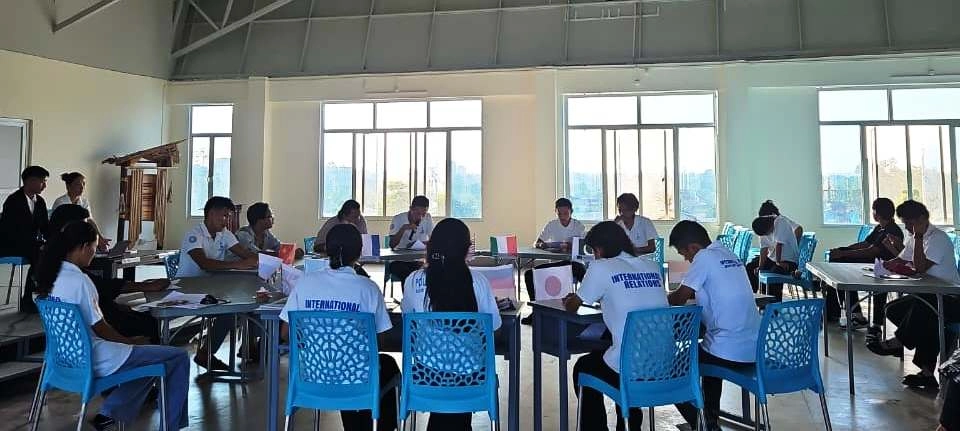
DIMAPUR: International Relations (IR) Programme, North East Christian University (NECU) organized “The Diplomatic Table”, a UN diplomatic debate simulation on the topic “India’s Bid for Permanent Membership of the United Nations Security Council: Representation, Power and Reform”, on October, 23, at Dr. Peter Armacost Hall, to commemorate United Nations Day 2026.
A press release by NECU informed that 14 students representing as delegates of 12 nations and 2 International Press Corps participated, with the debate focusing on three central questions, firstly, whether India’s population, economic growth, peacekeeping contributions, and global role justify permanent membership of the United Nations Security Council (UNSC)” secondly, whether the Security Council should reflect present-day global realities rather than the world of 1945, particularly regarding the underrepresentation of Africa and Latin America, and thirdly, whether new permanent members should receive veto power and whether the existing veto system requires reform.
During the discussion, delegates of India, the United States, the United Kingdom, France, Russia, Japan, Germany, Australia, and Brazil, supported India’s bid for permanent membership in UNSC taking into account India’s increasing relevance globally both politically and economically and its contribution towards UN peacekeeping force.
However, rejecting India’s bid and opinion of the other supporting countries, Pakistan and Italy opposed the creation of new permanent seat and alternatively suggested the expansion of elected membership. China further emphasized the need for Security Council reforms but it called for greater representation of the developing nations such as Africa and not to limit it to India’s individual aspiration.
Following the debate, the release informed that country delegates and members of International Press Corps participated in an informal discussion. The delegates exchanged views on India’s bid, discussed differences in national positions, and explored possible areas of agreement concerning representation, permanent and non-permanent membership, and veto power.
The International Press Corps raised question about Pakistan’s opposition to new permanent seats and its proposed alternatives, while China too was questioned about its position on India’s bid and the possible influence of bilateral tensions.
India was also asked how its permanent membership would strengthen representation of wider Global South. Brazil, Japan, Germany and India representing the Group of Four (G4) countries were also questioned about reconciling the different interests of its members and overcoming political obstacles to Security Council reform.
Despite all diplomatic debates, India and the G4 representatives reiterated their support for Security Council reform and broader representation of the UNSC, while other countries such as Pakistan, Italy and China reaffirmed their positions, leading to no decisive conclusion.
The release added that the discussion in general highlighted existing differences among countries regarding UNSC reforms, aspiration for regional representation, and the implication of veto power that was yielded by the Permanent Five (P5) countries of UNSC such as China, France, Russia, UK and the US.