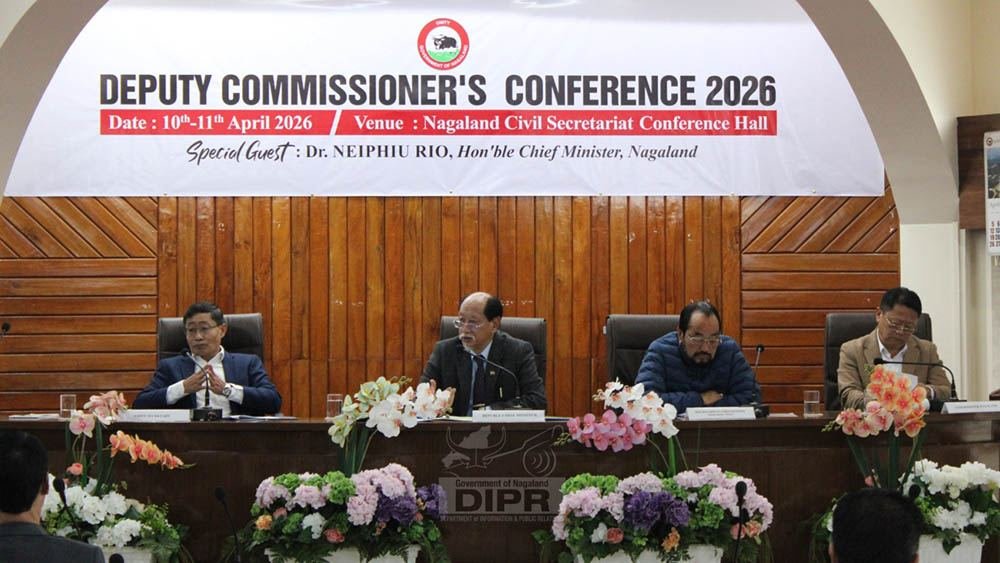
Nagaland chief minister Neiphiu Rio Friday highlighted the expanding responsibilities of Deputy Commissioners (DCs), urging them to balance traditional duties with new developmental roles. Speaking at the Deputy Commissioners Conference 2026 at the Civil Secretariat, Rio stressed accountability, transparency and accurate data as the foundation of effective governance.
He noted that while core responsibilities such as law and order, revenue administration, elections and census remain “non-negotiable,” DCs are now tasked with implementing Centrally Sponsored Schemes, disaster management, grievance redressal and inter-departmental coordination. Governance, he said, has become more citizen-centric, technology-driven and outcome-oriented, placing DCs at the frontline of service delivery.
Rio flagged fiscal challenges facing the state, citing the 16th Finance Commission’s recommendations that reduced Nagaland’s share of central taxes and excluded revenue deficit grants for 2026–31. Warning of rising deficits, he called for revenue augmentation and austerity measures.
On employment, Rio said the Nagaland Skill and Entrepreneurship Development Mission had evolved into a demand-driven system aligned with key sectors. He noted over 73,000 applicants registered in the Live Register and highlighted initiatives such as Nagaland Japan Connect 2026 linking youth to global opportunities.
In health, he expressed concern over low participation in government recruitment, pointing out that only 193 of 1,553 registered doctors applied during COVID-19 hiring.
He also cited reforms including the Nagaland Staff Selection Board for merit-based recruitment and the Chief Minister’s Micro Finance Initiative for inclusive growth.
Rio emphasised the role of tribal and village councils in governance, particularly in implementing the Register of Indigenous Inhabitants of Nagaland (RIIN). He directed DCs to ensure transparency in issuing Indigenous Inhabitant Certificates.
Looking ahead to Census 2027, India’s first fully digital exercise, Rio urged DCs to ensure accuracy, warning that flawed data could distort policy. He also touched on issues of Inner Line Permit, Bengal Eastern Frontier Regulation and the Frontier Nagaland Territorial Authority, calling DCs “drivers of transformation” with a focus on accountability and outcomes.
In his opening remarks, Nagaland chief secretary Sentiyanger Imchen said Deputy Commissioners’ (DCs) conferences, traditionally held under the Commissioner’s office to review district administration and law and order, were being broadened to address wider governance challenges.
Speaking at the opening of the two-day DCs Conference 2026, Imchen explained that the extended format was designed to deliberate on developmental issues alongside preparations for the upcoming Census.
He noted that DCs’ responsibilities had grown beyond law and order, elections and census, to include leadership in implementing Centrally Sponsored Schemes and state initiatives. DCs also chair key programmes such as the Chief Minister’s Micro Finance Initiative and the Nagaland Skill and Entrepreneurship Development Mission.
Imchen added that Additional Deputy Commissioners, serving as CEOs of Urban Local Bodies, were included to discuss urban concerns like solid waste management. He said the conference aimed to integrate field-level inputs into policy decisions and ensure smooth conduct of Census 2027.
Nagaland Commissioner Gregory Thejawelie delivered the vote of thanks at the inaugural session of the Deputy Commissioners Conference 2026, attended by deputy chief minister Yanthungo Patton, AHoDs, DCs, ADCs and senior officials.
The opening day featured briefings on critical subjects, including the National Green Tribunal case (OA 606/2018), Solid Waste Management Rules 2026 under the Swachh Bharat Mission, and amendments to Chapter IVA on Customary Courts under the Rules for Administration of Justice and Police in Nagaland (Fifth Amendment) Act, 2025. Afternoon sessions focused on skilling initiatives, the Chief Minister’s Micro Finance Initiative, and land acquisition issues under the RFCTLARR Act and the National Highways Act, 1956.
The second day will deliberate on RIIN, Inner Line Permit and border affairs, alongside a session on “Viksit Nagaland for Viksit Bharat 2047.” The conference will conclude with a State-Level Conference on Census of India 2027.