
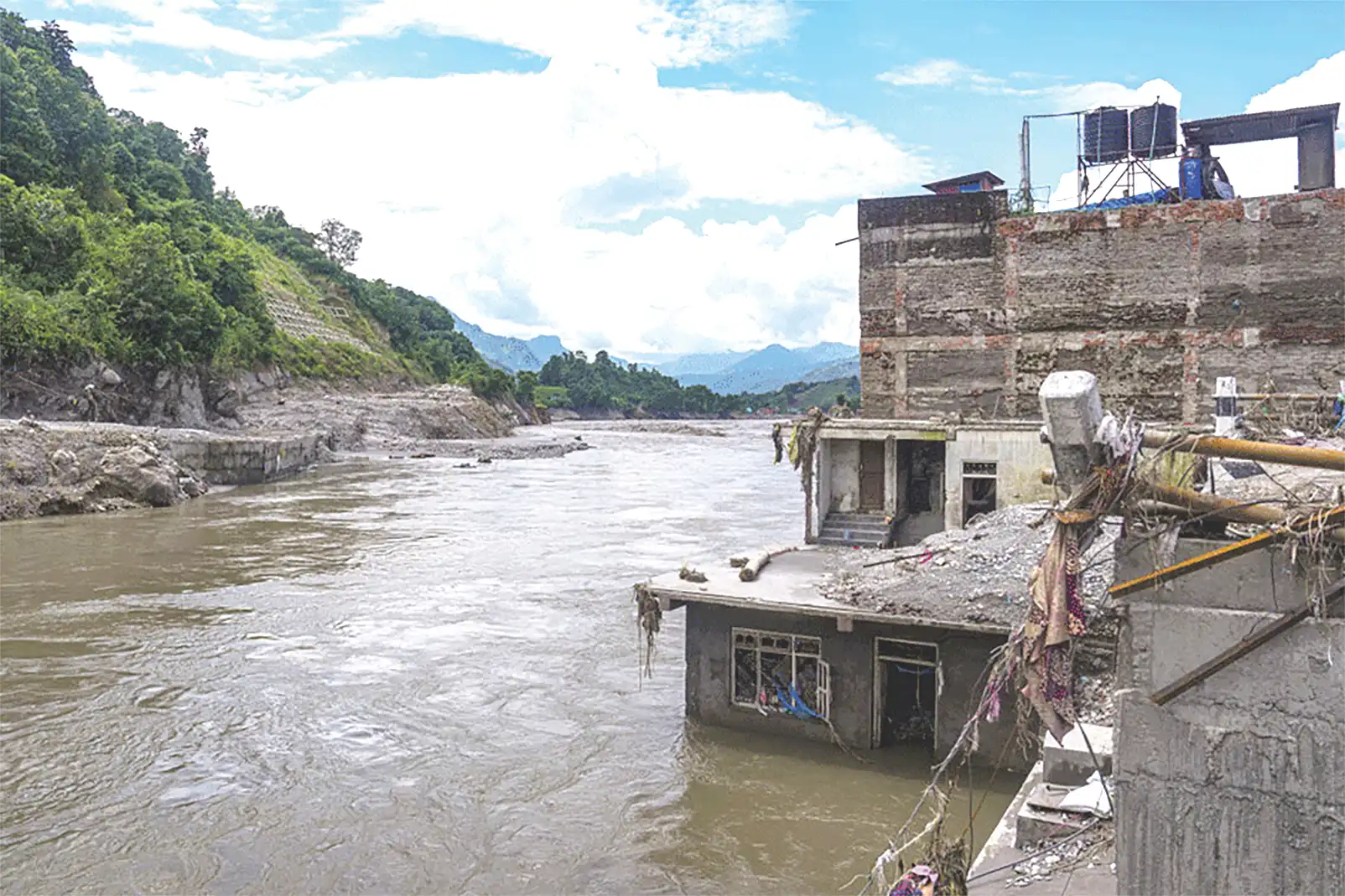
KATHMANDU, AUG 31 (PTI): The devastating floods that swept through Nepal were triggered by a massive fall of ice and rock in the high Himalayas and not by an earthquake or glacial lake outburst flood (GLOF), according to experts.
The flash floods that triggered near the Nepal-Tibet border on August 26 swept through northern and central Nepal, killing hundreds, leaving thousands missing and damaging homes, roads, bridges and hydropower infrastructure.
A study, commissioned by the Nepal Environment Society (NES), found that a huge mass of ice, rock and debris fell from around 5,200 metres in the Langtang Lirung area of Rasuwa and entered the Lhende River, generating a powerful debris-laden flood that travelled downstream through the Bhotekoshi and Trishuli rivers.
Bishal Nath Upreti, president of the Nepal Centre for Disaster Management, said initial theories that the disaster was caused by a GLOF or an earthquake had subsequently been discarded.
“Initially, many thought it was a glacial lake outburst flood, or GLOF. Later, it became clear that there had been no lake burst in Tibet along that line, so that theory was discarded,” Upreti told PTI Videos.
It was then thought that an earthquake had triggered the ice and rock fall, but the US Geological Survey later clarified that the sequence was the other way around, he said.
“A massive rock and ice fall into the valley generated the earthquake,” Upreti said, adding that the earthquake was initially recorded at magnitude 4.2 and later revised to 5.2.
“So, the disaster was not caused by an earthquake; rather, the falling ice and rock generated the earthquake,” he said.
The NES study, released on Sunday, also concluded that the disaster was not caused by a GLOF.
Researchers from NES analysed satellite imagery, hydrological and meteorological data, terrain characteristics and changes in elevation and slope along the river system and found no evidence of a lake outburst.
According to the study, the ice-rock mass began falling from the northern part of Langtang Lirung at around 8:37 am on Wednesday. It descended steep terrain from about 5,200 metres before reaching the Lhende River at around 2,930 metres.
Satellite images showed major geographical changes across about 10 square kilometres, while a section of glacier covering approximately 0.56 square kilometres had broken away.
The NES study found that the ice-rock mass travelled about 22 km to Rasuwagadhi in just over seven minutes, reaching an estimated average speed of 46.3 metres per second, or 167 kmph.
Its speed fell to around 73 kmph between Rasuwagadhi and Betrabati and to about 22 kmph further downstream. Despite slowing, the flow continued carrying huge quantities of rock, sediment and soil, the report said.
The study also found no evidence of exceptionally heavy rainfall in the upper watershed that day, weakening the assumption that the disaster was caused solely by extreme rainfall or a cloudburst.
Upreti said a second, smaller flood occurred after another landslide around three hours and eight minutes later created a temporary dam that subsequently breached.
“Fortunately, it flowed slowly and did not result in a major disaster,” he said.
The floods also caused extensive damage to hydropower infrastructure. Citing preliminary Nepal Electricity Authority data, the NES report said 13 hydropower projects and one solar project were affected, taking around 431 MW of generation capacity out of the system.
The study said further field investigation was needed to determine the precise geological mechanism, the contribution of melting ice and whether the river was temporarily blocked upstream.
Upreti cautioned that the possible cause of the flash floods in Nepal remains uncertain, with scientific interpretations changing rapidly as new information emerges.
“New ideas are coming up. So as a scientist, I cannot just confirm right now what is happening. But these are the developing hypotheses or developing theories or developing information that is coming up right now,” he told PTI Videos.
On India’s assistance, Upreti said the country had always been supportive during major earthquakes and disasters in Nepal.
“India has been always supportive whenever we have big earthquakes or these kind of disasters. In 2015 earthquake, India was the first to send all its relief materials and also your rescue people, and search and rescue team and all that. So definitely India has been always supportive whenever and this time also the first consignment of the relief material came from India immediately within hours.”
He also called for greater scientific cooperation between India and Nepal, saying the two neighbouring countries have significant scope for joint research on disasters.
“Our countries are so close, we are friendly countries, adjacent to each other, share the boundaries. I can say millions of people crossover on a daily basis. But scientific cooperation between India and Nepal almost doesn’t exist,” he said
“We can do a lot, together for the people. Research is so important. Scientific cooperation, collaborations, joint research are very, very important,” Upreti added.
China rejects criticism linking to Nepal flash flood
BEIJING, AUG 31 (PTI): China on Monday dismissed claims linking its massive hydropower projects in Tibet to the August 26 flash flood disaster in Nepal, calling them “malicious speculation”.
The flash floods, believed to have been triggered by an ice-rock avalanche near the Nepal-Tibet border, swept through northern and central Nepal last week, killing hundreds, leaving thousands missing and damaging homes, roads, bridges and hydropower infrastructure.
“We noted that experts and official institutions of China and Nepal have made some assessment on the cause of the disaster,” Chinese Foreign Ministry spokesman Guo Jiakun told a media briefing in Beijing when asked about criticism blaming Chinese projects.
“According to their analysis, the mudslide was triggered by a collapse of a high-altitude glacier in Nepal,” he said.
Nepal seeks additional international support
KATHMANDU, AUG 31 (PTI): Nepal has sought additional international support, including specialised equipment and technical assistance for tunnel rescue and forensic work, as rescue operations continued after the floods that have killed hundreds and left thousands missing.
During a press briefing in Kathmandu on Monday, Nepal’s foreign ministry spokesperson Lok Bahadur Chhetri said the country had sought essential non-food items and services such as freezers, DNA testing kits and LiDAR from the US, relief-specific items like DVI from Singapore, and belly bridges and high-capacity drones from China and Singapore.
Nepal has received rescue support from India, China, Japan, the United States, the United Arab Emirates, South Korea and other countries and development partners.
Likewise, relief materials have been received from India, China, the UAE and other countries. More supplies are coming from the UAE, Myanmar, the US, Qatar, the UK, Australia, South Korea, Japan, New Zealand, Malaysia, Singapore, Bangladesh, Pakistan and other friendly countries, and international organisations and partners such as the UN, WHO, WFP and UNICEF, he said.