
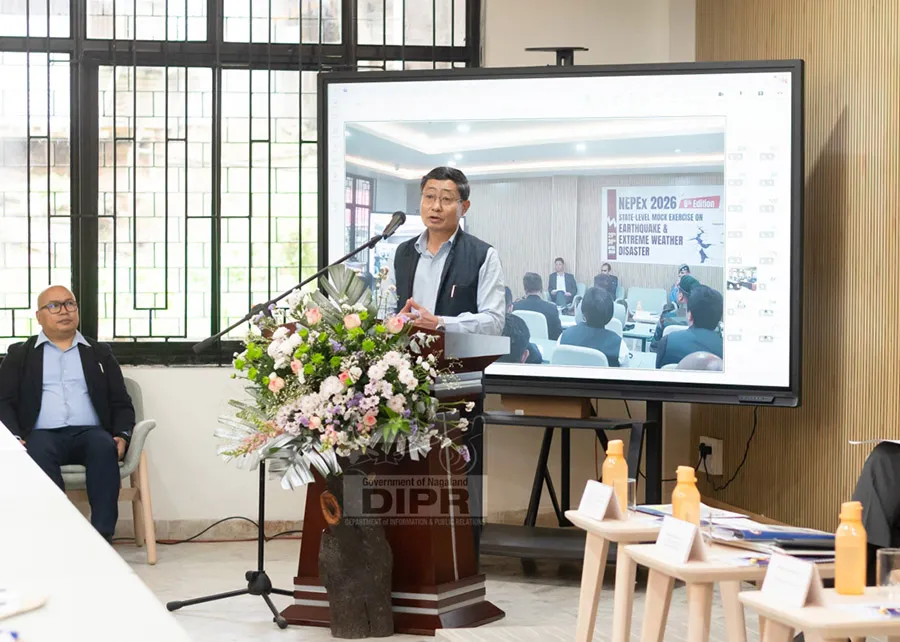
CS underscores need for stronger coordination
State chief secretary and chairman of the state executive committee, Sentiyanger Imchen, on Wednesday underscored the need for robust inter-agency coordination, continuous system testing, and honest identification of gaps to strengthen Nagaland’s disaster preparedness, during the tabletop exercise of the Nagaland Emergency Preparedness Exercise (NEPEx) held at the State Emergency Operation Centre, Capital Convention Centre, Kohima.
He said the 8th edition of NEPEx, which includes a simulated 7.7 magnitude earthquake scenario, was aimed at assessing preparedness, validating standard operating procedures, strengthening coordination among stakeholders, and evaluating critical response systems. Imchen emphasised that preparedness must remain dynamic and continuously evolve through regular exercises.
Warning of likely large-scale destruction, disruption of communication systems, strain on healthcare infrastructure, and secondary disasters such as landslides and fires, the chief secretary said the exercise brings together multiple stakeholders including security forces, paramilitary units, district administrations, health services, urban local bodies, village councils, NGOs and churches.
He reiterated that NEPEx was not meant for performance evaluation but for identifying systemic weaknesses.
Appreciating districts that have previously reported shortcomings frankly, Imchen urged all departments to adopt the same approach for meaningful improvement.
Imchen also suggested broadening future exercises beyond earthquakes to include other disaster scenarios relevant to Nagaland. He noted that earthquakes could trigger cascading disasters and were often “the mother of all disasters.” Imchen stressed that such exercises must be treated as realistic simulations to strengthen systems and institutional readiness.
Delivering the welcome address, home commissioner Abhijit Sinha said disaster preparedness depended on strong inter-departmental coordination, particularly in a rapidly changing risk environment shaped by climate change and frequent extreme events. He said NEPEx was designed to improve communication, command structures, and synergy among departments during emergencies.
Sinha said the exercise helps clarify roles and improve information flow during crises, adding that preparedness must be built in advance as there was no time once disasters strike.
He also highlighted that NEPEx reflected NSDMA’s sustained effort to strengthen disaster response systems.
Lead Consultant (ME & IRS), NDMA, Sudhir Bahl said the exercise has been redesigned based on a scientifically vetted earthquake scenario with casualty and damage modelling. He said the aim was to strengthen coordination between the state government and multiple agencies, including the armed forces, under a whole-of-government approach.
He informed that the mock exercise would be conducted across selected sites in each district to validate planning and coordination outcomes, noting that a full-scale simulation was not feasible administratively.
The programme was chaired by NSDMA secretary Sentiwapang Aier. The technical session included a review of previous exercises and presentation of the disaster management plan by NSDMA joint CEO Dr. Johnny Kadunsin Ruangmei followed by coordination and scenario briefing by Sudhir Bahl.