
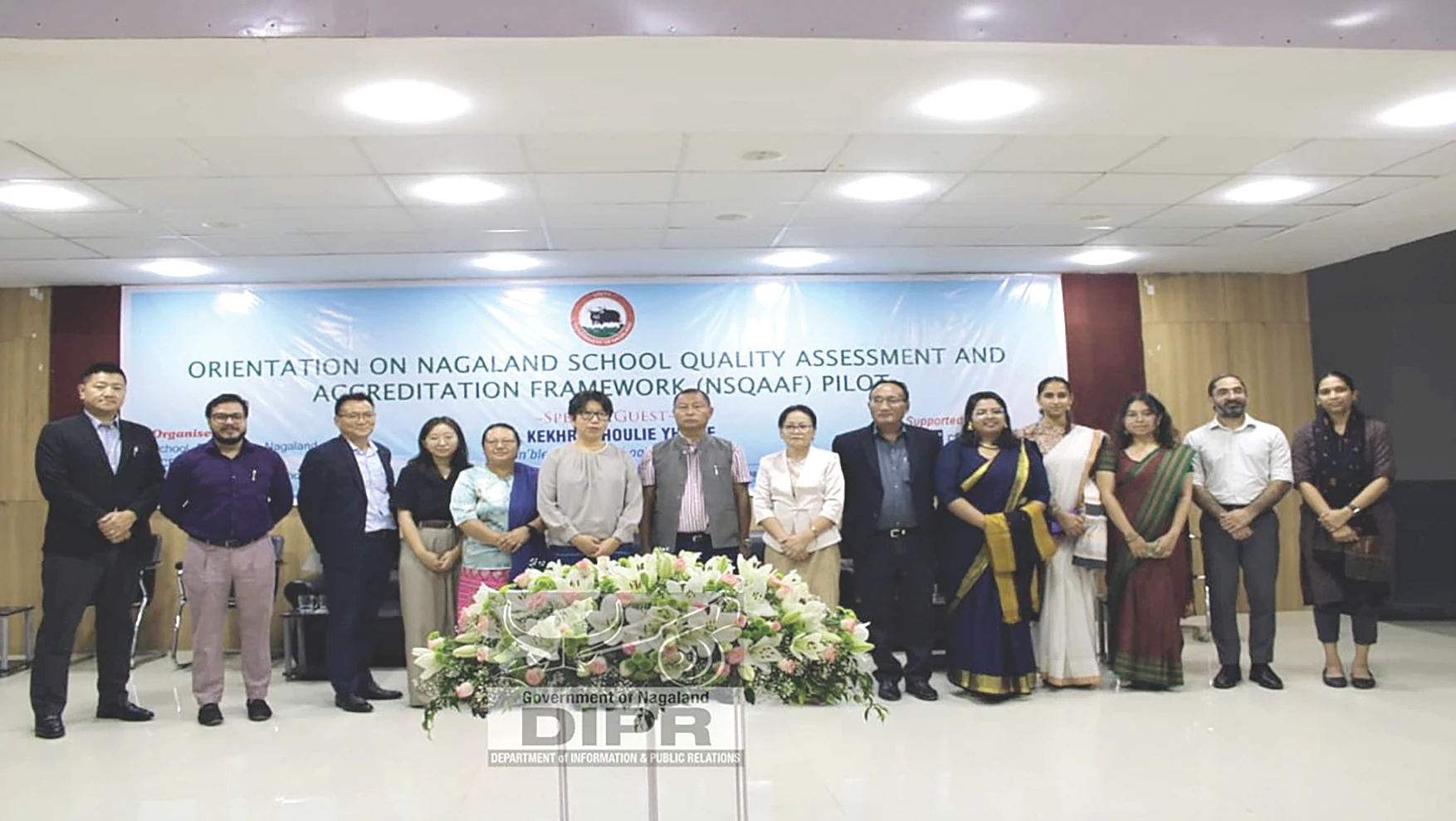
Dimapur, JUN 22 (NPN): State government has rolled out the pilot phase of the Nagaland School Quality Assessment and Accreditation Framework (NSQAAF), aimed at bringing significant improvement in the quality of education across government and private schools in the state.
A one-day orientation programme for the NSQAAF pilot was held on June 19, 2026, at the Capital Convention Centre, Kohima. It was attended by heads of institutions and proprietors from 100 selected schools (both government and private) and 90 external evaluators. The programme was supported by the Central Square Foundation.
Advisor for school education Dr. Kekhrielhoulie Yhome highlighted the importance of NSQAAF in transforming the education system. He said the framework will help schools identify their strengths and areas needing improvement through a structured evaluation covering five key domains — administration, curriculum, assessment, infrastructure, and inclusiveness. Dr. Yhome noted that Nagaland has around 1,900 government schools, 880 private schools, and a dozen central schools, with approximately 34,000 teachers.
He acknowledged existing challenges such as schools with very low or zero enrolment and said the government is working on rationalisation while ensuring the Right to Education.
Commissioner and secretary school education Kevileno Angami, who is also chairperson of the Interim Nagaland State School Standards Authority (NSSSA), said NSQAAF will provide standardised criteria for evaluating all schools. She clarified that the framework is not a one-time exercise but will function as a permanent independent regulatory body for continuous improvement.
Additional secretary school education and SCERT, Vikhweno Chale, informed that the framework has five domains, 53 sub-domains, and 338 standards with three performance levels from pre-school to Class 12.
It is aligned with the National Education Policy (NEP) 2020 and emphasises learning outcomes, transparency, and self-assessment.
Director SCERT Keruupfeu Rupreo urged schools to approach the pilot with honesty and sincerity, describing it as a tool for self-reflection and continuous growth rather than judgment.
The programme was chaired by the under secretary, school education, while secretary of Nagaland Board of School Education and member secretary of the interim NSSSA, Rangumbuing Nsarangbe, proposed the vote of thanks.
Resource persons for the orientation programme included Niharika Suresh, Prasuti Sharma and Zephyr Pegu from Central Square Foundation.