
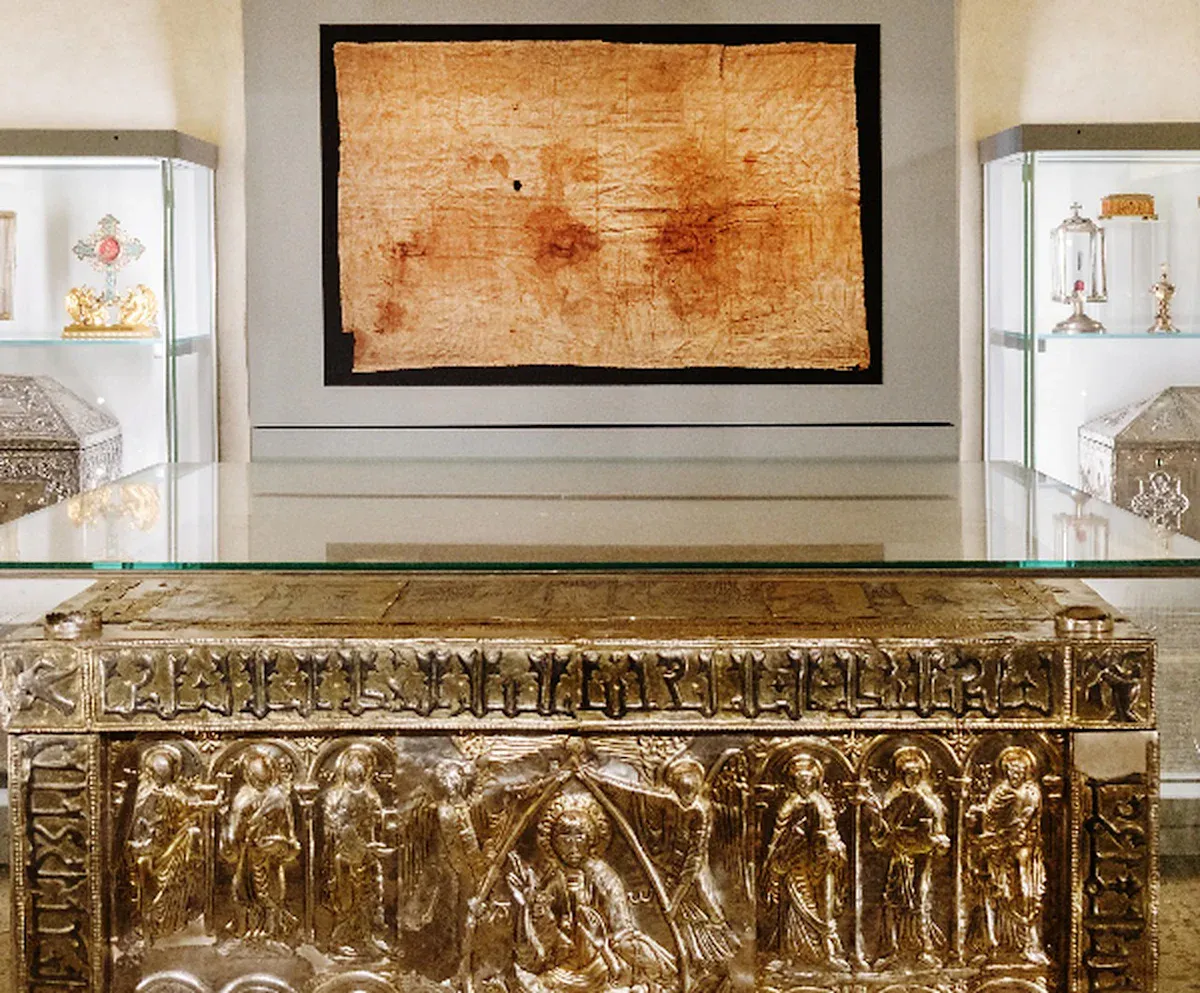
A new scientific study of an ancient bloodstained cloth believed by some Christians to have covered the head of Jesus Christ after his crucifixion has found evidence that it may have been held in place by a bandage.
The findings offer a possible explanation for mysterious stains and markings on the Sudarium of Oviedo, a linen cloth kept in Spain that has long been linked to the more famous Shroud of Turin.
The two relics are traditionally believed to have served different purposes during Jesus’ burial. The smaller Sudarium is believed to have covered his head or face, while the much larger Shroud of Turin is believed to have wrapped his entire body.
The new study, published in the scientific journal Measurement, used computer imaging and laboratory experiments to examine how the stains and markings on the Sudarium might have formed.
Researchers found that some markings were consistent with pressure from a bandage wrapped around a person’s head, suggesting the cloth may have been secured during burial preparations.
However, the researchers cautioned that their findings do not prove the cloth covered Jesus’ head or establish that it was used alongside the Shroud of Turin.
The Sudarium measures about 33 inches long and 21 inches wide and is kept in the Cathedral of San Salvador in Oviedo, Spain, where its documented history dates to at least 1075.
Unlike the Shroud of Turin, which bears the faint image of a man who appears to have been crucified, the Sudarium has no recognizable human image.
Instead, it contains bloodstains, folds and other markings that have puzzled researchers for decades.
The Bible describes separate burial cloths associated with Jesus’ body and head.
In John 20:6-7, the apostle John describes linen burial cloths lying in Jesus’ empty tomb, along with a separate cloth that had covered his head.
Some believers and researchers have suggested that these two cloths could be the Shroud of Turin and the Sudarium of Oviedo.
However, the origins of both relics remain disputed, and scientists have not established that either was used during Jesus’ burial.
For the new study, researchers examined detailed scans of the Sudarium to identify patterns in the stains and markings.
They found lines across areas believed to have rested against the forehead and back of a person’s head.
They also identified areas where blood or other fluids appeared to have collected under pressure. To test their theory, the researchers conducted experiments using a model of a human head, linen fabric, and a liquid designed to behave like blood. (Yahoo)
They wrapped the model with cloth, applied light pressure, and changed its position to see how the liquid would spread.
The experiments produced several patterns similar to those found on the Sudarium.
The results suggested that a bandage could have held the cloth against a person’s head while changing the way blood or other fluids spread across the fabric.
The researchers also examined ancient burial customs to determine whether such a practice would have been common.
They noted that wrapping the head and securing the jaw were known practices in ancient Egypt, the Roman world and parts of the Middle East.
Such bindings could keep the mouth closed, hold burial cloths in place and help prevent bodily fluids from spreading while a body was being prepared for burial.
The researchers said these practices offered a possible explanation for the marks found on the Sudarium.