
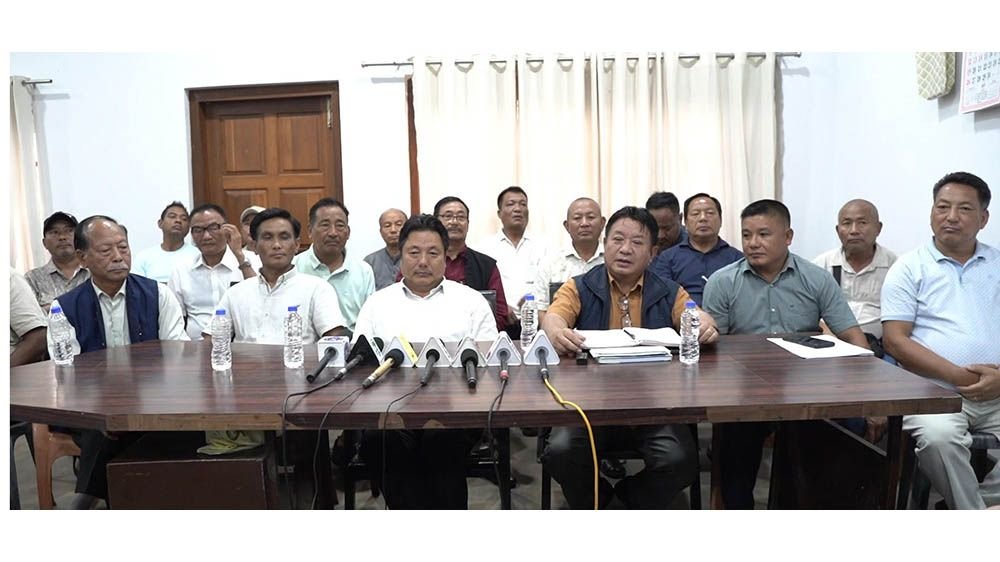
Nagaland Foothills Road Coordination Committee (NFHRCC) has resolved to boycott the State government’s meeting scheduled for April 7, 2026.
The decision was taken during a meeting on Monday with Dimapur-based tribal Hohos, many of whom were endorsed by their respective apex Hohos.
Following the meeting, NFHRCC officials addressed a press conference at its Khermahal office, where they announced the boycott and launch a phase-wise agitation beginning April 15.
NFHRCC general secretary Chenithung Humtsoe said the resolution reaffirmed the committee’s March 30 decision to abstain from the government meeting unless NFHRCC was formally included.
He noted that the committee has been actively pursuing the Foothills Road project since 2013, working to support the government in ensuring quality control and effective implementation. However, Humtsoe said its efforts have often been “misunderstood,” resulting in friction with the authorities.
NFHRCC convenor Supu Jamir stated that, along with Dimapur-based tribal Hohos, the committee has decided to lock PWD (R&B) office in Dimapur from April 15 if the second-phase work order was not issued.
Jamir alleged that despite overseeing the project for over 13 years, the NFHRCC has been repeatedly excluded from key meetings.
He expressed concerns over alleged substandard execution by certain contractors and criticised the repeated extensions granted to them despite show-cause notices.
Jamir demanded that non-performing contractors be blacklisted to ensure quality and timely completion of the project.
Questioning the government’s proposal to shift to a four-lane project instead of completing the ongoing two-lane work, Jamir said the four-lane alignment has not received approval from the Ministry of Road Transport and Highways (MoRTH). He termed the move “confusing” and lacking logic, pointing out that even the long-announced Dimapur-Kohima four-lane project remained incomplete.
He asserted that landowners have already provided no objection certificates (NOCs), dismissing the government’s claim of land-related constraints.
Referring to earlier assurances from the government, Jamir said the committee took those commitments seriously and that the matter now rested with the responsible minister to act on his own statement.
Jamir also criticised the chief minister Dr. Neiphiu Rio and deputy chief minister Y. Patton for responding with “no comments” to media queries on the exclusion of NFHRCC and apex Hohos from the April 7 meeting. “If the chief minister and deputy chief minister have no comments on such a vital state issue, then the meeting holds no meaning,” he said, terming the situation “very unfortunate.”
He highlighted that the Foothills Road project has been pending for over 13 years and remained a “burning issue” for the public.
He recalled that NFHRCC had appealed to landowners not to demand compensation, urged national workers not to impose taxes on the project, and suggested that only statutory deductions be made.
Jamir maintained that the committee’s sole focus was on ensuring the project’s completion with proper workmanship.
Responding to a query on why the agitation targets PWD (R&B) office in Dimapur when decisions were taken at higher levels, Jamir said, “If a part of the body is hurt, the whole body is sick.”
He said that the committee has repeatedly sought appointments with the department and the chief minister but has not been given the opportunity, and would therefore raise its voice wherever possible.
On the next course of action, including possible demands for an investigation into the utilisation of large public funds, Jamir said the committee would first seek engagement with the department, as it was the executing agency.
He clarified that NFHRCC remained a pressure group, but warned that continued inaction could force the committee to take stronger measures.
NFHRCC member Chenithung Humtsoe emphasised that the committee was “very serious” about the assurance given by R&B minister G. Kaito Aye that he would resign on moral grounds if the project fails. “It is in his court now,” he said, pointing out that the ground situation clearly showed the project was not progressing well.
He also raised concerns over defects in the detailed project report (DPR), including shortfalls in hume pipes and culverts, and alleged lack of cooperation from field officials during joint inspections.
Humtsoe said several anomalies exist and the department should be held accountable.
Supu Jamir supplemented this by stating that contractors have repeatedly sought time extensions despite deadlines, and suggested that incapable firms should be blacklisted and the work reassigned to capable agencies.
In his concluding remarks, NFHRCC member L. Wati Jamir described the Foothills Road as a “lifeline” and “economic road” for Nagaland. He urged the people of Nagaland to come together and “make things right before it is too late.”
‘No Comment’, says Rio
State chief minister Neiphiu Rio on Monday declined to comment on the boycott of the State government’s April 7 meeting on the Nagaland Foothills Road by several tribal Hohos.
Speaking to media at Dimapur airport upon his arrival to receive Prime Minister Narendra Modi, Rio replied “No Comment” regarding the decision of the tribal Hohos to boycott the meeting.
The boycott was triggered by the non-invitation of the Nagaland Foothills Road Coordination Committee (NFHRCC).
On the state’s financial position following his recent visit to New Delhi, Rio said that instead of the expected deficit grant from the 16th Finance Commission, Nagaland has been brought under the Special Assistance to States for Capital Investment (SASCI) scheme.
He informed that the State has been allocated Rs 3,880 crore under this scheme, while the remaining financial gap would have to be met through internal resource mobilisation.
On the Frontier Nagaland Territory (FNT) issue, Rio reiterated that the State government was awaiting directives from the Centre. He disclosed that a draft bill had already been submitted to the Government of India as per the provisions of the Memorandum of Understanding, but no response has been received so far.
Rio maintained that due to constitutional limitations, the State legislature cannot delegate its powers, and any such arrangement would require clear guidance from the Centre.
The chief minister added that the matter has reportedly been referred to the Solicitor General, and the State was awaiting further directions.
On the proposed border surveillance system, which has drawn criticism over potential environmental and community impact, Rio said the government would first study the matter thoroughly.
Meanwhile, minister for higher education and tourism, Temjen Imna Along, who was also present at the airport to greet the Prime Minister, urged the tribal apex bodies not to boycott the April 7 meeting. He said the government had called the Hohos for “discussion and discourse” on the complexities surrounding the Foothills Road project. “I think the apex bodies need to understand the real context of it immediately. Not calling NFHRCC or not is not the most important issue right now because they are part and parcel of the tribal Hohos that have constituted it,” he stated.
Emphasising that engagement was the better course of action, Along suggested that any grievances, including the non-invitation of NFHRCC, should be addressed across the table.
He expressed confidence that the government would be open to resolving such issues through dialogue rather than confrontation from outside.