
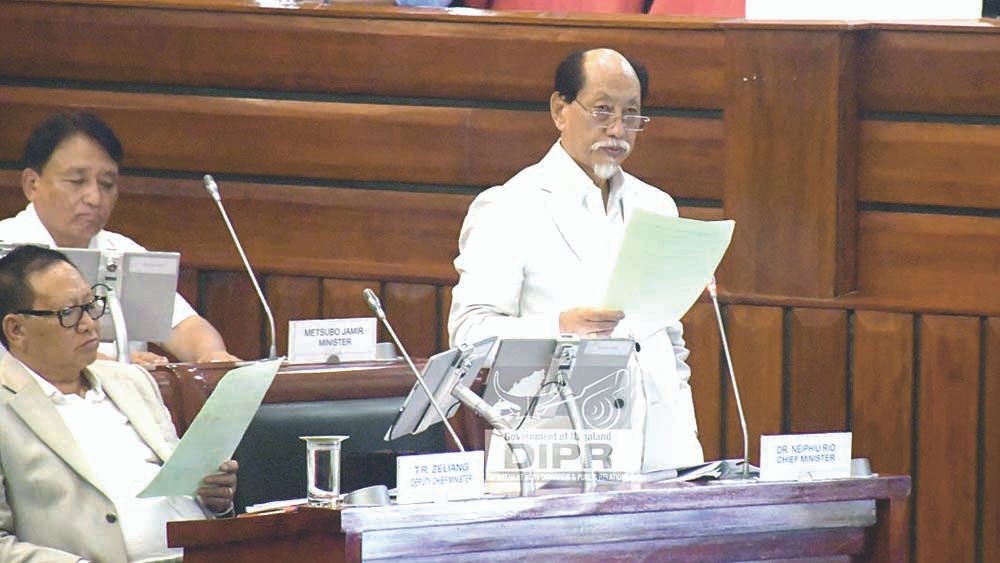
The Nagaland Legislative Assembly on Thursday deliberated on safeguarding indigenous communities, highlighting concerns over identity, land, and opportunities amid migration pressures. Members stressed effective implementation of Article 371A, the Inner Line Permit, and the RIIN, while pointing to anomalies in reservation policies and enforcement gaps. The urgent matter of public importance, “Safeguarding the Indigenous Communities,” was initiated by NPF MLA Kuzholuzo (Azo) Nienu, who called for collective responsibility to secure future generations.
Leader of the house and chief minister Neiphiu Rio, in his concluding remarks on the Assembly discussion on safeguarding indigenous communities, thanked members for their concerns and said it was encouraging to witness a united voice on the issue of rights, safety, and preservation of Naga identity and traditions. He recalled that Azo Nienu had earlier submitted a letter from the Northeast Indigenous People Association, which was referred to the Speaker for deliberation.
Tracing history, Rio noted that Nagas resisted British entry into the Naga Hills for over six decades before a peace treaty in 1879. Even under colonial administration, village institutions were left intact, recognizing the uniqueness of Naga traditions. To safeguard this, the Bengal Eastern Frontier Regulation of 1873 introduced the Inner Line Permit (ILP), prohibiting land ownership by outsiders and restricting removal of ancestral artifacts.
Rio said these protections continued post-statehood, enshrined in the 16-Point Agreement and Article 371A of the Constitution, which guarantees Naga customary laws, practices, and ownership of land and resources. He stressed that confusion over indigenous rights today stemmed from failures of government, civil society, and village leaders to enforce safeguards effectively.
Earlier, initiating the discussion, Nienu said migration pressures and weak enforcement had made protection urgent. He called for clarity in implementing Article 371A, ILP, and the Register of Indigenous Inhabitants of Nagaland (RIIN), urging the House to pass a clear resolution to ensure safeguards for future generations.
On reservations, Dr.Rio acknowledged concerns over Nagaland’s reservation policy and the need to redefine backward and forward areas, tribes, and reservations in jobs and higher education. He noted that several committees-including the Banuo Committee (2005), Kevichüsa Committees (2008, 2010), and Temjen Toy Committee-had earlier examined the issue, while a Cabinet Subcommittee led by Deputy CM Y. Patton recommended a review based on the 2021 Census, which was not held. Rio urged collective effort to ensure accurate enumeration in the upcoming 2026–2027 Census.
Responding to demands from tribal hohos, Dr.Rio said a commission has been formed to examine reservation comprehensively. Acknowledging the Konyak Union’s concerns over the roster system, he assured that such disparities would be studied for fair solutions.
On indigenous identity, Rio warned against equating indigenous inhabitants with permanent residents or migrants, citing Tripura and Assam as cautionary examples. He emphasized that only village councils and local authorities could certify indigenous status, not the government.
Detailing RIIN, Rio said councils, head GBs, women representatives, church leaders, and teachers were empowered to certify applicants. Non-Naga tribes such as Kuki, Kachari, Garo, and Mikir were given a 1963 cut-off, while Nepali-Gorkhas had December 31, 1940. He warned that false certification would invite criminal cases.
Rio clarified distinctions between indigenous, permanent, and temporary residents, stressing ILP regulations for migrants. Contractors and village councils were directed to register non-Naga workers, with 33% of fees retained locally. He welcomed APO’s suggestion for an app-based registration system, calling it a potential model for all districts.
Chief Minister Neiphiu Rio told the Assembly that Nagas must equip themselves with skills and entrepreneurship to achieve economic self-reliance. Unless Nagas step into small-scale businesses, migrants would continue to fill the gap, he cautioned, adding that simply driving them away would only create a vacuum.
Rio urged youth to take advantage of state initiatives such as health insurance and micro-financing schemes, which require only 10% equity from entrepreneurs, with the rest covered by government and banks. He highlighted tourism and agriculture as growth sectors, citing the success of tribal festivals like Hornbill and Mungmung. Nagaland, he announced, will also host a Coffee Festival during the upcoming Hornbill Festival, after the Coffee Board of India recognized the state as a coffee-growing destination.
Calling for unity, Rio appealed to citizens to move beyond a culture of constant complaint and work collectively to safeguard indigenous pride, culture, and livelihood.
Joining the debate, Minister Jacob Zhimomi stressed that the issue of indigenous identity must not be diluted with permanent residency and warned against politicisation. He called for stronger village authorities to ensure genuine certification. Legislators Dr. Neisatuo Mero, Kekhrielhoulie Yhome, and KT Sukhalu also shared their views.
7th session of 14th NLA adjourned sine die
The seventh session of the 14th Nagaland Legislative Assembly was adjourned sine die by the Speaker, Sharingain Longkumer, on September 4. The Speaker expressed gratitude to all members for their cooperation in maintaining the decorum and sanctity of the House, and for ensuring the efficiency of the proceedings.