
The North East Shiksha Samvaad was held at Tetseo College on Friday under the theme, ‘Reimagining Education in Northeast for a Future Ready Generation.’ The programme was sponsored by HDFC Bank and supported by Mantra4Change and Elevate Foundation.
Delivering the keynote address on the topic, ‘Why future readiness cannot wait; The Northeast Imperative’, Vice Chancellor, North East Christian University (NECU), Dr Darlando Thanmi Khathing stressed that the region must shift from “waiting” to immediate action, asserting that opportunities already exist within the Northeast.
He said that the region should not depend solely on infrastructure or external support, pointing out that digital connectivity and local innovation have already enabled growth. Citing examples from Dimapur and across the Northeast, he highlighted emerging entrepreneurship in sectors such as food, handicrafts, textiles, agro-products, and eco-tourism, as well as local innovations in technology and renewable energy.
Khathing further emphasised that the key challenge was not the absence of opportunities, but the lack of responsiveness and collective effort.
He noted that while there is strong demand for Northeast products such as bamboo shoots, pineapples, and turmeric in national and international markets, adding that the region often fails to meet large-scale orders due to fragmented production.
Here, he underscored the need for community-driven and cooperative approaches to fully utilise such opportunities.
On education, he called for a shift towards a future-oriented system that prioritises adaptability, lifelong learning, and real-world problem solving.
He observed that with rapid changes driven by artificial intelligence, climate change, and evolving job markets, traditional education models must evolve to focus not only on academic knowledge but also on skills such as critical thinking, creativity, emotional intelligence, and ethical reasoning.
He further pointed out that the Northeast, with its young population and strong community networks, holds unique advantage in adapting quickly to change.
Concluding his address, Dr Khathing asserted that the region does not need to replicate external models but must align its education, skills, and opportunities to prepare the present generation for a rapidly changing future.
Delivering the second keynote address, associate professor, Nagaland University, Dr. Mary N. Odyuo, dwelling on the topic, “What does future-ready learning look like in our classrooms?”, she emphasised that future-ready learning must go beyond textbooks and examinations, focusing instead on critical thinking, adaptability, and real-life problem solving. She also stressed the need to balance global exposure with preparedness for local challenges, identifying practical skills, creativity, and adaptability as key competencies for students.
She further noted that when education fails to align with local realities, it pushes youth to seek opportunities elsewhere instead of empowering them to build within their own communities, and urged educators to reflect on whether the current system is producing job seekers or nurturing leaders and innovators.
Highlighting the impact of the National Education Policy (NEP) 2020, she dwelled on the positive shifts towards flexible, skill-oriented learning through vocational courses, multidisciplinary approaches, and blended education models.
Drawing from her experience as principal investigator of an Indian Council of Agricultural Research (ICAR)-funded project, she underscored that soft skills such as communication, confidence, leadership, and entrepreneurial thinking are developed over time and remain a major gap among students due to exam-centric learning systems. She also informed that targeted interventions, including training in communication, interview skills, emotional intelligence, and entrepreneurship, have shown visible improvements in students’ confidence and initiative. She further asserted that programmes such as ‘Shark Tank Nagaland’ have further encouraged students to develop and present business ideas with mentorship support.
Dr. Odyuo later stressed the importance of stronger mentorship, career guidance, and institutional self-assessment to ensure education remains relevant to real-world demands. She also called for greater collaboration among educators, institutions, and stakeholders, asserting that meaningful change in the education sector can only be achieved through collective effort and resource sharing.
Encouraging continued engagement beyond the dialogue, she offered collaboration opportunities through Nagaland University’s agricultural resources and expertise, urging participants to work together towards building a more responsive and empowering education system.
Earlier, founder, NagaEd, and director, ELEVATE foundation, Kevisato Sanyü, briefed the gathering on the Samvaad, while principal, Tetseo College, Dr Hewasa L Khing, delivered the welcome address.
The Samvaad also witnessed two panel discussions. The first discussion was held on the topic, ‘From infrastructure to learning impact: What is changing on the ground’, moderated by Ransom Lunleng, with panellists jt mission director, Samagra Shiksha Nagaland, Dr Bijano Murry, consultant, strategy and design specialist, NECTAR, DoSE, Benjamin Vinito Chishi, and graduate teacher, GMS Jalukie Sector B, Ruth Jami.
The second discussion dwelled on the topic, “It takes a village: Building an ecosystem for future-ready children”, moderated by Ketousieno Prescilla Khamo, with panellists, Founder, Highland Dreamers, Golan Suanzamung Naulak, managing director, Bridges Educational Foundation, Moyangla Longkumer, lead operaetions-ECE Hamara gaon, Pratham Education, Saveri Kulshreshth, and assistant academic officer, NBSE, Rüchünino Ziephrü.
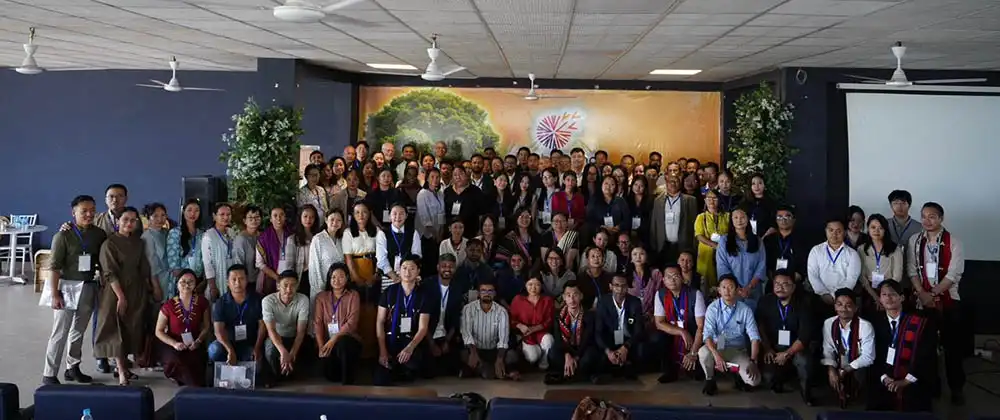
North East Shiksha Samvaad held at Tetseo College
Staff Reporter