
Staff Reporter
DIMAPUR, SEP 19 (NPN): North Eastern states have called for stronger regional cooperation, greater industry and skills integration and a region-specific roadmap to address gaps in implementing the National Education Policy (NEP) 2020, as the two-day Education Conclave 2026 concluded here Saturday.
Addressing the valedictory function held at J.P. Park & Banquets, Naga United Village, Chümoukedima, as chief guest, Tripura minister for Higher Education, Panchayats and General Administration Kishor Barman said the success of NEP would ultimately depend on implementation and its impact on students, particularly those in remote areas. He said education should prepare young people not only for employment but also to become problem-solvers, innovators and entrepreneurs.
Barman called for stronger links between education and the region’s resources, citing the potential of bamboo, tourism, agriculture, environment and biodiversity to generate research, employment and entrepreneurial opportunities through technology and innovation.
He urged colleges and universities to expand internships, apprenticeships, skill courses, incubation, entrepreneurship programmes and career counselling. Barman also proposed regional faculty networks, shared research infrastructure, student mobility, joint research projects and a common digital platform among the eight North Eastern states.
Barman identified five areas of focus emerging from the conclave — access, quality, skills, research and innovation, and entrepreneurship — and called for measures to turn “brain drain” into “brain circulation” by encouraging students who leave the region to bring back knowledge, investment, experience and innovation.
Addressing the concluding session, additional secretary, higher and technical education, Ministry of Education, Anandrao V. Patel said NEP implementation needed to move beyond degree-oriented education by integrating skills, industry exposure and multidisciplinary learning. He also called for systems that would allow students to move more freely between institutions across the region through credit transfer, multiple entry and exit options and the Academic Bank of Credits.
Patel said the major challenges included preparing for the demographic dividend, addressing climate change, creating a skilled multidisciplinary workforce and developing an education system rooted in Indian values. He said the policy sought to address these through equitable access, holistic and multidisciplinary education, stronger research, critical and creative thinking and greater emphasis on teachers.
He said achieving the NEP target of a 50% Gross Enrolment Ratio by 2035 would require additional infrastructure, teachers and teacher training, particularly to address dropout and transition gaps between Classes X and XII and higher education.
Patel also urged North Eastern states to strengthen industry linkages, including by facilitating student training in industrial clusters outside the region. He highlighted online and open-distance learning as tools for expanding access where physical infrastructure could not be created everywhere.
Sharing progress on NEP implementation, he said 51% of institutions had adopted the National Higher Education Qualifications Framework, 58% the National Curriculum Framework structure, 56% the four-year undergraduate programme and 69% the Academic Bank of Credits. He said 65% had established research and development cells, while 47% had prepared institutional development plans.
The conclave’s resolutions also called for stronger teacher capacity development, context-responsive and multilingual curricula, vocational education with clear progression pathways, skill hubs in higher education institutions, improved academic mobility and infrastructure, greater attention to indigenous knowledge and the establishment of state public universities.
The recommendations further highlighted gaps in technical education, resource utilisation and region-specific challenges, with participants seeking solutions tailored to the North East region.
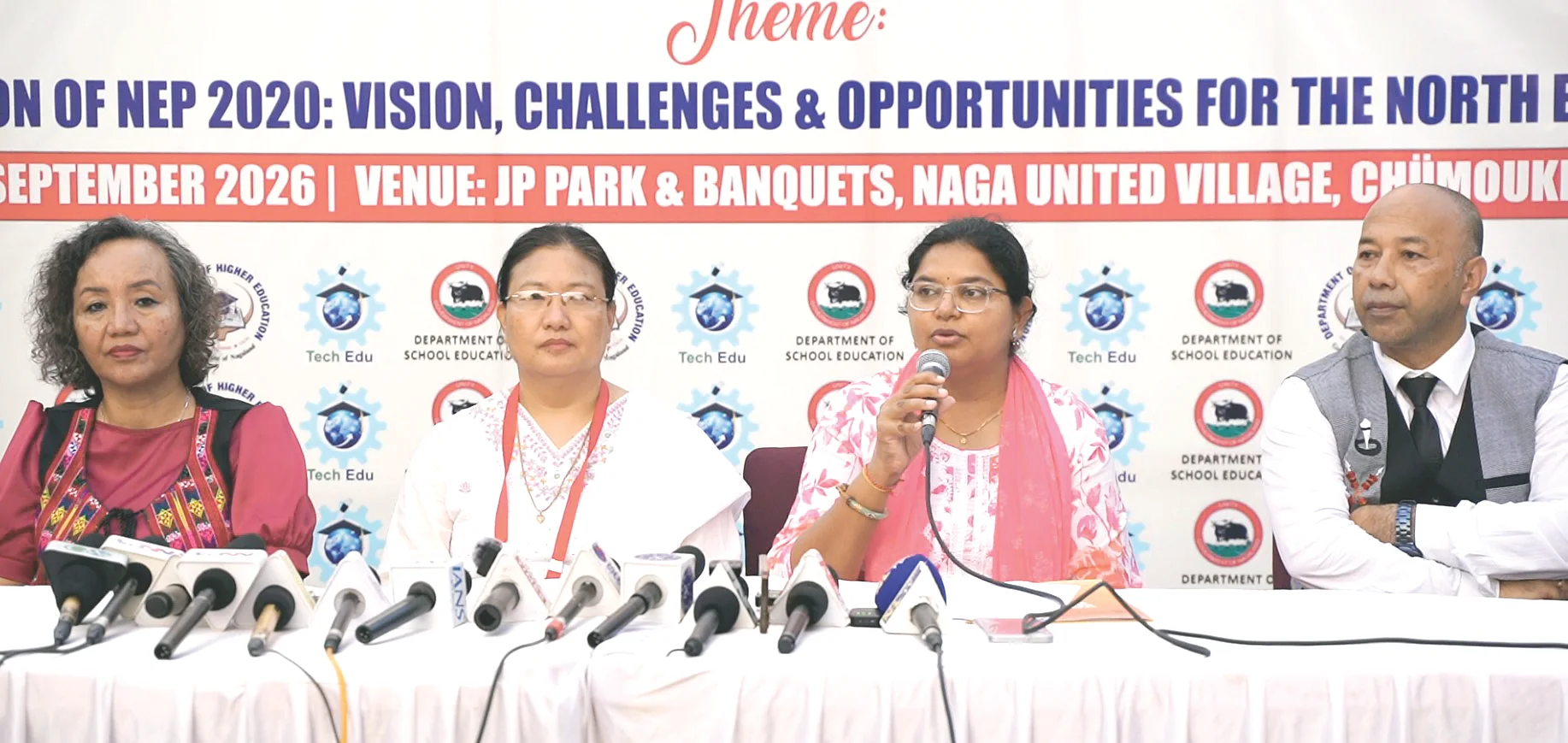
Higher and Technical Education secretary Sarita Yadav said the conclave brought together 748 participants from all seven Northeastern states, including ministers, MLAs, officials and representatives of central universities, as well as participants from 32 schools and 16 technical colleges.
She said the recommendations included stronger infrastructure support from the state and central governments, a Forum of Ministers for educational transformation in the North East and a policy framework for the use of artificial intelligence in education. The conclave also recommended continuous digital tracking and mandatory monitoring of student and teacher activities.
Yadav said the resolutions would be formally submitted to the Ministry of Education after completion of the state government’s official process. The recommendations had already been shared verbally with the ministry’s additional secretary during the conclave, she said.
Asked about a monitoring mechanism, Nagaland University (NU) pro-vice chancellor Dipak Sinha said this would depend on how the Ministry of Education takes forward the recommendations. The state government has not set a specific timeline for submission, he said.
Nagaland higher education joint director Dr. Medongoi Rhakho said the conclave should not be interpreted as a failure to implement NEP 2020. “We are not failing at all to implement. There are gaps. So we are filling the gaps,” he said.
Additional secretary, higher and technical education, and ex-officio director of higher education, Lovitoly Sema said the conclave provided a platform for Northeastern states to share their achievements, challenges and implementation gaps. She said the recommendations would require a roadmap suited to the region’s unique culture and circumstances and should be addressed as a policy matter rather than through short-term measures.
Professor Lalbiakdkki Hnamgr of Mizoram University’s department of education said the conclave had highlighted common challenges across the North East while underscoring the need to account for the region’s distinct circumstances and culture.
He expressed hope that continued cooperation among the states would strengthen regional coordination in implementing NEP 2020.
Tiakaba Amer, additional director Technical Education proposed the vote of thanks.