
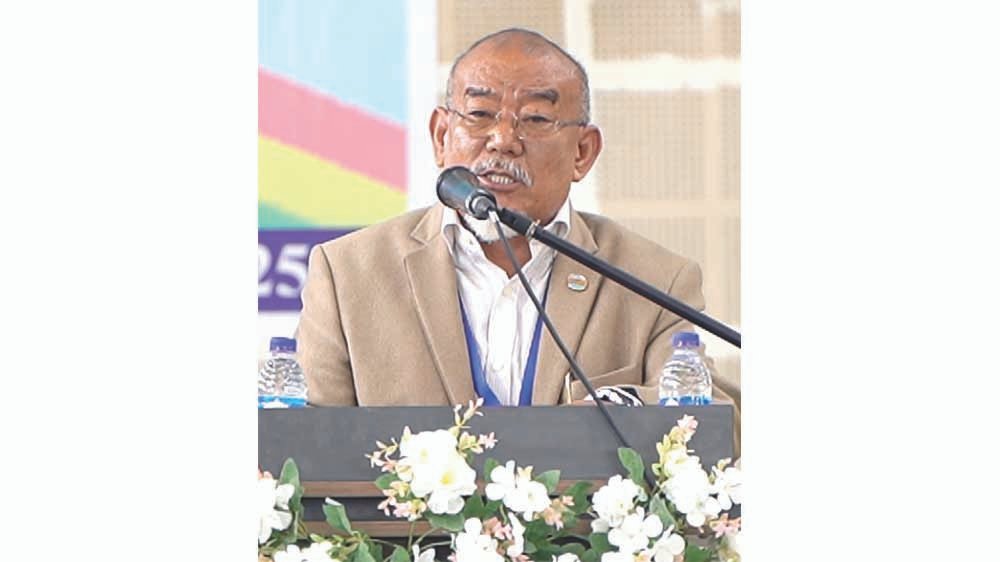
GPRN/NSCN(N.Kitovi) commemorated the 79th Naga Independence Day declaration on August 14 at Tatar Hoho-Ki at camp Kehoyi near Dimapur.
Speaking on the occasion, N.Kitovi Zhimomi, Ato Kilonser, GPRN/NSCN and also convener, Working Committee, Naga National Political Groups (WC NNPGs) warned that the NSCN(I-M) was harmful for the Naga people, and also questioned the latter’s reluctance to work together with the WC, NNPGs for an inclusive solution.
Kitovi recalled events of 1988 that led to the split in the NSCN resulting in years of violent clashes. He recalled that after 21 years of factional conflicts, civil society organisations and public paved the way for peace through the efforts of Forum for Naga Reconciliation (FNR) under Rev. Dr.WatiAier.
Kitovi said FNR was instrumental in cessation of factional fighting and killings and the signing of covenant of reconciliation which facilitated signing of 14 agreements under FNR amongst various Naga Political Groups. He said FNR strived to achieve peace between all groups and also to come together and work for Naga Solution.
Kitovi however said that despite all these efforts, NSCN (I-M) “hurriedly” signed the Framework Agreement with Government of India on August 3, 2015 and that it had resulted in no tangible outcome even after years of the signing of the FA.
On the other hand, he said the WC,NNPGs initiated their own dialogue with the government of India, resulting in the signing of the Agreed Position on November 17, 2017, “for transparency and to safeguard the Nagas”.
He said WC NNPGs held 52 rounds of negotiations with the Government of India, and concluded talks on October 31, 2019, and has since been waiting the final signing of the solution.
Kitovi added that when WC NNPGs were waiting for solution, the NSCN (I-M) in 2020, after all negotiations were concluded, brought out their demanded for Flag and Constitution on the plea that without these two, solution, would not be accepted.
He alleged that NSCN (I-M) not wanting to come together with NNPG,as stated by their president, Q Tuccu, was nothing new because even after signing 14 agreements in the past for a common goal, NSCN (I-M) went ahead and signed the Framework Agreement.
Kitovi however made it clear that Q Tuccu’s statement that NSCN (I-M) did not want to work together with NNPGs was not from his own heart but that he was made to sign the statement. “He might not have been forced , but he was made to sign”, Kivoti said.
He further alleged that only a handful of NSCN (I-M) leaders, “three to four individuals”, were aware of the contents of the Framework Agreement, while “99% of its members,” were kept in the dark.
Kitovi claimed that solution would instead “pose a danger” to the NSCN (I-M), due to their past actions, including massacring thousands of innocent Nagas, and leaving thousands of widows and orphans.
He reiterated that NSCN (I-M) should be straightforward on what was its agenda and openly tell people that they don’t want solution. Kitovi asked, if NSCN (I-M) doesn’t want to unite for the Nagas, then whom was it working for?
Kitovi claimed there was a huge difference between NSCN (I-M) and GPRN/NSCN. According to him, NNPG solution for entire Nagas and “unexpected” provisions for Nagas of Manipur and Arunachal Pradesh as well. On the other hand, he said for NSCN (I-M), attainment of solution would only benefit few individuals.
He later stressed that NNPGs remain open to unity for the greater good of Nagas, and reiterated that WC NNPGs’ philosophy was to pursue an inclusive solution benefiting all Nagas.
Earlier, the programme was chaired by special secretary to Collective Leadership, GPPRN/NSCN, Kanato Chophy, and director, Research Wing, GPRN/NSCN, Dr Subonglemba Aier, invocation offered by Chaplain, GHQ, GPRN/NSCN, Meren Lemtur, and welcome address delivered by kilo kilonser, GPRN/NSCN, HukaviYeptho.
Short speeches were also delivered by leaders of WC NNPGs, namely, president, NSCN-R (Akato led), and co-convener, WC NNPG, Akato Chophi, general secretary, NNC (Parents Body), Toshi Walling, ato kilonser, NNC/NPGN, Shitoho Chophi, ato kilonser, NNC/GDRN, George Yangba, and general secretary, UGN/NNC, Nupavi.
Special numbers were also presented by Alovi Ayemi, and LansobeniTungoe, while note of gratitude delivered by chief secretary, GPRN/NSCN, Kideon V Zhimomi, and benediction pronounced by Pastor, CHQ, GPRN/NSCN, Rev ZutoviAwomi.
For inclusive, early Naga solution
GPRN/NSCN ato kilonser and WC, NNPGs convener N. Kitovi Zhimomi on Thursday reiterated the importance of unity among all Nagas and affirmed that the Naga political journey was rooted in history.
Speaking to media persons on the sidelines of the 79th Naga Independence Day, Kitovi recalled the decades-long struggle and more than 16-17 rounds of agreements in the past, which failed to bear results. He said there was once a collective aspiration for a common platform towards a solution until the NSCN (I-M) unilaterally entered into the Framework Agreement (FA) with the Government of India on August 3, 2015. As the FA did not yield results, Kitovi said different groups came together without preconditions under the banner of NNPGs.
He recalled that on January 14, 2023, top leaders of NSCN (I-M) and NNPGs reached an understanding to expedite the Naga solution. However, he said that this was nullified by NSCN (I-M) through its Ministry of Information and Publicity just four days later.
Admitting past mistakes, Kitovi said the inability to bring all Naga people, NGOs, civil societies and political groups together in the initial stages was a major blunder. He questioned why NSCN (I-M) could not accept the inclusive nomenclature of NNPGs, adding that the NNPGs represented all Nagas across states and even in Myanmar.
Despite NSCN (I-M)’s reluctance, Kitovi said NNPGs remained open to collaboration and continued to extend a hand of partnership, adding that many within NSCN (I-M) desired an early solution. Warning that the Naga community was reaching a “dangerous point,” he urged urgent action to secure the future of the younger generation, claiming that 90% of Nagas supported the solution while only a few elements were attempting to derail it.
On the frequent visits of Government of India’s representative for Naga talks A.K. Mishra, Kitovi said Mishra was meeting stakeholders but no formal dialogue had been held with both NSCN (I-M) and NNPGs as the former continued to insist on a separate flag and constitution. He believed Mishra’s visits were to assess whether the “landing of the solution” would be smooth.
Kitovi informed that the NNPGs’ “Agreed Position” Status Paper had been shared with all Nagas, receiving broad acceptance, while the contents of the FA remained undisclosed. He urged the Government of India to compile both agreements to explore whether a unified solution could be achieved, but noted that the Centre had clarified both could not co-exist.
Terming the “Agreed Position” more inclusive, Kitovi said it provided for Nagas in Manipur, Assam, Arunachal Pradesh and across the border in Myanmar, unlike the FA which he claimed served a select few. He insisted the final outcome must benefit the entire Naga population and not be stalled for vested interests.
Calling upon Naga youth to actively shape their future, Kitovi said further delays would only complicate matters. Concluding, he stressed the urgency of finalising the Naga political solution, asserting that the Government of India was preparing to issue a final call soon.