
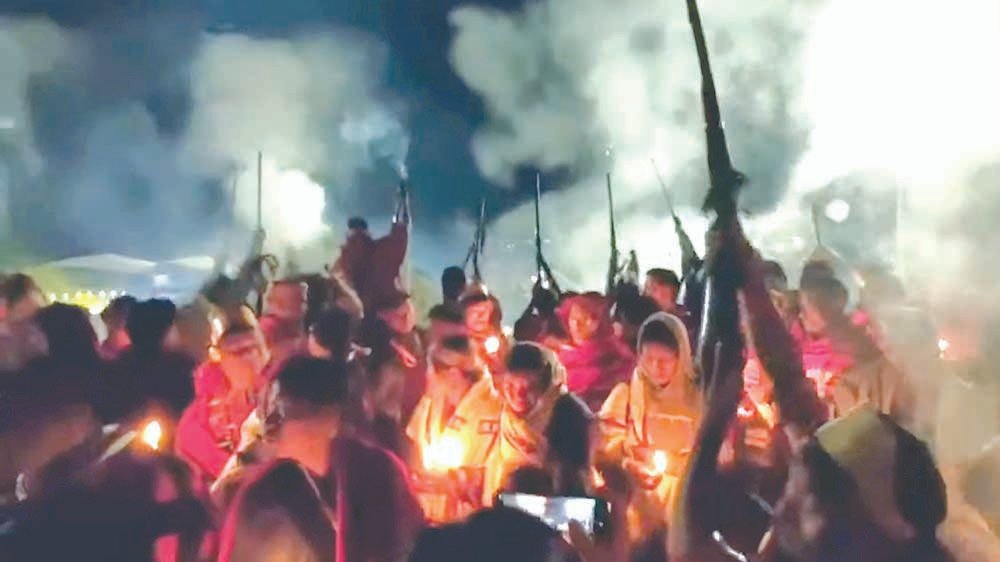
Amidst the ongoing festivities at the Hornbill Festival, Kisama, Eastern Naga Students’ Federation (ENSF) on Friday held a solemn candlelight vigil at the Konyak Morung, in memory of the 14 civilians killed by security forces on December 4 and 5, 2021, in the Oting massacre. The programme was organised to honour the victims and reaffirm its call for justice.
During the observance, ENSF president, Nuheymong Yimkhiung, presented a detailed ground report based on testimonies from eyewitnesses and survivors of the December 4 incident at Oting village, Mon district. He said earlier unverified and incomplete narratives surrounding the killings had caused deep wounds among the Konyak and Naga community. He stated that the report sought to present facts gathered directly from those who were present at the site.
According to the account shared, the first group of eight coal miners left Tiru mining area around 4:05 p.m. in a Bolero pickup. The second group, still at the mining site, reportedly heard gunshots shortly afterward but did not assume that the first group was in danger. When they later returned, they were allegedly stopped by a uniformed personnel who instructed them to avoid the usual shortcut to Oting and instead take the longer Pioneer Road, reaching the village at around 6 p.m.
Nuheymong said villagers became worried when the first group failed to arrive home even after two hours, despite the shortcut route usually taking just 30 minutes.
By 7:30 p.m., youths initiated a search operation after informing the district administration.
At around 8:13 p.m., the search team discovered the abandoned Bolero with a bullet mark on the windshield and bloodstains inside, he said.
Upon moving further, youths encountered a four-vehicle convoy of para-military forces. One vehicle allegedly attempted to flee, but the villagers intercepted the convoy. Nuheymong said the personnel reportedly claimed they had no information about the missing villagers and that they were only reinforcements. However, a search of the vehicles allegedly revealed six bodies of the miners hidden under a tarpaulin along with their belongings, he said. He alleged that there appeared to be attempts to dress the victims in combat attire.
The discovery triggered a confrontation, during which firing broke out, resulting in more casualties. Nuheymong stated that villagers alleged that security personnel positioned in surrounding ambush locations also opened fire. Personnel then fled the area using villagers’ motorcycles while firing, leaving several individuals critically injured, he stated.
The ground report, according to Nuheymong, also noted that two more individuals- Bipul Konwar of Assam and Ngampho Konyak- who had been hiding under a Poclain excavator at the coal depot and were not involved in the confrontation- were shot dead. Another civilian, Pongche Konyak of Jakphang village, was reported killed in his field hut. These accounts, Nuheymong stated, raised further doubts about claims of self-defence.
He added that on the following day, Dibrugarh Hospital authorities informed villagers that two injured individuals- initially assumed to have died- were brought to the hospital by personnel of the 21 Para unit. Hospital staff allegedly said they were told the injured were NSCN cadres, a claim that villagers questioned given the incident was later termed a case of “mistaken identity.”
Calling December 4 “a shameful day in the history of Indian intelligence,” the ENSF president said the killings raised grave concerns about the credibility of the national security apparatus. He reiterated the Federation’s demand for justice and the complete repeal of AFSPA from Nagaland. “We can no longer stand to witness another bloodshed,” he stated.
Speaking at the vigil, president of Eastern Naga People’s Union Kohima (ENPUK), Toshi Chang, said the event was organised to honour the victims not only for the tragic manner in which they lost their lives but for the lives they lived. He said grief continued for families “in quiet everyday moments” even four years after the incident.
Reflecting on the massacre, he said the tragedy had shown how collective grief united the people of Nagaland. He reminded that although four years had passed, “memory has no expiry date,” and that remembrance was important not to hold on to pain but to affirm that human life must never be taken for granted. He urged continued solidarity with the bereaved families.
Earlier, the programme was led by Pusho P, vice president, ENSF. Invocation was pronounced by Konnang Konyak, APY, KBBK. Welcome address was delivered by Khongjah, president, Kobyak Union Kohima, while prayer for the departed souls was offered by Rev. Nahngom Konyak, pastor, KBBK. The vigil was attended by various tribes, students and visitors at the Hornbill Festival venue.
After the vigil, traditional guns were fired and members of the community beat the log drum in honour of the victims, symbolising unity and remembrance.
Oting massacre: ENSF vigil reasserts justice call
CorrespondentKOHIMA, DEC 5 (NPN)