
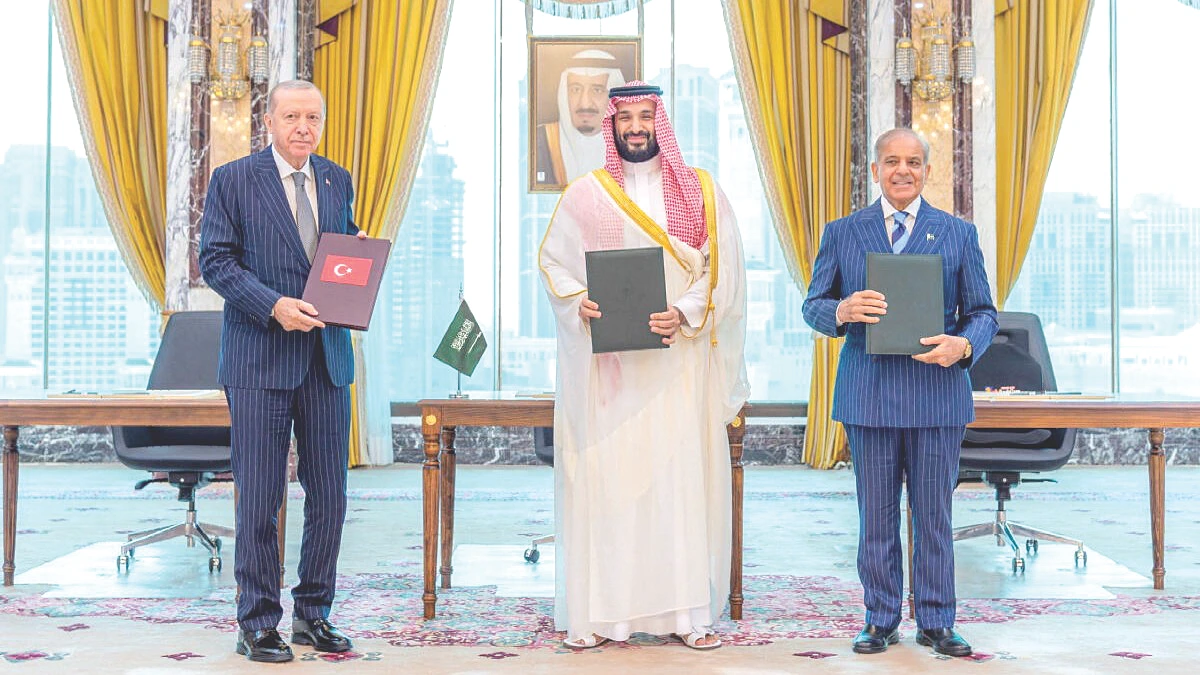
ISLAMABAD, AUG 7 (PTI): Pakistan, Saudi Arabia and Turkiye on Friday signed a joint defence agreement under which an attack against any one of the three countries will be regarded as an attack against them all, amid escalating tensions in West Asia.
Pakistan Prime Minister Shehbaz Sharif, Saudi Crown Prince Mohammed bin Salman and Turkish President Recep Tayyip Erdogan signed the ‘Makkah Joint Defence Agreement’ during a meeting at Al-Safa Palace in Mecca, according to a joint statement.
The agreement, signed during the Makkah Al-Mukarramah Summit for Joint Defence, is “intended to strengthen collective deterrence against any act of aggression, and stipulates that any armed attack against any one of the three States shall be regarded as an attack against them all,” it added.
It further provides for the “enhancement of all aspects of defence cooperation among the three States,” the statement said.
The development comes at a time when the West Asia conflict has widened across multiple fronts, including the Red Sea and the Bab al-Mandeb Strait, prompting Gulf states to strengthen regional security coordination. Sharif had visited Saudi Arabia in April, during which he had held talks with the Kingdom’s top leadership.
Last week, Saudi Arabia proposed a Multinational Maritime Defence Coalition (MMDC) to safeguard commercial shipping lanes and critical energy supply routes through the Red Sea and the Bab al-Mandeb Strait after Saudi ships came under attack from Iran-backed Yemen’s Houthis.
Fourteen countries, including Pakistan, expressed support for the initiative, underscoring growing concerns over the security of one of the world’s most vital maritime corridors, according to reports.
Also, Pakistan last week said it is “doing its utmost” to bring the US and Iran back to the negotiating table under the Islamabad Memorandum of Understanding signed on June 18.
The Makkah agreement reflects “the three States’ shared commitment to further strengthening their collective security and to promoting peace, security, and stability in the region and beyond, in pursuit of a secure and prosperous future,” the statement said.
In September last year, Pakistan and Saudi Arabia had signed the “Strategic Mutual Defence Agreement”, pledging that any attack on either country would be treated as an “act of aggression against both.”
Under the defence framework, Pakistan deployed military personnel and aircraft to Saudi Arabia to support joint training, defence cooperation and the kingdom’s security requirements.
The joint statement said that the Makkah agreement is “guided by the longstanding historical ties among the three states, based on the enduring bonds of brotherhood and Islamic solidarity that unite them, and building upon their shared strategic interests and longstanding defence cooperation.”
During Friday’s summit, the three sides reviewed their ties and discussed several issues of mutual interest.
Before the summit, Prime Minister Sharif and Chief of Defence Forces Field Marshal Asim Munir, who arrived here on a three-day official visit on Thursday, met the Saudi crown prince, the prime minister’s office said.
Sharif was also accompanied by Deputy PM and Foreign Minister Ishaq Dar and Defence Minister Khawaja Asif, among others, it said.
“Although taking place amid heightened tensions in the Gulf, the visit carries significance beyond the immediate crisis and short-term considerations. It will further strengthen bilateral relations, deepen strategic cooperation, enhance coordination on regional and international issues of mutual interest and also reinforce multilateral cooperation,” the Foreign Office had said on Thursday.
Iran criticises joint defence deal
A prominent Iranian lawmaker on Friday criticised a joint defence agreement signed by Saudi Arabia, Turkey and Pakistan, saying that the deal will not bring security to Riyadh.
Saudi Arabia, Turkey and Pakistan signed the deal that would treat an attack on one as an attack on all three, officials said, solidifying cooperation between the three regional powers at a time of growing security concerns.
Ebrahim Rezaei, a member of the Iranian Parliament’s National Security and Foreign Policy Commission, criticised the deal on X.
“The Saudis should know that a paper agreement with Turkey and Pakistan will not bring them security, just as years of one-sided milking’ by the Americans did not bring them security. Change your policies so that you do not have to #BegForSecurity from others,” he wrote.
The agreement was signed in the Saudi holy city of Mecca by Saudi Crown Prince Mohammed bin Salman, Turkish President Recep Tayyip Erdogan and Pakistan’s Prime Minister Shehbaz Sharif, according to statements from all three countries.
The agreement between the three Sunni Muslim-majority states brings together oil-rich Saudi Arabia and nuclear power Pakistan as well as Turkiye, which has NATO’s second-largest army and a rapidly growing defence industry.
It would increase cooperation and deterrence at a time of increased regional uncertainty and threats from the war in Iran.
A statement from Saudi Arabia insisted that the agreement does not amount to a military pact and would not affect the kingdom’s existing partnerships.
“The agreement does not represent any orientation toward building a military axis or sectarian/religious bloc, and it is not linked to nuclear endeavors or an arms race, but rather to building sustainable self-reliant capabilities,” the statement read. “The agreement does not come at the expense of the Kingdom’s strategic and strong relations at the Gulf, Arab, and international levels.”
A Turkish government official described the agreement as “purely defensive in nature,” saying the sides have pledged mutual support only for defense.
The official, who spoke on condition of anonymity because he was not authorised to discuss the issue publicly, insisted that the deal is “not against any specific actor” and was open for other regional countries to join.
The agreement does not abrogate or replace any bilateral or multilateral agreements between these states or with other states and organisations, the official added.
In addition to the three countries’ commitment to supporting one another’s security, the agreement seeks to enhance defence industry cooperation and military coordination, another Turkish official said.
In Islamabad, defence analyst Abdullah Khan described the agreement as a natural evolution and formalisation of decades of strategic ties among Pakistan, Saudi Arabia, and Turkey, saying a changing regional security environment and the evolving nature of warfare had increased the need for closer cooperation.
Khan said the pact was “purely defensive” and not directed against any country, with collective deterrence intended to raise the cost of aggression and prevent conflict.
The analyst said the three countries bring complementary strengths to the arrangement: Pakistan’s military experience and expertise in managing escalation, Saudi Arabia’s economic strength and regional influence, and Turkey’s advanced defense technology and industrial capabilities.
Ozgur Unluhisarcikli, director of the Ankara office for The German Marshall Fund think tank, said the agreement was the culmination of the countries’ shared concerns over regional fragmentation, civil conflict, and armed non-state groups.
“This is a reflection of their growing desire for greater regional stability,” Unluhisarcikli said. “They see state fragmentation, civil conflict, an environment of non-state actors as sources of instability.”
Unluhisarcikli said Pakistan, Saudi Arabia and Turkey have varying degrees of concerns over Iran and Israel: Pakistan is geographically removed, and while Turkey and Saudi Arabia both see Iran and Israel as destabilizing, Ankara is more concerned about Israel and Riyadh more concerned about Iran.
“At the end of the day, all three countries are concerned about instability,” he said.