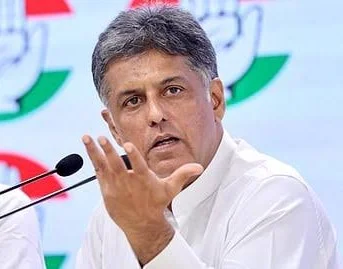
NEW DELHI, AUG 17 (PTI): Senior Congress MPs Manish Tewari and Vivek Tankha on Monday alleged that questions raised by parliamentarians are routinely being disallowed or left unanswered, raising concerns over the government’s accountability to Parliament.
The remarks came a day after the Cockroach Janta Party (CJP) alleged that three sets of questions about its protests were disallowed in the Lok Sabha during the recent Monsoon Session, citing provisions governing the admissibility of questions.
Tewari, Lok Sabha MP from Chandigarh, said more than 120 questions submitted by him between September 2020 and August 2025 — covering issues such as incursions at the Chinese border, Operation Sindoor, terrorism by Pakistan, crude oil imports from Russia, farmer protests and constituency development — had been disallowed.
“We have not updated the list since. Will ask my colleagues to do so,” Tewari said in an X post.
He said repeated letters to Lok Sabha Speaker Om Birla and the Lok Sabha Secretariat over the years had “fallen on deaf ears”.
“Government is diffident in answering questions that are embarrassing for it. Therefore, these questions are rejected at the very threshold citing frivolous rules, without even the courtesy of a perfunctory explanation,” Tewari alleged.
He said the disallowance of questions concerning CJP’s protests was now “a norm and not the exception” and the situation was “very unfortunate”.
Tankha, a Rajya Sabha MP, said he had submitted around 90 questions in the Upper House during the current session but had received answers to fewer than 10.
“Not answering parliamentary Qs is a pattern statement. Government is not answerable to Parliament in a democracy; symbolises our institutional irrelevance & decay,” Tankha said in an X post. Tewari also attributed the weakening of parliamentary scrutiny to growing disruptions in legislative proceedings.
“When disruptions and sloganeering has been the norm and not the exception since mid-1980s, when political parties across the board take pride in wiping out entire sessions of Parliament rather than winning debates by reasoned arguments, when parliamentarians and legislators are adjudged on their ability to scream and shout in the well of the House and outside rather than on the strength of cogent submissions, then the demise of such institutions is guaranteed,” Tewari said.
“Parliament and legislative institutions today are nothing more than gladiatorial arenas to seize executive power rather than hallowed chambers of deliberations to make good laws and hold the government to account,” he added. The CJP on Sunday said three sets of questions submitted by DMK MP Matheswaran V S on the recent youth protests were disallowed during the Monsoon Session.
CJP chief spokesperson Saurav Das said the questions sought information on issues such as refund of NEET-UG 2026 application fees, public distrust in the government, facilities provided to protesters in Delhi, the government’s engagement with protesting students and youth, student welfare, paper leaks, education reforms and the treatment of people exercising their right to peaceful protest.
Matheswaran confirmed that the questions had been disallowed and that he received the information through the Lok Sabha members’ portal.
The CJP-led protests began on June 6 over wider concerns regarding paper leaks during competitive examinations, including the NEET-UG, and demanding examination reforms and student welfare. The agitation intensified after activist Sonam Wangchuk joined the protest at Jantar Mantar on June 28 and began an indefinite hunger strike.
The protesters later organised a ‘Sansad Chalo’ march on July 20. Police action on young protesters during the march, including the alleged use of pellet guns, became a major issue, with opposition parties raising the matter in Parliament and seeking accountability over alleged use of force against agitating students.
The CJP called off its agitation on July 25 after the government accepted its demands, including the resignation of Dharmendra Pradhan as education minister.
The Lok Sabha website states that admissibility of questions is governed by Rules 41 to 44 of the Rules of Procedure and Conduct of Business, besides the Speaker’s directions, parliamentary precedents and established practices.