
Staff Reporter
DIMAPUR, NOV 27 (NPN): Principal Chief Conservator of Forests (PCCF) and Head of Forest Force, Nagaland, Vedpal Singh, stressed the importance of community participation in preventing and controlling forest fires, saying that the Forest Department alone cannot effectively tackle the problem without the cooperation of tribal hohos, civil society organisations (CSOs) and local communities.
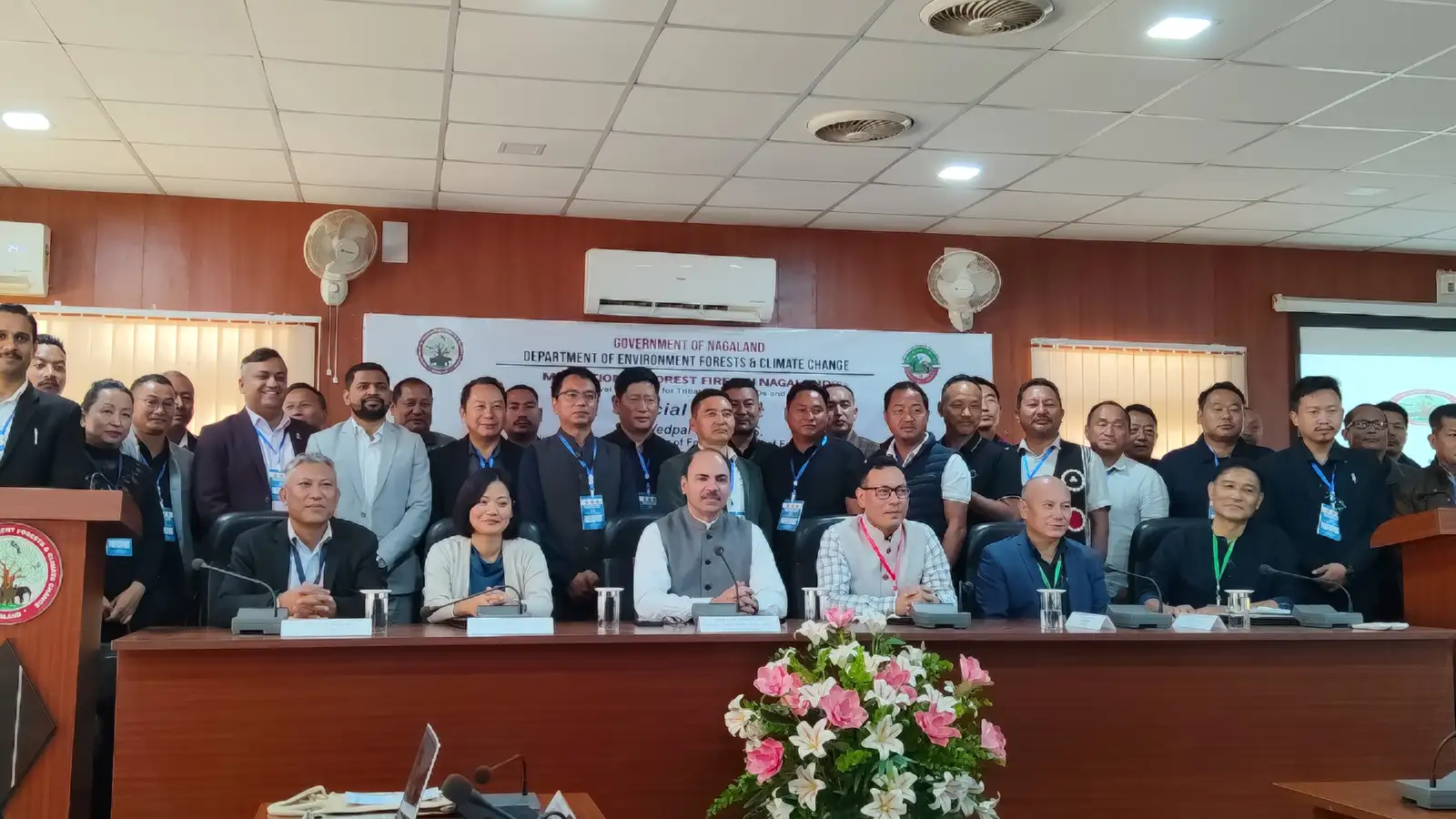
Addressing a state-level workshop on mitigation of forest fires in Nagaland as the special guest at the Conference Hall of the Forest Office Complex, Midland Colony, Dimapur, on Friday, Singh said public awareness was crucial as most forests in Nagaland were owned by communities, villages, clans and individuals.
Pointing out that forest fires were largely man-made, he said they could be significantly reduced through awareness and precautionary measures, particularly during jhum cultivation, picnics and other activities involving the use of fire in forest areas. Singh said community participation was equally important in controlling forest fires once they broke out, as factors such as wind direction and terrain often made fires difficult to contain.
He noted that people living near forests were usually the first to notice such incidents and could act as first responders before authorities arrived.
The PCCF urged tribal hohos, CSOs, churches and other organisations to create awareness at the grassroots level and encourage people to exercise caution while handling fire. He also appealed to the public to assist the Forest Department and other agencies in extinguishing forest fires whenever required.
Emphasising the need for collective action, Singh said the department must work closely with public organisations and NGOs to reduce forest fire incidents. He added that prevention remained the most effective strategy, as controlling fires after they spread could be an extremely challenging task.
The workshop was organised by the State Environment & Forestry Training Institute (SEFTI), Dimapur, under the Department of Environment, Forests & Climate Change, Nagaland, and attended by representatives of tribal hohos, CSOs and Divisional Forest Officers (DFOs) from across the state.
Delivering the keynote address, SEFTI director Rampaukai said the workshop was part of a forest fire mitigation scheme sanctioned by the Ministry of Environment, Forest and Climate Change, Government of India, and jointly implemented by the Nagaland State Disaster Management Authority (NSDMA) and the Department of Environment, Forests & Climate Change.
He informed that the training programme was being conducted in three modules. The first module, held on November 13 and 14, trained around 60 to 70 range and beat officers, who were expected to further sensitise villagers in their respective jurisdictions.
According to Rampaukai, the second module, conducted on Friday, focused on DFOs, tribal hohos and CSOs, bringing together forest officials and community stakeholders to strengthen coordination in forest fire prevention and management.
He observed that communities were the custodians of natural resources, including forests, biodiversity, wildlife and medicinal plants, while the government’s role was to guide, facilitate and support them in managing forest fire-related challenges.
Stressing the importance of shared responsibility, Rampaukai said forest fires resulted in losses for both landowners and the Forest Department through the destruction of trees, wildlife and other valuable resources.
The second session of the workshop covered topics including the Wildlife Protection Act, 1972, Nagaland-specific vulnerability mapping, the Nagaland Action Plan for Forest Fires (NAPFF), community-based forest fire management, and fire-alert and smart surveillance systems. The session concluded with feedback and experience-sharing by participants.
The programme was chaired by SEFTI faculty Aosungla Imsong. The welcome address was delivered by Lhinghoikim Touthang, Conservator of Forests (RPU), while the vote of thanks was proposed by Imtitongdang Ozukum, Assistant Director, SEFTI.