
CM inaugurates 51 school infra under Samagra Shiksha
In a move to strengthen the education sector in Nagaland, chief minister Dr. Neiphiu Rio virtually inaugurated 51 school infrastructure funded under Samagra Shiksha on August 2.
The virtual inauguration included 15 new school buildings, additional classrooms in 17 schools, 18 teachers’ quarters and one residential hostel spread across the state.
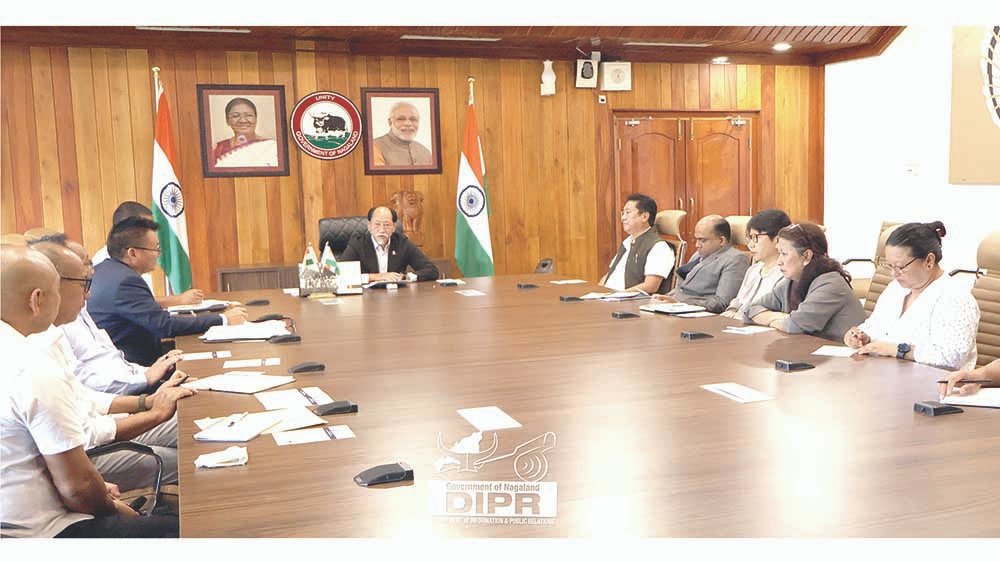
Speaking at the inaugural programme held at the Chief Minister’s Residential Complex, Kohima, Dr. Rio said it was a significant step in strengthening education infrastructure and expressed gratitude to the Government of India for its continued support. He also lauded the efforts of the Samagra Shiksha team led by State Mission Director, L. Jamithung Lotha.
The chief minister lamented that many school infrastructures in the state remained temporary and stressed the need for permanent structures with quality workmanship. He appreciated the Department of School Education for their efforts despite challenges and called for a comprehensive study to assess the department’s needs and requirements.
Despite the state’s difficult geographical terrain, especially in remote areas, Dr. Rio said Nagaland was making progress in transforming school infrastructure. He emphasised the importance of community participation, stating that good infrastructure alone was not enough and urged communities to take ownership to ensure proper maintenance and effective utilisation.
Underscoring the importance of quality education, he said it was central to development, empowering citizens, driving economic progress, opening opportunities and building a prosperous society. He called for collective efforts to create a safe, inclusive and nurturing environment for students’ holistic development.
Advisor for School Education & SCERT, Dr. Kekhrielhoulie Yhome, informed that out of 16,087 rooms in government schools, 13,767 rooms (86%) were used for instructional purposes, while the rest served as laboratories, libraries and teachers’ rooms. He said the rooms were categorised based on condition—good, requiring major or minor repairs, and dilapidated—and that schools were classified as pucca, partially pucca and kutcha.
Dr. Yhome stated that Samagra Shiksha funding had significantly assisted in meeting the need for school buildings. He said the department was working towards the goal of Viksit Bharat and outlined a target to bring back around one lakh students to the school system by 2030. He expressed hope that improved infrastructure would lead to better enrolment in government schools.
In his introductory address, State Mission Director L. Jamithung Lotha, gave an overview of Samagra Shiksha—an overarching scheme for school education from pre-primary to class XII. He stated that the scheme integrated Sarva Shiksha Abhiyan (SSA), Rashtriya Madhyamik Shiksha Abhiyan (RMSA) and Teacher Education (TE) under the National Education Policy 2020. Key interventions under the scheme, he said, included infrastructure development, free textbooks, uniforms, teacher training and smart classrooms. He also highlighted various issues faced in implementation.
Delivering the vote of thanks, commissioner & secretary, School Education & SCERT, Kevileno Angami, appreciated the chief minister for his guidance and support and acknowledged all those involved in the successful implementation of the projects.
The virtual inauguration included 15 new school buildings, additional classrooms in 17 schools, 18 teachers’ quarters and one residential hostel spread across the state.
The event was also attended by A. Pongshi Phom, MLA; commissioner & secretary to chief minister Mohammad Ali Shihab and officials from line departments.