
Correspondent
KOHIMA, AUG 25 (NPN): Nagaland police is testing a new single-window digital system that would allow members of the public to lodge and electronically track civil and criminal grievances, with its launch expected within the next 10-12 days, the Director General of Police (DGP) Nagaland Rupin Sharma announced Tuesday.
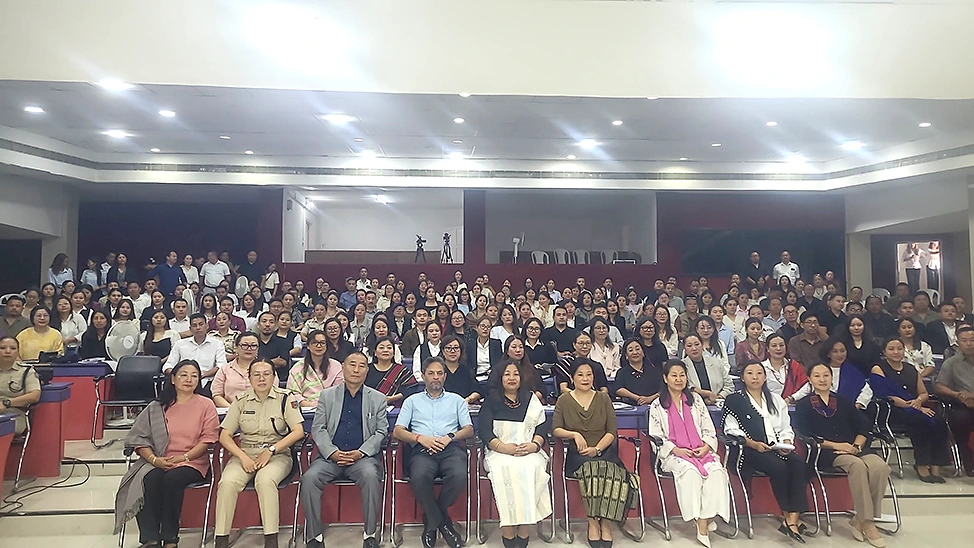
Speaking at a state-level convergence meeting on addressing violence against women and children at Capital Convention Centre here, Sharma said the proposed system would assign each complainant a unique number, enabling them to track the status of their complaint and subsequent police enquiry.
DGP said the complaint would be assigned by the officer-in-charge to an investigating officer, who would examine whether the matter involved a cognisable offence, a non-cognisable offence or was purely civil in nature.
Sharma said an FIR would have to be registered if a cognisable offence was disclosed.
In cases involving non-cognisable offences, he said the complainant would be advised to approach the magistrate for appropriate directions, while purely civil matters would be identified as being outside the jurisdiction of the police.
State police chief said the system would also enable complainants to know whether an FIR had been registered and, if not, the reasons for not registering one. As provided under the new criminal laws, complainants would also be able to download a copy of the enquiry conducted by the police officer.
“Your complaints will not go unanswered,” Sharma said.
DGP said the system would allow senior officers—from the investigating officer and officer-in-charge to SDPOs, DCPs, DIGs, IGs and the DGP—to monitor the progress of complaints and enquiries.
According to Sharma, the initiative could be particularly useful for women and children by enabling smaller incidents of child abuse, stalking and harassment to be reported before they developed into more serious patterns of offending behaviour.
The announcement came during a state-level convergence meeting organised by Mission Vatsalya and Mission Shakti under the Department of Social Welfare in collaboration with Nagaland Police and Nagaland State Legal Services Authority (NSLSA).
Sharma said that while several mechanisms were already in place to address violence against women and children, more effective intervention and coordination were needed on the ground.
He noted that the police were frequently approached by the public on a wide range of issues, including disasters, thefts, landslides, roadblocks, monetary disputes, fraud, family conflicts, domestic violence and child abuse, even where the police might not have direct legal authority to intervene.
Highlighting the importance of reporting offences, Sharma urged people not to remain silent, saying authorities could understand the extent of a problem only when cases were brought to their notice.
He also stressed the need to distinguish between civil disputes and criminal matters.
On domestic violence and child abuse, Sharma said agencies dealing with such cases must be sensitive and empathetic while coordinating to ensure that the appropriate authority handled each case. He said the police would extend all possible assistance within the limits of the law, including coercive measures such as separation or arrest wherever required.
Sharma also raised concern over money lending in Nagaland, claiming that thousands of families had suffered because of interest rates that could go as high as 20% per month. He said such practices should not merely be viewed as illegal money lending but, in his opinion, could amount to extortion.
He further said liquor consumption had affected thousands of families, including women and children, and noted that while other departments had specific powers under the Nagaland Liquor Total Prohibition Act, the public often expected the police to act because of the trust associated with the force.
DGP also cautioned NGOs, civil society organisations and the public against taking the law into their own hands. He said certain cognisable offences, including rape and stalking, could not be dealt with by village councils or customary courts and should be reported to the police.
Social Welfare director Tosheli Zhimomi said that during 2025-26, Sakhi-One Stop Centres handled 311 cases, while Women Helpline 181 received 144 cases involving gender-based violence and information-seeking calls.
Under Mission Vatsalya, Child Welfare Committees received 640 cases involving children in need of care and protection, while Juvenile Justice Boards received 56 cases involving children in conflict with law. A total of 639 children were living in Child Care Institutions, while Child Helpline 1098 received 2,632 cases between September 1, 2023 and March 25, 2026.
Earlier, Olemjungla Aier said the meeting was organised to enable key stakeholders to establish a seamless institutional mechanism for comprehensive protection of women and children.
She highlighted that Mission Shakti is dedicated to the safety, security and empowerment of women.
On Mission Vatsalya, she said the programme, formerly known as the Child Protection Services Scheme, was fully operational across all 17 districts. It includes District Child Protection Units, Child Welfare Committees, Juvenile Justice Boards, Child Care Institutions and the Child Helpline 1098, which provides round-the-clock emergency assistance to children in distress.
She expressed hope that the deliberations would address challenges faced on the ground and help move beyond departmental boundaries to create a strong coordinated mechanism for service delivery.