
Banks cite job security, EPF, employer profile and recovery concerns
Bendangchuba
DIMAPUR, AUG 23 (NPN): At a time when the Nagaland government is encouraging youths to move away from traditional dependence on government jobs and explore private employment and entrepreneurship, salaried private-sector employees in the State say access to bank credit remains a significant challenge.
Several private employees told Nagaland Post that even with regular monthly salaries of Rs 25,000 or more, obtaining a personal loan is far from assured. Applicants said they are often asked to submit salary slips, bank statements, employment certificates and other documents, only to find that the application may still be rejected.
Bank managers, however, said the issue is not simply the salary amount. According to them, banks assess the overall risk profile of a borrower, including employment stability, the financial standing of the employer, EPF coverage, payroll systems, staff turnover and the likelihood of continued income throughout the repayment period.
Private-sector employees working for smaller companies are considered comparatively riskier, particularly where employment benefits are limited or documentation is less formalised. Bank officials also said the absence of EPF, while not a mandatory requirement for obtaining a loan, can indicate a lower level of formalisation of the employer.
Another concern is employer guarantees. Officials said many private employers are unwilling to act as guarantors or assume responsibility for employees’ loans. Even where employment bonds or contracts exist, employees can change jobs or leave organisations, creating uncertainty over repayment capacity.
This contrasts with government employees, whose regular salaries and established service conditions are generally viewed as more predictable. While bankers describe this as risk assessment rather than preferential treatment, private employees perceive the difference as discrimination based on the nature of their employment.
The centralisation of loan approvals adds to the difficulty. Bank officials said branch-level processing does not necessarily mean final approval, as applications beyond prescribed limits or categories may have to be referred to controlling or regional offices outside Nagaland.
Applicants also said they are sometimes not given clear reasons for rejection after meeting the basic eligibility and documentation requirements. Greater transparency in communicating the reasons for rejection, they argue, would allow applicants to address deficiencies rather than repeatedly approach different lenders.
Bankers, meanwhile, cited recovery concerns and non-performing assets as another reason for cautious lending. The State Level Bankers’ Committee report for September 2025 showed high NPA ratios in certain government-sponsored schemes—25.70% under PMEGP, 16.48% under NULM, 10.04% under MUDRA and 6.63% under SUI. These figures relate to specific schemes and should not be treated as the NPA rate for all bank loans in Nagaland.
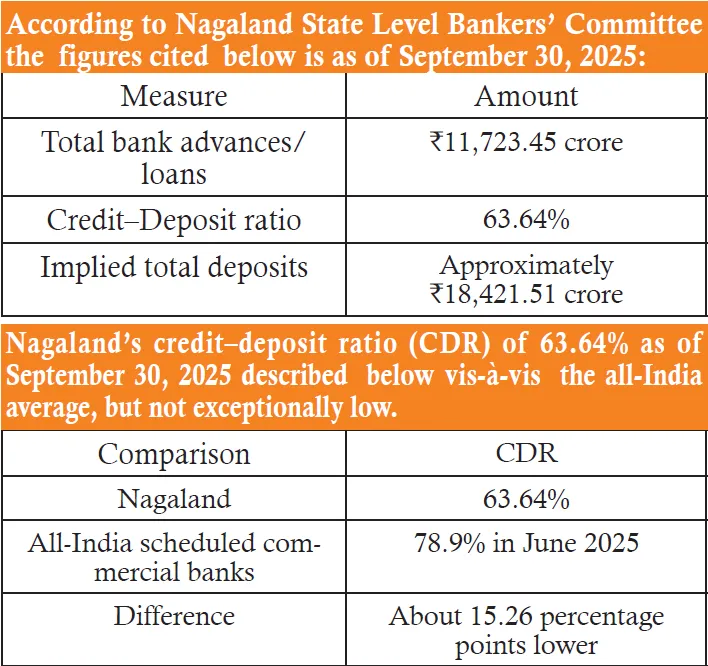
At the same time, credit is flowing into the State. The SLBC report showed a Credit-Deposit ratio of 63.64% as on September 30, 2025.
Total bank advances stood at Rs 11,723.45 crore, while priority-sector advances accounted for Rs 2,909.62 crore. Advances to the MSME sector stood at Rs 1,672.49 crore, registering 13.47% year-on-year growth, with micro-enterprise advances rising 34.69% to Rs 1,310.77 crore.
The figures indicate that lending activity is growing, particularly in the MSME sector, even as salaried private employees continue to report difficulty accessing personal credit.
The issue becomes more significant in the context of the State’s employment policy. Nagaland Skill & Entrepreneurship Development Mission has acknowledged the State’s historical dependence on government employment and subsistence agriculture while identifying opportunities in hospitality, healthcare, IT, construction, renewable energy and the digital economy.
The government has also reported 48,655 enterprises registered on the Udyam portal as of March 9, 2026, including 48,464 micro enterprises. Further, 777 MSME units have reportedly been established under the Chief Minister’s Micro Finance Initiative, generating more than 1,500 direct employment opportunities.
However, the transition towards a private-sector-led economy requires more than encouraging young people to take up private jobs. It also requires a financial ecosystem that recognises stable private employment and provides reasonable access to formal credit.
For a salaried employee, access to loans can be important not only for purchasing a vehicle or house but also for education, family requirements, emergencies or starting a small business.
The larger question, therefore, is whether Nagaland’s push towards private employment and entrepreneurship is being matched by adequate financial inclusion.
If private-sector employees continue to be assessed primarily through the perceived stability of their employers rather than their individual income, banking history and repayment capacity, many may remain financially constrained despite having regular employment.
For a State seeking to reduce dependence on government jobs, making private employment economically viable must also include ensuring that those employed in the private sector are able to access credit on transparent, fair and risk-based terms.