
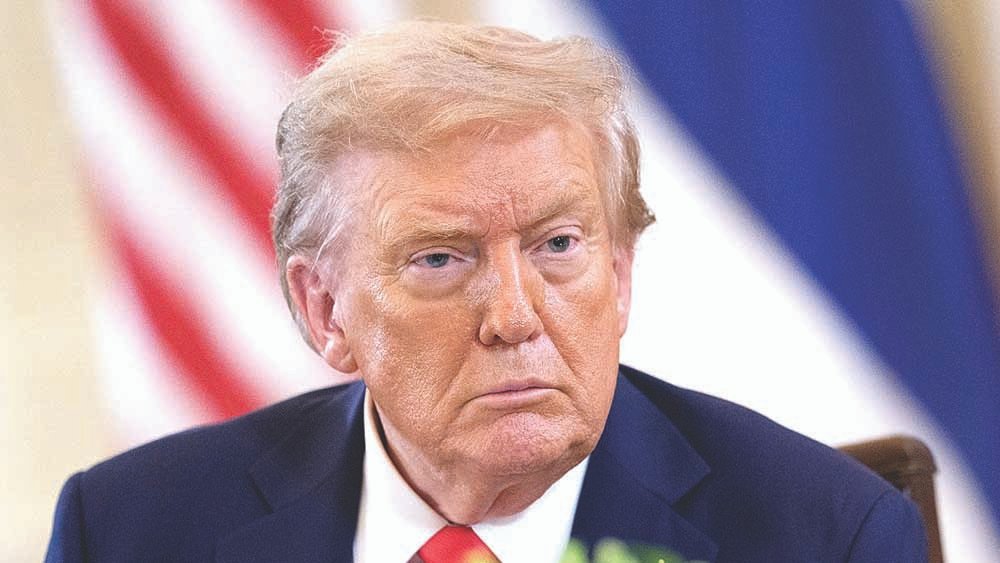
Trump says will approach SC
In a setback to U.S. President Donald Trump, a federal appeals court struck down most of the administration’s global reciprocal tariffs.
In its ruling, the court ruled that President Trump did not have the “power to impose tariffs.” Hours after the ruling President Trump stated that he would approach the Supreme Court on the ruling.
“The statute bestows significant authority on the President to undertake a number of actions in response to a declared national emergency, but none of these actions explicitly include the power to impose tariffs, duties, or the like, or the power to tax,” it said.
The ruling stopped short of implementing the order until October 14 to provide time to the administration to seek legal recourse in the Supreme Court.
However, U.S. tariffs on steel and aluminium, which were enacted through a different legal authority, would stay in place.
Remarking on the President’s use of the 1977 International Emergency Economic Powers Act (IEEPA) to impose “reciprocal” tariffs, the court said it did not give Trump “unlimited authority to impose tariffs.”
“The statute neither mentions tariffs (or any of its synonyms) nor has procedural safeguards that contain clear limits on the President’s power to impose tariffs,” the court mentioned in its ruling.
The 25 per cent reciprocal tariff that hit India is likely to be removed under the ruling if it survives the Supreme Court challenge.
It was not explicit if the punitive 25 per cent tariff for buying Russian oil is covered by the court ruling because Homeland Security Secretary Kristi Noem said it was to address “threats to the United States” by Russia.
Reacting to the ruling on social media, Trump wrote, ALL TARIFFS ARE STILL IN EFFECT!” and added that if the ruling is implemented, it would “literally destroy the United States of America.”
He also indicated that an appeal to the Supreme Court is imminent. “Now, with the help of the United States Supreme Court, we will use them to the benefit of our Nation,” he posted on Truth Social.
Since returning to power in January, President Trump has used tariffs as a major bargaining tool to seek major concessions from countries in trade agreements or to punish those who refused to comply.
In May, the U.S. Court of International Trade in New York had also ruled against Trump, saying the American President exceeded his authority to impose tariffs.