
Correspondent
KOHIMA, SEP 1 (NPN): The revised Frontier Nagaland Territorial Authority (FNTA) Bill, 2026, introduced in the Nagaland Legislative Assembly on Tuesday, proposes a 62-member regional authority with legislative, executive, administrative and financial powers over 46 subjects across the six districts of eastern Nagaland.
Deputy chief minister Y Patton introduced the Bill during the ongoing ninth session of the 14th Nagaland Legislative Assembly after the previous FNTA Bill, passed by the House on March 26, 2026, during the Budget Session, was withdrawn.
Speaker Sharingain Longkumer put the motion before the House, following which it was withdrawn through a voice vote. The revised Bill is scheduled to be taken up for consideration and passing on September 3. The Speaker informed members that amendments or clarifications, if any, should be submitted by 2 pm on Wednesday.
The proposed legislation seeks to constitute the FNTA for Tuensang, Mon, Longleng, Kiphire, Noklak and Shamator districts. It is based on the Memorandum of Agreement (MoA) signed on February 5, 2026, among the Government of India, Government of Nagaland and Eastern Nagaland Peoples’ Organization (ENPO).
According to the Bill, the FNTA is intended to provide democratic and decentralised self-governance at the regional level while remaining within Nagaland and the constitutional framework. It seeks to uphold the autonomy of the FNTA in the spirit of Article 371(A), with legislative, executive and financial autonomy.
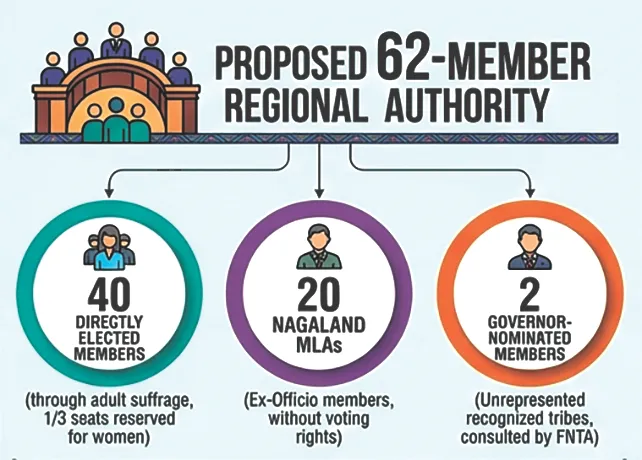
The authority will comprise 62 members, including 40 directly elected members from territorial constituencies through adult suffrage, with one-third of the seats reserved for women. Two members will be nominated by the Governor, in consultation with FNTA, from recognised tribes of the Frontier Nagaland Territory (FNT) that may be unrepresented or under-represented.
The remaining 20 members will be Nagaland MLAs elected from Assembly constituencies falling within the FNT. They will be ex-officio members without voting rights.
The 40 elected members will represent 40 single-member territorial constituencies. Their territorial limits will be determined by the State Government through an order published in the official Gazette, while elections will be under the overall control of the State Election Commission. Elected and nominated members will normally hold office for five years.
The executive authority of FNTA will vest in an Executive Council comprising not more than nine members, headed by a Chief Executive Member (CEM), along with a Deputy CEM and other Executive Council members.
The CEM and deputy CEM will enjoy status equivalent to cabinet ministers in the State for protocol purposes, while other Executive Council members will have status equivalent to Ministers of State within the FNT.
Before the elected authority is constituted, the State Government may establish an Interim Council. The Governor may nominate up to 13 members to the Interim Council, recommended by ENPO in consultation with respective Tribal Councils. Up to four elected representatives—one Member of Parliament and three MLAs from the FNT—may also be nominated as advisers to facilitate coordination with the Central and State governments.
The Interim Council will function for a maximum of one year from its constitution or until the first elected FNTA is constituted, whichever is earlier.
A major feature of the revised Bill is the transfer of 46 subjects to FNTA. These include agriculture and allied activities, tribal art and culture, cooperation, non-reserve forests, irrigation, jhum cultivation, fisheries, health, school education, horticulture, labour and employment, land records and revenue, power and renewable energy, public transport, district roads, rural development, social welfare, tourism, Village Guards, veterinary and animal husbandry, water resources, sports, handloom and handicrafts, trade and commerce, housing, tribal affairs, public health engineering, village customary courts, food and civil supplies, markets and fairs, DUDA, and fire and emergency services up to district level.
The transfer of powers will have certain limitations. Health and Family Welfare will initially be transferred only up to the Primary Health Centre level, while the feasibility of transferring higher medical centres will be examined after assessing the effectiveness of the arrangement. Geology and Mining will remain exclusively with the State Government, although a regional office will be established under FNTA. Tourism projects having State-wide potential will also remain with the State Government, while projects exclusively within ENPO areas will be managed by FNTA.
FNTA will be empowered to formulate integrated development plans and implement schemes for the region. It may also make laws, rules, regulations and orders on matters listed in the First Schedule, subject to the general policy of the State Government.
Its legislative powers, however, will remain subject to the State’s constitutional and legislative framework. A proposed law must first be affirmed through a resolution by a majority of voting members of FNTA.
It will then be forwarded to the State Government, which will submit it with its comments to the Governor. The law will have no effect until it receives the Governor’s assent and is published in the State Gazette.
Existing laws of Nagaland will continue to apply in the FNT. If an FNTA law or regulation concerning a transferred subject conflicts with a State law, the State law will prevail to the extent of the conflict.
Although FNTA will exercise authority over transferred subjects, the State Government will continue to provide its administrative machinery.
An IAS officer, preferably of Additional Chief Secretary rank and not below Principal Secretary rank, subject to availability, will be appointed as Chief Executive Secretary (CES) of FNTA. The CES will be posted in consultation with the CEM and function according to policies, directions and instructions issued by FNTA.
A dedicated FNTA Secretariat will be created under the CES, while an Additional Commissioner for District Administration will be posted at the FNTA headquarters.
Officers posted to FNTA will continue to belong to their respective State cadres and remain subject to State service rules, disciplinary control and transfer policies. Preference will be given to officers and staff belonging to recognised Naga tribes of the FNT in postings.
Grade III recruitment will continue through NPSC/NSSB for the State as a whole, while FNTA will have greater authority over Grade IV appointments, redeployment and rationalisation within its jurisdiction.
The proposed financial arrangement is another key feature. FNTA will receive annual allocations to perform its administrative and developmental functions and will have authority to administer funds placed at its disposal.
The development outlay for the Eastern Nagaland Region will be shared proportionally according to population and area after deducting common expenditure. Funds earmarked for development of the region will then be apportioned between the State Government and FNTA.
FNTA will receive funds under a separate major sub-head in the State Budget, with releases to be made in a time-bound manner according to laid-down State and Central norms. Developmental funds allocated to FNTA will be subject to CAG audit, with the audit report and Action Taken Report placed before the State Assembly at the end of each financial year.
The State Government will retain a significant role in police administration. An IGP Range-level IPS officer will be posted at the FNTA headquarters to supervise police administration throughout the FNT, in consultation with the CEM. DIGP-level posts may also be created at other locations if required.
The State Government will take steps to strengthen administration and police arrangements in border areas. FNTA will work with ENPO and Tribal Councils to maintain peace and a conducive environment for development.
The authority will also take steps to preserve and modernise Village Guards through restructuring, recruitment, training and other measures, with consultation and financial assistance from the Government of India.
The Bill specifically states that the special constitutional provisions under Article 371(A), along with the Bengal Eastern Frontier Regulation, 1873, and exemption from Panchayati Raj, will continue to apply without amendment or dilution.
FNTA will be tasked with strengthening Village Councils and Urban Local Bodies within the FNT so they function effectively as democratic grassroots institutions. These bodies will continue to function as statutory institutions under applicable laws. FNTA may recommend creation of new Village Councils and ULBs to the State Government.
The Bill also provides for a State Government committee to examine backlog vacancies in various grades and determine how these vacancies should be filled under the existing reservation policy for the eight recognised indigenous Naga tribes of the FNT, in consultation with FNTA.
It calls for promotion of tribal dialects of the FNT, with tribal languages to be taught in educational institutions, as far as possible, in addition to English and Hindi.
FNTA will be responsible for ensuring equitable development throughout the region and will establish a Quality Control Board to monitor projects executed by it.
The Government of India may provide Special Development Grants in view of the region’s underdevelopment and infrastructure deficit. Projects under the grant will be identified by FNTA in consultation with the State Government.
The illustrative list includes a separate Nagaland University campus by upgrading Wakching Modern College; upgrading Mon Medical College to a regional institute; a National Institute of Information Technology; DIET/B.Ed institutions; engineering and management college; nursing college; hotel management institution; agricultural university/research centre; herbal medicine and Ayurvedic hospital and research centre; FNTA history, language and culture research centre; handloom and handicraft research centre; polytechnic/ITI; inter-district four-lane roads; FNTA guest houses at the FNTA headquarters, New Delhi and Guwahati; Eastern Frontier Railway connecting Kiphire with Naginimora/Tizit; a domestic airport/airstrip; Trans-Eastern Frontier Highway connecting Arunachal Pradesh and Manipur through the FNT; and international trade centres.
A Joint Monitoring Committee comprising representatives of the Ministry of Home Affairs, Government of Nagaland, FNTA and ENPO will periodically review implementation of the February 5 MoA.
The Bill also provides for suspension or dissolution of FNTA if its Executive Council fails to discharge its functions, the authority fails to perform assigned functions, or political instability prevents administration according to law.
In such circumstances, the State Government may recommend action to the Governor, who may suspend or dissolve FNTA and appoint an Administrator. Such administration cannot continue beyond six months.
The administrative set-up of FNTA will also be reviewed after 10 years to assess its efficacy in fulfilling the aspirations of the people of the Frontier Nagaland Territory.
The proposed framework thus seeks to establish a substantial regional governance structure for eastern Nagaland while retaining important links with the State Government, particularly in legislation, civil services, policing, financial oversight and subjects specifically excluded or only partially transferred under the First Schedule.