
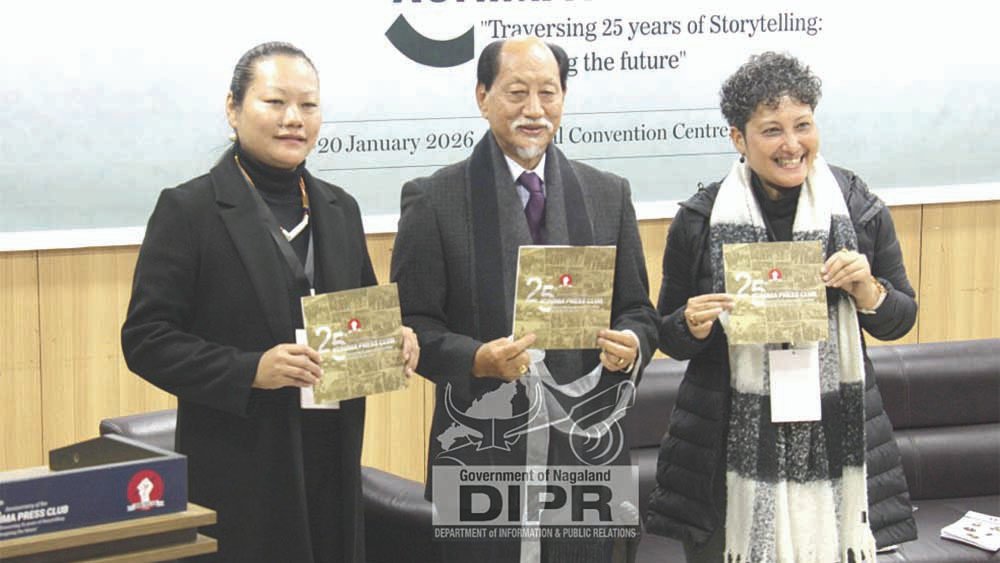
Emphasising the vital role of the fourth estate in sustaining democracy, chief minister Dr. Neiphiu Rio on Tuesday said journalism in Nagaland has survived against formidable odds and must be strengthened to ensure informed public discourse, accountability and social cohesion.
Addressing the silver jubilee celebration of the Kohima Press Club (KPC) as the special guest, Rio described the occasion as both an honour and a pleasant duty. He congratulated the club and its members on completing 25 years, stating that KPC’s journey symbolised resilience, perseverance and commitment to the larger interests of the state and its people.
Recalling the early history of journalism in Nagaland, Rio noted that a vernacular newspaper in the Ao dialect, Ao Milen- also known as The Naga Messenger- was launched as early as 1933, nearly 93 years ago. Though its circulation was limited mainly to Mokokchung district, he said it reflected a conscious effort to inform society, underscoring that the need for credible information had long been recognised among the Nagas.
However, Rio observed that Nagaland’s troubled political and socio-economic history had made it difficult for the media to grow as a strong and independent institution. He said newspapers and press bodies in the state often functioned at a low level with limited visibility, institutional backing and financial support.
According to him, the media in Nagaland has historically received little importance in terms of government patronage, public sponsorship, advertisements or corporate social responsibility initiatives.
The chief minister attributed this largely to the state’s weak economic base, pointing out that Nagaland lacks industries and manufacturing units. In the absence of a robust revenue ecosystem, he said many newspapers were forced to shut down over the years, while those that survived continued under severe financial constraints. Journalists, he added, have been the worst affected by these challenges, yet their resilience and dedication to public service have kept the fourth estate alive.
Calling for collective efforts to sustain journalism, Rio stressed that preserving newspapers also meant protecting journalists, who play a crucial role in holding institutions accountable and giving voice to the people.
Referring to the Kohima Press Club, Rio said the organisation, established in 2001, had grown from a small collective of committed journalists into a respected institution upholding ethical reporting, professional solidarity and responsible storytelling. He said KPC’s growth mirrored the broader evolution of journalism in Nagaland and reaffirmed the indispensable role of the media as the fourth pillar of democracy.
He commended the club for initiatives that go beyond routine news coverage, including efforts in media education, dialogue-building, institutional engagement and social and charitable activities. Such initiatives, he said, reflected a deep sense of responsibility towards society.
Rio also lauded the introduction of the Kohima Press Club Impact Journalism Award and people-centric reporting initiatives, including collaboration with the Nagaland Building and Other Construction Workers’ Welfare Board, which he noted was functioning effectively. These efforts, he said, encouraged in-depth journalism and amplified the voices of marginalised sections.
Against the backdrop of rapid technological change, misinformation and complex social realities, Rio urged journalists to remain steadfast in truth, ethics and sensitivity. He said the role of the media in promoting peace, fostering informed debate and contributing to constructive development had become more critical than ever.
The chief minister also expressed concern over global media trends, observing that contemporary news narratives were often dominated by controversy and negativity, with few positive stories. In some parts of the world, he said, the media had adopted an overtly anti-establishment posture, creating uncertainty and a sense that global systems were under stress.
Rio described the Northeast Media Conclave, organised as part of KPC’s silver jubilee celebrations, as timely and forward-looking. He said the conclave reflected preparedness to address emerging challenges while reinforcing core journalistic values of credibility, responsibility and integrity.
As the Kohima Press Club enters its next phase, Rio expressed hope that it would continue to serve as a beacon of fearless and responsible journalism. He wished the club unity, wisdom and continued success, and expressed his desire for greater engagement and dialogue with the media fraternity to collectively build a more informed, peaceful and prosperous Nagaland and Northeast.
Independent media needs public support: PCI president
Earlier, addressing the inaugural programme as the guest of honour, senior journalist and Press Club of India (PCI) president Sangeeta Barooah Pisharoty said journalism had “never been easy” and asserted that despite India being a democracy, the profession had steadily declined over the past three decades. Drawing from her nearly 30 years of experience, she said the downturn was largely driven by a faulty financial model for media houses in India.
She underscored that the press, as the fourth pillar of democracy, exists to hold elected representatives accountable, stressing that its allegiance must lie solely with public interest. Unlike several countries in Europe, North America and parts of Asia where public funding mechanisms help insulate journalism from political and corporate pressure, she said India failed to create a sustainable independent model.
As a result, she observed, the vacuum was filled by a corporate-driven system that eroded editorial independence. While industrial houses funded newspapers in the early post-Independence years without interfering in editorial autonomy, she said that balance collapsed over the last 15–20 years as corporate ownership expanded and editors lost control.
Pisharoty further pointed out that legacy media had increasingly aligned with governments and business interests, blurring the lines between journalism and public relations. The entry of politicians and their families into media ownership, she added, further weakened credibility.
Expressing concern over the legal environment, she cited the Digital Personal Data Protection (DPDP) Act, noting that the removal of a proposed journalistic exemption could severely restrict investigative reporting. She also warned that dilution of the RTI mechanism under the DPDP Act could undermine transparency and accountability.
She identified technology, including artificial intelligence, as another challenge, noting its impact on newsroom jobs, and highlighted the growing trend of legal cases against journalists, particularly in smaller towns.
Calling for solutions, she urged greater public support for independent media, especially digital platforms, through subscriptions and small contributions. Citing her experience at The Wire, she said public-funded journalism allowed reporters to remain accountable only to readers.
Outlining her priorities as PCI president, Pisharoty said protecting journalists’ right to work without pressure was paramount. She spoke about plans to set up a legal cell to assist journalists, conduct free workshops on digital security, and form a federation of elected press clubs nationwide, inviting KPC to join.
KPC president Alice Yhoshü, in her presidential address, recalled the club’s formation on January 20, 2001, following informal meetings among journalists in the early 2000s. Founded on the belief that democracy rests on a free and ethical press, she said the club has worked for 25 years to uphold professional standards, fellowship and public-interest journalism, growing to 66 members today.
She paid tribute to past leaders, particularly former president late Xavier Rutsa, describing him as a mentor whose legacy continues to guide the fraternity.
The programme also featured the Northeast Media Conclave under the theme “Reimagining Truth: Northeast Journalism for a Changing World,” with panel discussions on media ethics, misinformation and journalism as peace work, featuring senior editors and journalists from across the region.