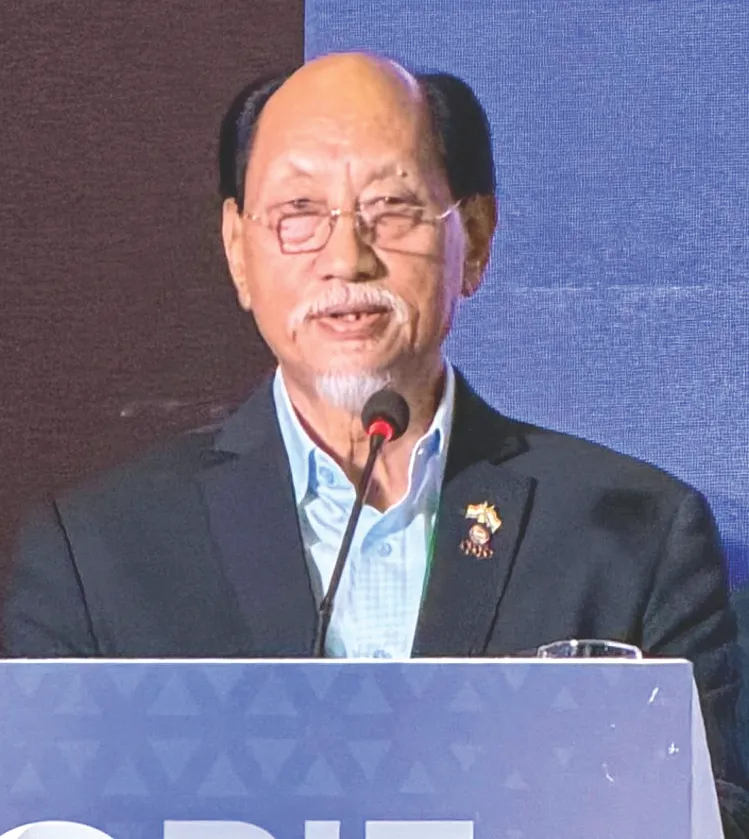
Dimapur, Oct 26 (NPN): Nagaland Chief Minister Dr. Rio has urged corporate India to move beyond conventional Corporate Social Responsibility initiatives and invest in long-term partnerships that can accelerate development, strengthen communities and open new economic opportunities in the Northeast, reports DIPR.
Delivering the keynote address at the inaugural ceremony of the 13th Edition of the One Purpose India Forum 2026 at Hotel Pullman, New Delhi Aerocity, Dr. Rio called for stronger cooperation among governments, businesses, civil society organisations and local communities. The three-day forum, organised by CSRBOX from October 26 to 28, brings together policymakers, corporate leaders, philanthropists and development practitioners.
The Chief Minister said the transformation of the India CSR and ESG Summit into the One Purpose India Forum reflected a wider recognition that development cannot be delivered by governments alone. While public institutions must identify priorities and create an enabling environment, companies and philanthropic organisations must contribute expertise, technology, innovation, research, finance and sustained institutional support.
Dr. Rio argued that the success of CSR and philanthropy should not be measured only by the amount of money committed or the number of projects launched. The more important test, he said, is whether such interventions create better opportunities, stronger communities and lasting improvements in people’s lives.
That approach, he suggested, requires credible institutions, transparent processes and clear accountability. It also requires organisations to document successful initiatives, measure outcomes and replicate effective models. Short-term interventions may produce visible results, but meaningful development, he emphasised, depends on continuity and long-term partnerships.
The Chief Minister used Nagaland’s social and cultural strengths to make the case for greater corporate engagement with the State. He described Nagaland as a region of rich biodiversity, diverse communities, living traditions and considerable potential in innovation, entrepreneurship, music, arts and the creative economy.
The annual Hornbill Festival, he noted, has become an internationally recognised platform that connects the State’s cultural identity and contemporary creativity with audiences beyond the region.
He also highlighted Nagaland’s historical importance. Referring to the resistance offered by the Nagas during British colonial expansion, Dr. Rio spoke about the ongoing effort to repatriate Naga ancestral human remains held abroad. The Government of Nagaland, working with the Pitt Rivers Museum at the University of Oxford, is undertaking the repatriation and decolonisation exercise, with the remains expected to arrive in India later in November.
The Chief Minister also recalled the Battle of Kohima during the Second World War, describing it as a decisive episode that halted the Japanese advance towards the Indian subcontinent. The reference placed Nagaland’s historical experience alongside its current effort to build a stronger economic and development profile.
Despite geographical constraints, infrastructure gaps, limited resources and political uncertainty, Dr. Rio said the people of Nagaland—particularly its youth—had continued to contribute to nation-building. He cited the achievements of Dr. Talimeren Ao, captain of India’s first Olympic football team at the 1948 London Olympics; filmmaker Theja Rio; para-athlete Hokato Hotozhe Sema; and the Nagaland Madrigal Singers.
These examples, he said, demonstrated the State’s potential in the creative economy, innovation, sports and start-up entrepreneurship. With stronger support and access to opportunities, Nagaland’s contribution could expand significantly. The Chief Minister called on corporate India to build partnerships that provide such support while contributing to the broader goal of a developed India.
He identified education, skill development, sports, healthcare, entrepreneurship, sustainable livelihoods, women-led enterprises, environmental conservation, water security, climate-resilient agriculture and community development as priority areas for collaboration. He also stressed the importance of combining traditional knowledge, local enterprises and cultural heritage with modern technology, professional expertise and access to wider markets.
Dr. Rio positioned Nagaland and the wider Northeast as an emerging gateway to the East, particularly the ASEAN region. He pointed to the region’s geographical location, cultural links and connectivity potential, including the Trans-Asian Highway. He urged companies to look beyond CSR and examine opportunities in logistics, infrastructure, manufacturing, economic zones, tourism, natural resources, sports and the creative economy.
The proposed future city of Nagaki, in the foothills of Nagaland, was also presented as part of this wider development vision. The Investment and Development Authority of Nagaland, he said, would help.