
Correspondent
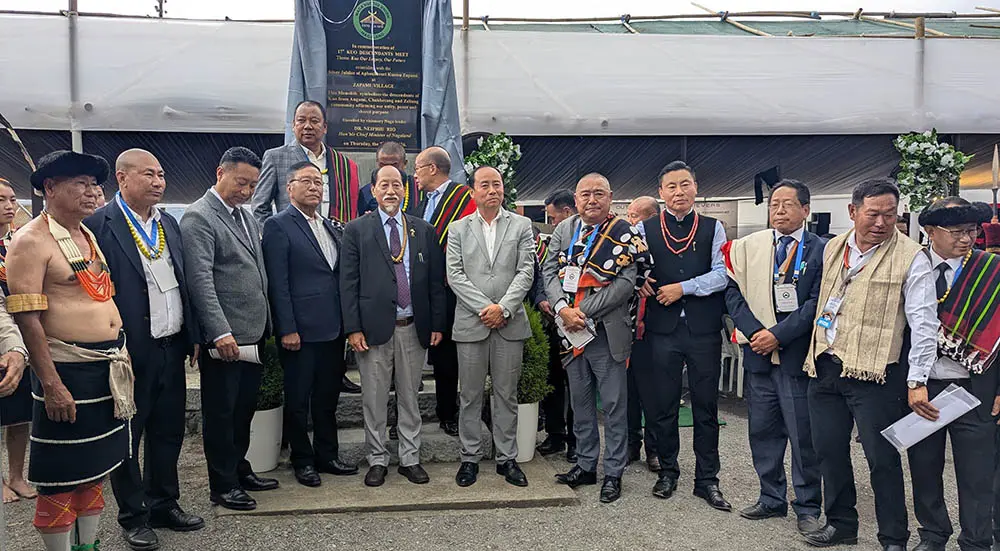
KOHIMA, MAY 7 (NPN): State chief minister Neiphiu Rio on Thursday called upon Nagas to preserve their identity, culture and traditions while strengthening unity and “Nagaism” at the 17th Kuo Descendants Meet organised by the Naga Kuotsu Union (NKU) at Zapami village.
Addressing the NKU’s 17th Triennial General Conference as chief guest, Rio said there was “no greater joy than coming together and celebrating as one family.” He described the NKU as a strong and vibrant organisation that had expanded across different regions and continued to serve as a pillar of strength among the Nagas.
Lauding the pioneers who established the union 56 years ago, Rio recalled the close relationship he shared with the founding members of the Kuotsu clan since the time of his father. He lauded the descendants for remaining united for over five decades and for bringing together members from different states under one umbrella.
Referring to the conference theme, “Our Legacy, Our Future,” Rio said legacy was not merely about stories of the past, but about the values, customs and practices handed down from one generation to another. He described the theme as timely and relevant in today’s rapidly changing world shaped by westernisation and modern influences, stressing the need for Nagas to protect their roots, history and identity. Rio remarked that while money lost could be regained and sickness could weaken a person, los-ing one’s roots and identity would leave people completely lost.
Calling for greater unity among Nagas, he urged people to rise above tribalism and individualism and instead strengthen togeth-erness and “Nagaism.”
He said all clans and communities must work collectively to build a stronger foundation for Naga society and ensure that future generations inherit their customs and traditions intact. Recounting Naga history, Rio observed that despite colonial rule, Naga traditions and customary systems largely remained protected.
He highlighted that the Bengal Eastern Frontier Regulation Act of 1871 and Article 371(A) of the Constitution continued to safeguard Naga land rights, traditions and identity. He also point-ed out that Nagaland remained exempted from the Panchayati Raj system and that villages con-tinued to be governed through village councils under customary practices.
Rio said Nagas were recognised by outsiders and therefore Nagas themselves must also recognise and value their own identity. Expressing hope that the Kuotsu descendants spread across Naga-land and neighbouring states would become an example for others, he said “Nagaism” should continue to grow stronger through collective participation in nation-building.
Touching on the issue of Naga ancestral remains and artefacts housed at the Pitt Rivers Museum, Rio said that among the lakhs of items preserved there, 41 belonged to Nagas, including human remains, artefacts and antiques. He informed that a tribal delegation had already visited the mu-seum to discuss the repatriation process and that tribal hohos were expected to travel to the Unit-ed Kingdom in the coming months to formally begin the process. He added that plans were also being considered to construct a memorial and respectfully bury the remains.
Referring to the 16-Point Agreement and the presence of Nagas across Nagaland, Assam, Aruna-chal Pradesh, Manipur and Myanmar, Rio stressed the need for emotional, social and cultural in-tegration among Naga communities. He said stronger unity among Nagas would further reinforce the Naga political issue and contribute towards an eventual solution.
Drawing parallels with the unity displayed by the Kuotsu clan, Rio encouraged other Naga clans and communities to similarly strengthen oneness and solidarity among the people.
Earlier, NKU president Peter Kuotsu informed that the union was formally established in 1970 and presently comprised members from 89 villages across Nagaland, Assam and Manipur, includ-ing among the Angami, Chakhesang and Zeliang communities. He reiterated that the Kuotsu de-scendants had resolved to remain united under one umbrella irrespective of where members re-sided.
During the programme, 12 individuals were felicitated for their achievements and contributions in various fields.
The event featured an invocation by Rev. Dr. Neingupe Chiero Kuotsu, welcome address by or-ganising committee convenor Kedoutsolhi Wetsah Kuotsu, and cultural presentations by the Punglwa Cultural Troupe and Kuzha Culture Society.
Highlighting the history of “Kuo,” Zapuvisie Lhousa Kuotsu said that after India attained inde-pendence, the Nagas, under the Naga National Council, were fighting for their own independ-ence when Indian armed forces launched operations that scattered many Naga families to differ-ent regions. He said some like-minded elders later came together and resolved to restore unity, leading to the first meeting held on April 2, 1970, at Mezoma village.
He stated that their grandfather, Kuo-u, migrated from Mekhrora-Kezhakhenoma-Kigwema and later settled at Kuozhügei in Khonoma, where he passed away. He described Kuo as a great war-rior and religious man who hosted community feasts and rendered significant service to the peo-ple.
Nomination committee convenor Ravolhuto Whiso Kuotsu later announced that the existing of-fice bearers led by Peter Kuotsu of Zhadima village had been reinstated for the 2026–2029 ten-ure.
Welonyi Khutsoh Kuotsu pronounced the elderly blessing while the vote of thanks was delivered by Neivikuolie Khatsü Kuotsu.
The programme, hosted by Zapami village, which has the highest population of Kuo descendants in the Chakhesang region, also coincided with the village’s silver jubilee celebrations. Rio also released the jubilee souvenir of Aphou- Khrori (Kuotsu) during the event.
On the occasion, Rio also felicitated several outstanding achievers– Er. Chireuding Hieme Kuo-tsu, recognised as the first Naga nuclear scientist in 2019; Ruopfüzhano Whiso Kuotsu, fourth runner-up at Miss Universe India 2024; Dr. Rüüzeno Kuotsu, recipient of the Sushruta Award for academic excellence; and Visalie Kuotsu, whose film “Ade-On a Sunday” received the Best Film award.
Others honoured were Neibodzelie Solo Kuotsu, chairperson of Kohima Municipal Council; Peheutingyibe Herie Kuotsu, recipient of the National Service Scheme Award 2020–21; Eva Te-toe Khutsoh Kuotsu, Neithozonuo K. Kuotsu and Rukutho Kotso Kuotsu, all HSLC 2026 top-pers; Salevizo Kuotsu and Viphreno Kuotsu, HSLC 2024 toppers; and Aseno Kielienyü Kuotsu, HSSLC 2025 Arts topper.
The programme concluded with a community feast attended by delegates and participants from different regions.