
Nagaland chief minister Dr. Neiphiu Rio on Tuesday described the state’s rising unemployment as a burning issue, urging a radical shift in public mindset away from government job dependency and towards entrepreneurship.
Delivering his concluding remarks during the Discussion on Matter of Urgent Public Importance under Rule 50 on the topic “Unemployment in Nagaland” initiated by adviser industries and commerce Hekani Jakhalu at the ongoing Assembly session, Rio argued that the problem extends beyond a lack of jobs to “unemployability,” rooted in a societal obsession with government service.
Citing the 20,000 applicants for just 150 forest guard posts, he also called for decentralized recruitment exams to ensure transparency. With government employment now saturated, Rio stressed the urgent need to expand opportunities in private industries and skill-based occupations. To this end, Rio has directed the Department of Employment and Skill Development to conduct a comprehensive study and recommend corrective actions.
Highlighting government initiatives, Rio pointed to the Chief Minister’s Micro-Finance Scheme, which offers collateral-free loans up to Rs. 15 lakh for youth who undergo skill training. He also identified the handloom and handicrafts sector as an area with high potential for commercial viability. Rio attributed the failure of major industries in Nagaland to an unconducive business climate caused by the unresolved political issue and multiple taxation. He further revealed that the state lost Rs. 443 crore in the last fiscal year because government departments failed to utilize sanctioned funds, resulting in central penalties.
He concluded that unemployment is a collective responsibility, urging that Nagaland must align with India’s vision of becoming a developed nation by 2047 by creating an investment-friendly environment and equipping its youth with employable skills.
Earlier, initiating the discussion, Hekani Jakhalu, underscored the urgent need to address the State’s widening employment gap, especially among its youth.
Jakhalu reminded the House that according to the 2011 Census, 40 percent of Nagaland’s population falls within the 15–35 age bracket, making it one of the youngest states in the country. “In the next 15 to 20 years, this demographic will be the main driver of Nagaland’s socio-economic development. We cannot afford to neglect them,” she stated.
She noted that while the number of educated youth and the labour force has risen steadily, opportunities in both government and private sectors have not kept pace. Differentiating between “unemployed” and “unemployable,” Jakhalu said the State must not only generate jobs but also equip young people with the necessary skills to meet industry demands. “A certificate alone does not guarantee employment. Without skills, it becomes difficult to fit into the requirements of today’s job market,” she stressed, calling for greater emphasis on upskilling, adapting to new technologies, and reshaping the education system.
While highlighting the role of all stakeholders-legislators, government officers, parents, and youth-in fostering a mindset that upholds the dignity of labour, Hekani proposed interventions such as upgrading education, strengthening internship and apprenticeship programmes, providing support to entrepreneurs and MSMEs, and improving infrastructure such as roads and power to attract investors.
Advisor for School Education & SCERT, Dr. Kekhrielhoulie Yhome, supplemented the debate by pointing out that wages in Nagaland remain the lowest in the country under the Minimum Wage Act, 2025. He suggested creating sectoral wage schedules to ensure fair compensation and urged young people to explore employment opportunities outside Nagaland while bringing back knowledge and practices that could transform the local economy.
Dr. Yhome underlined the importance of vocational training under the National Education Policy (NEP) 2020. He said vocational subjects are being integrated into schools to equip students with employable skills. The government, he added, will launch the “SOAR Mission” on September 5 to upgrade vocational curricula and streamline accreditation systems across institutions.
Minister for Tourism and Higher Education, Temjen Imna Along, presented data showing that Nagaland’s unemployment rate for those aged 15 and above rose from 4.3 percent to 7.1 percent after the COVID-19 pandemic-a 65 percent increase. Urban areas were hardest hit, he said, with a sharp rise in educated unemployed youth. While the worker population rose from 32.8 percent to 68.1 percent, the mismatch between education and work opportunities created a glut of job-seekers, worsening the situation.
Others who also participated in the discussion included- Advisor for Transport and Technical education Temjenmenba, Advisor for Law & Justice and Land Revenue, T.N. Mannen; Advisor for Social Welfare, Wangpang Konyak; NPF member Achumbemo Kikon and; Independent legislator, Dr. Neisatuo Mero.
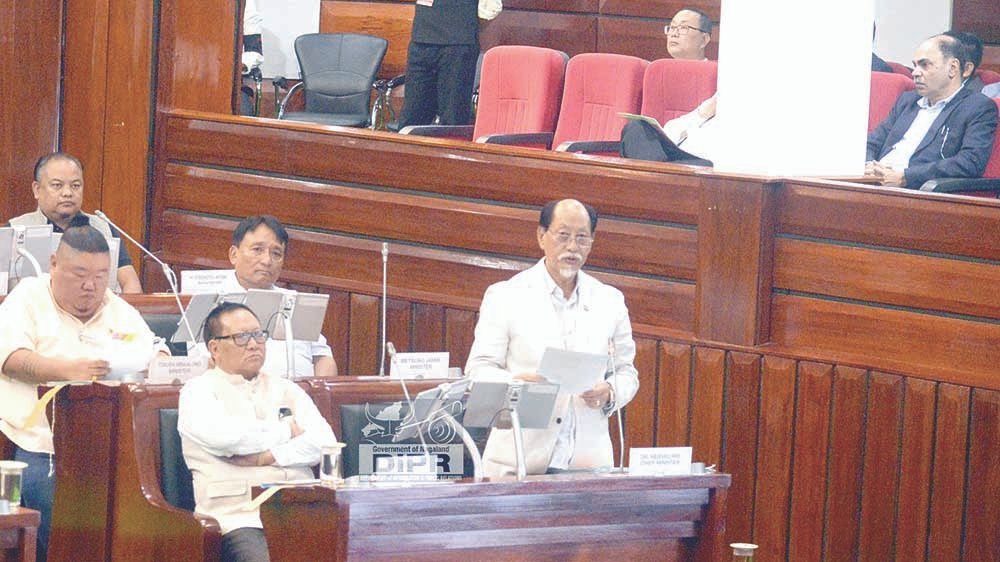
Rising unemployment a burning issue, says Rio
CorrespondentKOHIMA, SEP 2 (NPN)