
Staff Reporter
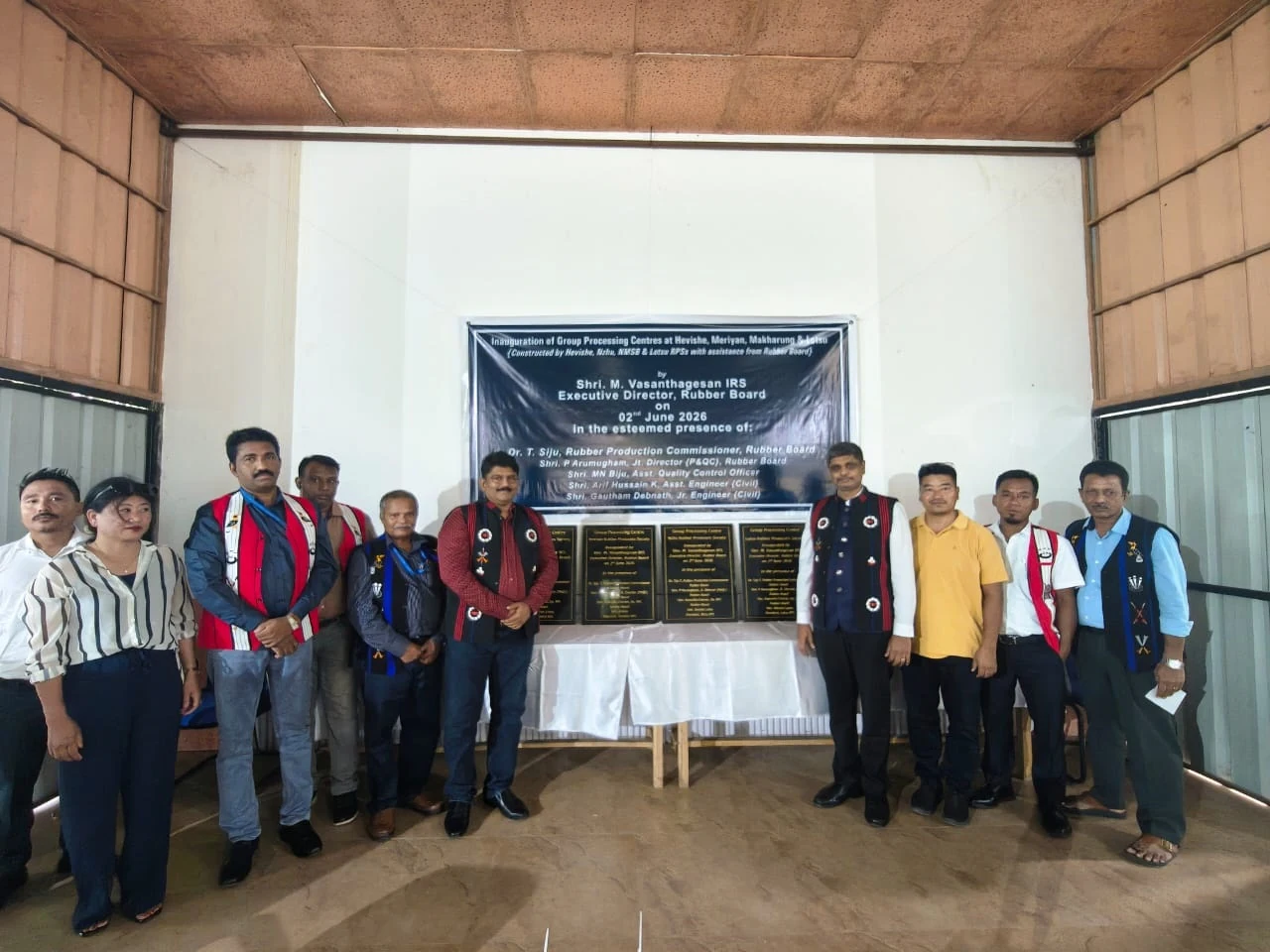
DIMAPUR, JUN 2 (NPN): Rubber Board Regional Office, Dimapur, on Tuesday inaugurated four new Group Processing Centres (GPCs) at the Development Association of Nagaland (DAN) complex, Chekiye, Dimapur. Constructed with assistance from the Rubber Board, Government of India, the centres will serve the Hevsihe, NMSB, Lotsu and NZHU Rubber Producers Societies (RPS), marking a major step toward strengthening quality control and processing facilities for local rubber growers.
Speaking at the programme, M. Vasanthagesan, executive director, Rubber Board, government of India, underscored the importance of establishing Group Processing Centres (GPCs) within localities to ensure timely latex processing and better returns for farmers. He explained that latex must be processed within three to four hours of tapping to maintain quality, failing which growers face reduced prices due to poor quality sheets. He noted that while GPCs remain limited, the establishment of 17 centres across Nagaland and the Northeast is expected to significantly benefit growers. He emphasized that the success of such initiatives depends on close cooperation between the government and farmers.
Vasanthagesan also cautioned against over tapping for short term gains, stressing that professional tapping practices are essential to safeguard tree health and ensure long term productivity. He reiterated that the Rubber Board’s recommendations are based on extensive scientific research conducted across multiple research stations in the country. He further called for greater awareness of welfare schemes available to tappers, including self tappers and women, covering education, healthcare, insurance and maternity benefits.
P. Arumugham, joint director (P&QC), Rubber Board, government of India, highlighted the need to move beyond primary processing and focus on value added rubber products to enhance income for growers. He pointed out that while GPCs have been established for sheet rubber production, there is significant potential to diversify into other products with government and MSME support. He explained that natural rubber is environmentally friendly and essential for tyre manufacturing due to its durability and heat resistant properties, but must be properly processed to remove impurities and prevent deterioration. He underlined three critical factors for sectoral growth—quantity, quality and marketability—stating that collective processing through GPCs ensures uniform quality and sufficient volume, making it easier to access better markets and prices.
Dr. T. Siju, rubber production commissioner, Rubber Board, government of India, stressed the urgent need to improve tapping practices in Nagaland, noting that poor methods were affecting overall productivity. He cautioned that improper tapping could reduce the productive life of trees from around 25 years to nearly 15 years, resulting in substantial financial losses for farmers and communities. He added that improving processing through GPCs would help produce better quality sheets and enable farmers to secure improved market rates. Stressing the importance of capacity building, he said training and exposure to standard practices would build confidence in the region’s rubber production system.
The foundation stone for the four centres was unveiled by M. Vasanthagesan in the presence of senior Rubber Board officials including Dr. T. Siju, P. Arumugham, MN Biju, Arif Hussain K and Gautham Debnath. The programme also featured short speeches by RPS presidents Khetoi Yeptho, Zachariah Ezung, Abemo Lapon and Benrilo Lotha, a welcome song by NZHU RPS, and felicitation of guests.
Earlier, the event was chaired by Kuruvilla Cherian, deputy rubber production commissioner, with invocation by Dr. Robin Thomas, MD, PIETNE Agro Foundation, and concluded with a vote of thanks by Amar Boro, assistant development officer, Rubber Board Regional Office, Dimapur.